
Sheriff renews consolidated 911 discussion
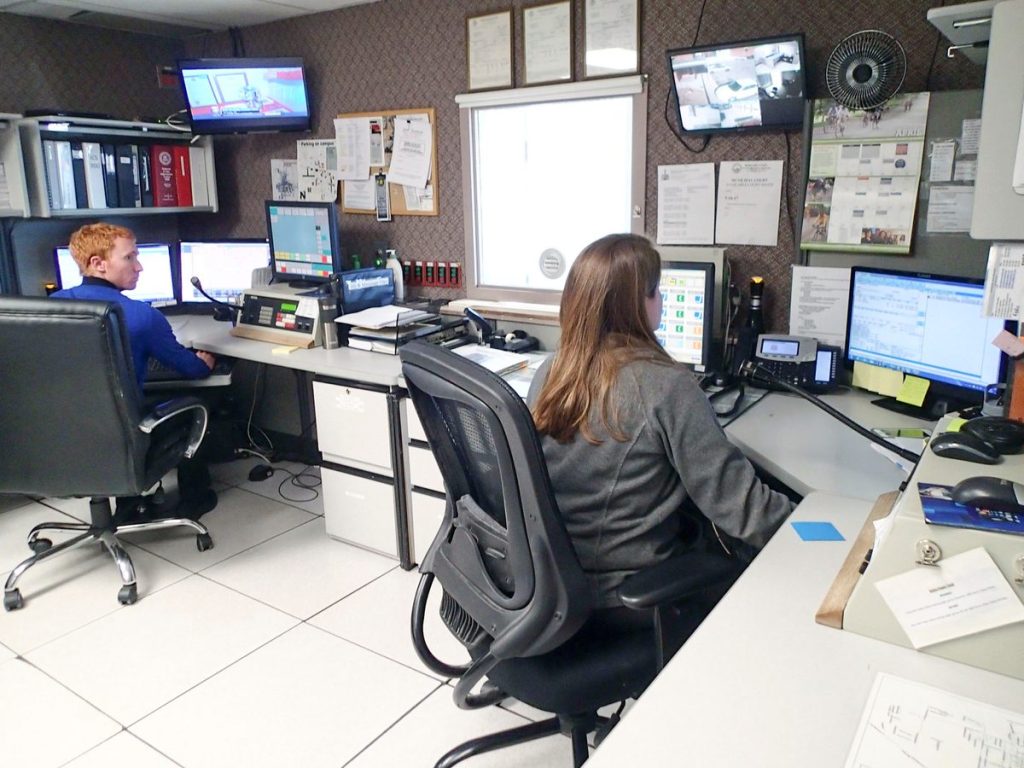
TONY BROWN/DAILY FORUM
Dispatcher Dakota Luke, left, and dispatch supervisor Jessica Sigman work the radio desk Thursday at Maryville Public Safety. Proposed construction of a new police-fire headquarters has resulted in renewed discussion about the possibility of creating a combined 911 dispatch center serving both MPS and the Nodaway County Sheriff’s Office.
A countywide public safety issue that has been kicked around for years — sometimes amid considerable controversy — may be on the road to resolution.
With recent voter renewal of the City of Maryville’s half-cent capital improvement sales tax paving the way for probable construction of a new police and fire station, local officials are talking once again about creating a consolidated 911 dispatch center.
And this time, it looks like the placement of city and county emergency communications under one roof may actually happen.
Consolidating 911 dispatch has been an issue for counties statewide, and it is almost always problematic. The most common obstacles revolve around funding and friction between law enforcement agencies seeking to guard jurisdictional turf.
Both concerns shadowed two previous efforts to bring combined 911 to Nodaway County, where the principal town — Maryville — is home to three separate dispatch operations: Maryville Public Safety (police and fire); the Sheriff’s Office, which also provides dispatch services for the Nodaway County Ambulance District; and the Northwest Missouri State University Police Department.
Sheriff Randy Strong said Thursday he has spoken to Maryville Public Safety Director Keith Wood and the County Commission, as well as University Police Chief Clarence Green, about the possibility of consolidating 911, and that the feedback is encouraging.
“I think it will happen,” said Strong, who added that, in his view, the existing system can contribute to longer response times.
For example, if someone is having a heart attack inside the Maryville city limits and manages to call 911 on their cell phone, the call is routed to Maryville Public Safety, where a dispatcher then notifies the Sheriff’s Office so that a second dispatcher can notify the ambulance district.
While all of this occurs quickly, it still takes longer than it would if city and county dispatch functioned as a single unit.
“Basically you close one step out of the loop,” Strong said.
Strong’s dispatch supervisor, Brent Blackburn, said that in terms of overall operations, an integrated 911 office would create a “one-stop shop” for citizens while offering “more seamless” interagency communication.
But while Maryville police and fire and the Sheriff’s Office are both in the public safety business, it is also true the agencies serve different constituencies with different needs and expectations.
So though it might look like a no-brainer to combine dispatch units located within easy walking distance of each other, actually doing so is easier said than done.
In the past, the main sticking point — but not the only one — has been money. Who pays and trains the dispatchers, for example? Who buys and maintains the equipment? Where will the 911 center be located, and who is responsible for paying the utility bill?
Complicating the funding issue is the fact that Missouri remains the only state without a 911 tax on cell phones. What state funds are available for 911 service come from a tax on land-line phone calls, revenue from which continues to plummet as more people go wireless.
All those factors have combined to keep 911 operations here separate, and unless the Legislature finally passes a cell phone tax this year, nothing much will change.
What is different is the prospect of a new police/fire headquarters, since any change in how 911 service is organized could affect how the building is designed and equipped.
Another piece that could help complete the puzzle is Strong, who made consolidating 911 a plank in his campaign platform last year.
“It just seemed like the time was right to come together and move forward on this,” the sheriff said, adding that warranties on radios, software, computers and other 911 gear used by both his office and Public Safety have expired or soon will.
In Strong’s view, the approaching necessity of replacing outdated equipment has created a window of opportunity.
“We need to look at this as soon as we can before we have equipment issues,” said the sheriff, who further suggested forming a 911 advisory committee representing both the community and law enforcement.
The panel, perhaps with the aid of an outside consultant, would be charged with answering a host of 911 questions about location, shared costs and staffing. Strong said the discussion will also include input from the ambulance district and university police.
Should combined dispatch becomes a reality, Strong thinks it will provide residents countywide with public safety responses that are both faster and better coordinated. What it probably won’t do, however, is save taxpayer dollars.
The jail, for example, will still have to be staffed 24-7, as will the police station. Also, increased call volume at a combined 911 center means the number of trained dispatchers will, if anything, go up, not down.
“Most of the people looking at this don’t think we’re going to save any money,” Strong said.
But whatever the cost, the sheriff believes consolidated 911 will offer increased efficiency as well as opportunities for more focused dispatcher training resulting in “a new level of professionalism.”




