Ag sorority plants seeds of awareness
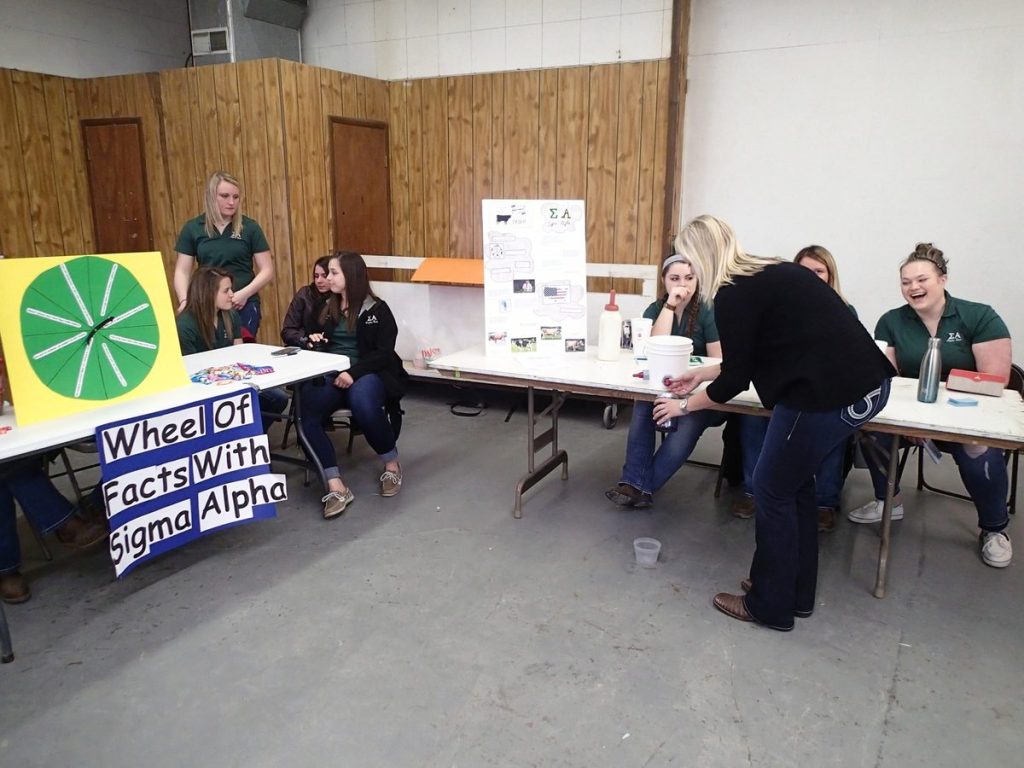
TONY BROWN/DAILY FORUM
Members of the Sigma Alpha professional agriculture sorority at Northwest Missouri State University are shown staffing tables Saturday during a fundraiser for Heifer International, a nonprofit charity with the stated goal of eliminating poverty and hunger in developing nations through sustainable livestock distribution, education and training. The event also sought to increase awareness about the importance of production agriculture in the United States.
A group of Northwest Missouri State University sorority sisters set up shop in the Nodaway County Community Building Saturday in an effort to show how American agriculture helps feed the world.
The students were all members of Sigma Alpha, a professional — as opposed to social — sorority founded in 1978 at The Ohio State University in an effort to promote excellence by women preparing for careers in various agriculture-related endeavors.
The name Sigma Alpha stands for “sisters in agriculture.”
Northwest’s Sigma Alpha chapter was chartered in 1995, and Saturday’s event was organized as the organization’s inaugural fundraiser, what Greek-letter organizations call a philanthropy, for Heifer International, a nonprofit charity with the stated goal of eliminating poverty and hunger in developing nations through sustainable livestock distribution, education and training.
Those who receive Heifer International livestock agree to share animal offspring, as well as newly acquired animal husbandry and agricultural skills, with other impoverished families and villages.
Since 1944, Heifer International has distributed livestock and other resources to nearly 21 million families in more than 125 countries.
Saturday’s event, held in the pavilion adjoining Northwest Missouri Regional Airport used each summer for 4-H and FFA youth livestock shows, served the dual purpose of raising funds and providing education and awareness about the importance of production agriculture.
The students set up a number of booths offering games, activities and information related to various aspects of American farming, including dairy production, horticulture, and row crops.
Dairy cows on loan from Northwest’s R.T. Wright Farm provided the raw material for “cow pie bingo,” a game in which people buy chances on which marked squares inside a livestock pen will receive what might be called an organic deposit from the cow in question.
Many of the activities were designed for children, including a coloring table and a “Wheel of Facts,” where youngsters spun an arrow pointing at various bits of ag knowledge in exchange for a free piece of candy.
Among the facts on display: the average dairy cow produces nearly seven gallons of milk each day; pork is the mostly widely eaten meat in the world; One pound of wool is enough to produce 10 miles of yarn; the longest recorded flight of a chicken lasted 13 seconds; and a single acre of soybeans, once processed, can yield 82,300 crayons.
And by the way, those seven gallons of milk can be turned into nine gallons of ice cream, 25 pounds of cheese, or one pounds of butter. The same milk could be consumed in 16 hours by 33 children, each drinking three glassfuls a day.
In addition to games, activities and information, the afternoon offered a pulled pork lunch with Blues Hog barbecue sauce, both of which were donated by Shake ’N Bake BBQ of Washington, Missouri, the hometown of Northwest Sigma Alpha member Taurie Schroeder.
Other highlights included a raffle for a half-hog carcass processed by Edson’s Meat in Stanberry.
Sigma Alpha President Morgan Martin, a junior animal science major from Atchison, Kansas, said one goal of the event — and of the sorority in general — was to educate people about the importance of production agriculture, and to counter what she described as emotion-based arguments posed by such organizations as the Humane Society of the United States and People for the Ethical Treatment of Animals.
“We try to present people with science, research and facts,” Martin said.
Schroeder, a senior animal science major from suburban St. Louis whose interest in agriculture began when she worked on a dairy farm while in high school, said she has been known to exhibit frustration when talking to her city-dwelling relatives about things like organic farming, farrowing crates and genetically modified crops.
“I go on rants. I have a soapbox. I bite my tongue and try to say things as nicely as possible,” Schroeder said. “I tell them that we’re the ones who feed everybody, and that if we weren’t here they would starve.”