
Senior advocates criticize proposed cuts
TONY BROWN/DAILY FORUM
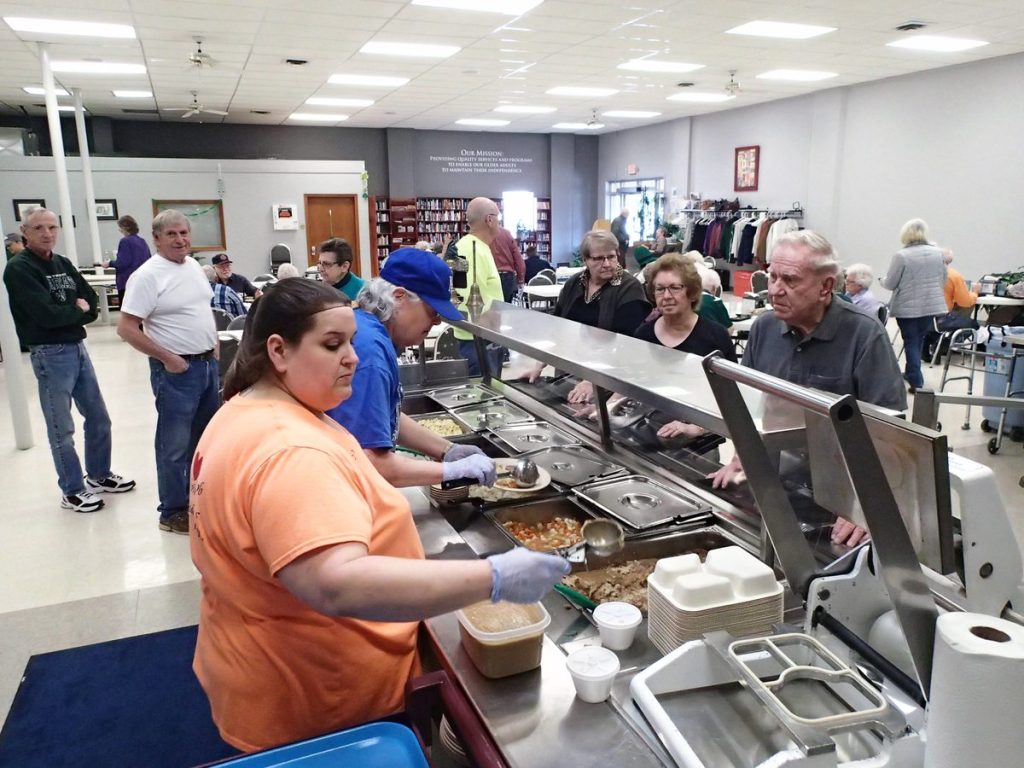
Patrons move through the cafeteria line over the lunch hour Thursday at the Nodaway County Senior Center on East First Street in Maryville. Actual and proposed cuts to senior citizen programs in Missouri, including a pending bill that would eliminate a tax break for low-income older residents who rent a house or apartment, have advocates worried that an increasing number of elderly citizens will lack the resources needed to continue living on their own.
A measure to repeal tax breaks for low-income Missouri seniors and disabled residents who live in rental housing is moving forward in the state House of Representatives and could have a significant impact on older residents in northwest Missouri, including Nodaway County.
Richard Logan, Nodaway County’s delegate to the Silver Haired Legislature, an advocacy group organized through the Missouri Association of Area Agencies on Aging, criticized the measure Thursday, saying that cutting the benefit would force more elderly people to give up their residences and move into nursing homes.
“It will affect seniors in Nodaway county like it will everywhere in the state,” Logan said. “I don’t understand why our Legislature doesn’t understand this. We want to keep seniors in their homes as long possible, but the Legislature keeps trying to cut funding for programs that allow people to stay in their homes.”
Logan said he didn’t know how many local residents would be affected if the tax break — essentially a partial rebate of annual rent paid — is eliminated. He added that Maryville and Nodaway County have a fairly large number of rental properties and apartments that cater to the low-income elderly.
He further noted that the Nodaway County Senior Center home-delivers about 75 meals each weekday to older residents and people with disabilities, at least some of whom would likely be affected by the proposed cut.
House members gave the bill final approval Thursday by a vote of 85-72. It now moves on to the Senate.
The measure would set aside roughly $55 million in revenue saved by eliminating rent rebates for other services for low-income seniors and those with disabilities.
According to the Associated Press, House Budget Committee Chairman Scott Fitzpatrick said eliminating the tax break could prevent proposed cuts to in-home and nursing care proposed by Governor Eric Greitens.
AP reported that the bill has met with bipartisan opposition with critics arguing that there are ways to balance next year’s budget without cutting support for low-income seniors and people coping with physical impairments.
Becky Flaherty, executive director of the 18-county Northwest Missouri Area Agency on Aging, which is headquartered in Albany, said her office recorded 172 tax-break applications from renters and homeowners last year. She explained that the program also offers a partial property tax exemption for older low-income citizens residing in their own homes, a benefit that lawmakers initially targeted for elimination as well.
The homeowner tax break was restored in the current version of the bill, said Flaherty, adding that her agency’s application total was about equally divided between renters and property owners.
If the tax break did not currently exist, older low-income renters across the region would lose a total of just under $43,000 in benefits, she said.
That’s not a lot of people or even a lot of money, but Flaherty said she suspects many seniors who might qualify for the program simply don’t know about it.
“These are folks who are riding on the edge all of the time,” she said.
Statewide, Missouri Association of Area Agencies on Aging Executive Director Catherine Edwards said the numbers grow significantly larger.
Edwards estimates that just over 100,000 low-income seniors and people with disabilities would be affected if the bill is signed into law.
According to agency figures, a senior citizen with approximately $13,000 in annual income and paying $400 a month in rent would receive a maximum annual rebate of $750.
State Representative Allen Andrews, whose 1st District includes Nodaway County, said Thursday the debate on the tax break bill was “very difficult,” and that lawmakers on both sides spent hours discussing the proposal on the floor.
Andrews said the legislation does not cut funding for seniors but reallocates it to the Senior Services Protection Fund, where it will be spent in support of nursing home residents and those who benefit from home-delivered meals and other programs serving the elderly, infirm and homebound.
Failure to eliminate the tax break, he said, would stretch available funding to the point that disability benefit standards would have to be raised, meaning that some seniors and people with handicaps would lose essential services.
“It’s one of those things where you wish there was plenty of money to be able to take care of everybody,” Andrews said. “But you realize that people have serious needs that should be met as our population grows older and demographics change.”
He added that ending rent subsidies will re-channel available funding to “those who are most vulnerable.”
The legislation to eliminate the tax break is just one of several fiscal challenges faced by state programs seeking to ease the plight of low-income seniors.
Early this year, Greitens withheld $200,000 in budgeted Area Agency on Aging funds, dollars mostly earmarked for the support of cafeteria and delivered-meals programs such as those operated by the Senior Center in Maryville.
State lawmakers are also considering scaling back the MoRX prescription drug assistance program, which supplements federal Medicare (Part D) benefits.
A proposed bill would limit MoRX benefits to seniors eligible for both Medicare and Medicaid. About 240,000 Missourians received MoRX benefits last year, according to state figures.
In addition, Flaherty said senior programs in Nodaway County and elsewhere are looking at a 1 percent across-the-board federal reduction that would impact a range of services including transportation, personal care, caregiver respite care, emergency response, case management and benefits counseling.
According to a Silver Haired Legislature release, about 400,000 of Missouri’s 1.2 million seniors rely on Social Security for 90 percent of their income. In addition, the organization maintains, the annual cost to taxpayers of caring for one person in a skilled nursing Medicaid-approved facility is $53,000.
The release claims that the same person with access to Area Agency on Aging services can live at home for $18,000.
“For every three seniors who may cross your path during the day, one is struggling to meet the most basic needs,” Edwards said.
“… Some lost the bulk of their retirement accounts in the recession, others suffered catastrophic illnesses that drained their savings, and some have simply lived longer than planned.
“There is no going back for them. They can’t wake up tomorrow and launch a new career or make those long-term investments that grow into nice nest eggs later on. This is real life.”




