Cleaver downplays politics, celebrates history
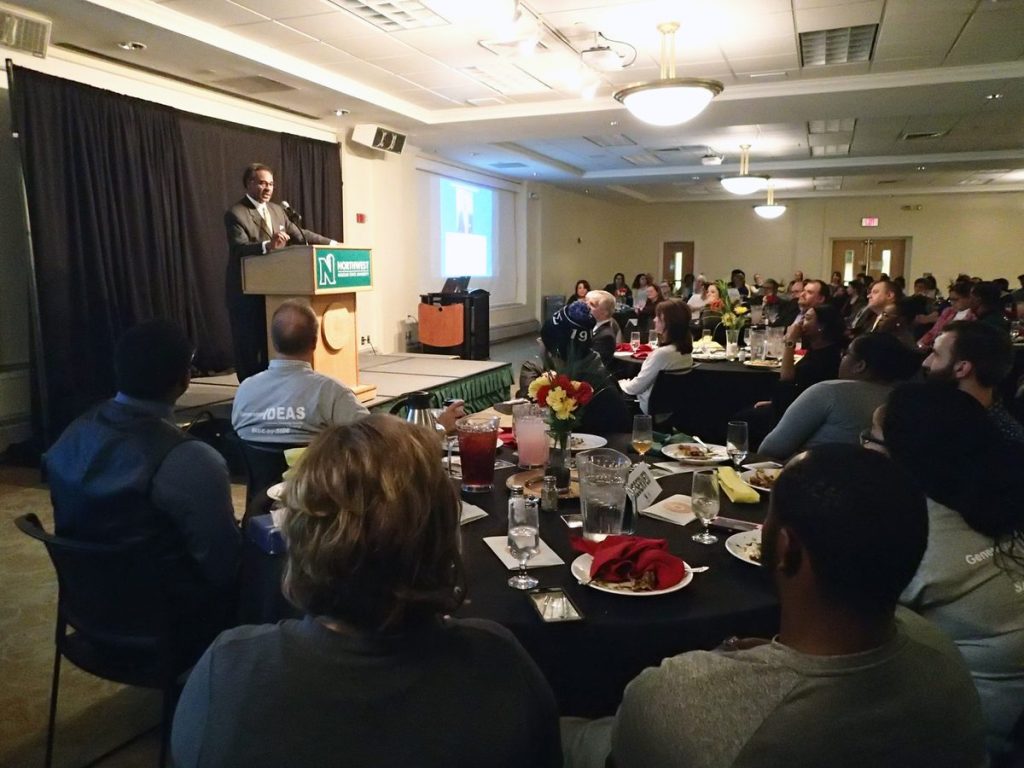
TONY BROWN/DAILY FORUM
U.S. Rep. Emanuel Cleaver is shown addressing this week’s Soul Food Dinner at Northwest Missouri State University. The event served as the centerpiece of Northwest’s annual celebration of Black History Month.
A capacity crowd of nearly 200 people, including a broad cross-section of students, faculty members, administrators, and local civic leaders, gathered in the J.W. Jones Student Union Ballroom Tuesday night for Northwest Missouri State University’s sixth annual Soul Food Dinner.
This year’s event — the highlight of Northwest’s annual round of Black History Month activities — took on a gala atmosphere thanks to the relatively rare appearance on campus of a national political figure, 5th District U.S. Rep. Emanuel Cleaver, who delivered the keynote address.
Also speaking briefly during the gathering were Northwest President John Jasinski; Maryville Mayor Jason McDowell; Juanita Simmons, Northwest vice president for diversity, equity; and inclusion, and Matt Barry, a field representative for 6th District U.S. Rep. Sam Graves.
Despite almost daily political turmoil on the national level — much of it with racial overtones — following the election of President Donald Trump, Cleaver and others made only oblique references to the ongoing controversies roiling the White House and Capitol Hill.
Instead, with more than 100 African American students in attendance, the focus was on unity, social progress, and decades of achievement by people of color woven inextricably into the fabric of American life.
Barry, whose boss is a deeply conservative Republican, described Graves and Cleaver — a moderately liberal Democrat — as “friends and colleagues” who work cooperatively as members of Missouri’s “tight congregational delegation.”
Cleaver himself made a passing reference to the often-toxic partisan atmosphere in Washington, D.C., saying that many people assume “that we (Cleaver and Graves) hate each other, but we don’t. We work together.”
During the main portion of his speech, the congressman talked about growing up poor in northeastern Texas as a member of a family that valued education and instilled in him a determination to attend college and succeed in life.
After graduating from Prairie View (Texas) A&M University, Cleaver moved to Kansas City where he founded a branch of the Southern Christian Leadership Conference and earned a master’s of divinity degree from the St. Paul School of Theology.
A minister before entering politics in the late 1970s, Cleaver was the longtime pastor of the St. James United Methodist Church in Kansas City, a post he held until 2009.
Following his biographical nod, Cleaver delivered what amounted to an outline of the history of African Americans in North America — a story dominated by the legacy of slavery.
After describing the sale of the first slaves in what would become the United States by the crew of a Dutch trading ship to British colonists in Jamestown, Virginia, Cleaver asked his audience to imagine “how different America would be if we had not come.”
He then touched on the careers of numerous African American inventors, musicians, athletes, statesmen, and politicians, including Elijah McCoy, who in 1872 patented an automatic lubricator for oiling steam engines.
Numerous manufacturers tried to copy the device, Cleaver said, but McCoy’s version proved superior and became known to customers as “the real McCoy,” a phrase that entered the language as a byword for authenticity.
The congressman also told of Ralph Bunche, the U.S. diplomat who received the 1950 Nobel Peace Prize for his efforts to broker peace during the first Arab-Israeli conflict.
Despite such accomplishments, Cleaver said, the constant threads running through African American life have been those of discrimination, injustice, prejudice, and hatred.
He talked of the infamous Black Codes passed by Southern states after the Civil War whose sole aim was to limit the freedom of emancipated slaves while encasing their lives in a shell of poverty and manual labor.
An especially horrific event, Cleaver said, was the Tulsa, Oklahoma, race riot of 1921, during which angry whites burned the homes of more than 1,000 African American residents, resulting in the deaths of at least 300 people.
The history of black Americans, the congressman said, in all its triumph and tragedy, is “an integral part of the history of the United States.” He added that he still hoped for a future in which the story of African Americans will be studied simply as part of the national saga and not something separate and apart.
In closing, Cleaver spoke of visiting the recently opened National Museum of African American History and Culture in Washington, and how the darkened, lower level of the museum displays shackles, chains, and other grim artifacts of slavery.
As one rises through the levels of the museum, he said, the exhibit spaces are filled with steadily brightening light, until, at the top, one views a portrait of former president Barack Obama.
Seizing the metaphor, Cleaver offered a challenge to his mostly young audience.
“But it’s not completely light,” he said. “We’ve still got to put in some more light. That’s what you’re in college for — to put in some more light.”
As an example, Cleaver turned to Italy at the time of the Renaissance, describing the period as one filled with warfare, violence, corruption, and political intrigue that nevertheless produced some of the greatest works of art and architecture ever created.
“Out of chaos, greatness can arise,” he said. “We can go through all kinds of things and still rise … Don’t let people tell you that this is not a great nation.”
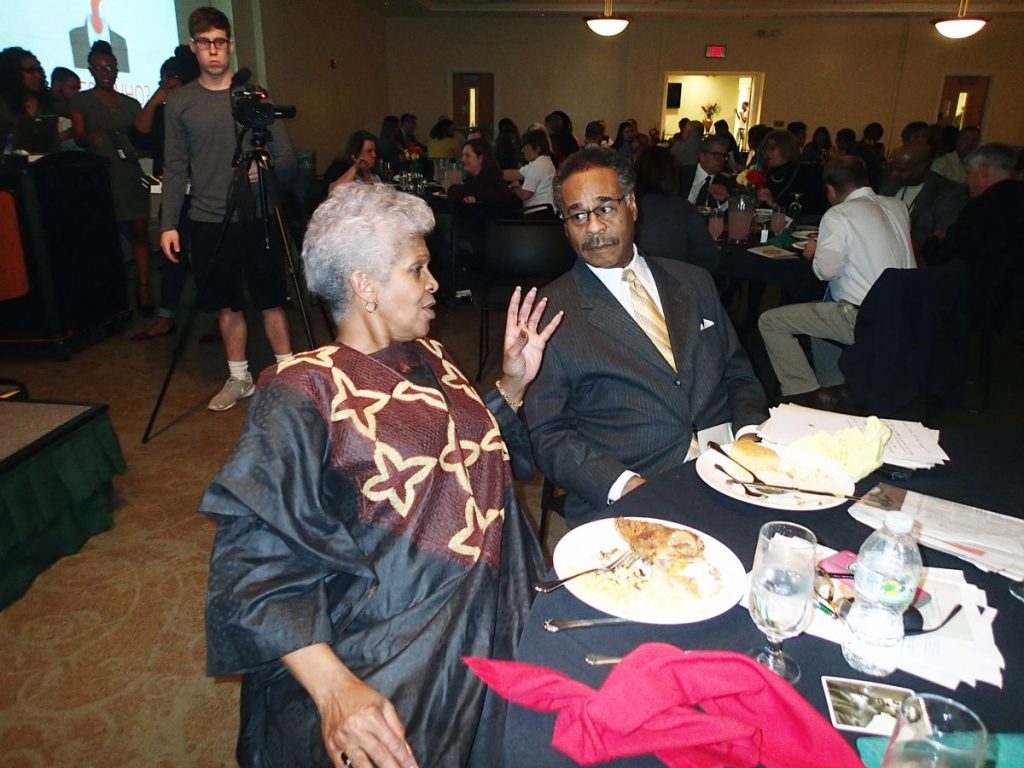
TONY BROWN/DAILY FORUM
U.S. Rep. Emanuel Cleaver, right, speaks with Juanita Simmons, vice president of diversity, equity, and inclusion at Northwest Missouri State University, during Tuesday’s Soul Food Dinner in the J.W. Jones Student Union. Delivering his keynote address to a capacity ballroom audience, Cleaver outlined nearly 400 years of African American history, contrasting the evils of slavery and segregation with the accomplishments of people of color who have played important roles in the development of the United States.