New campus gallery houses DeLuce collection
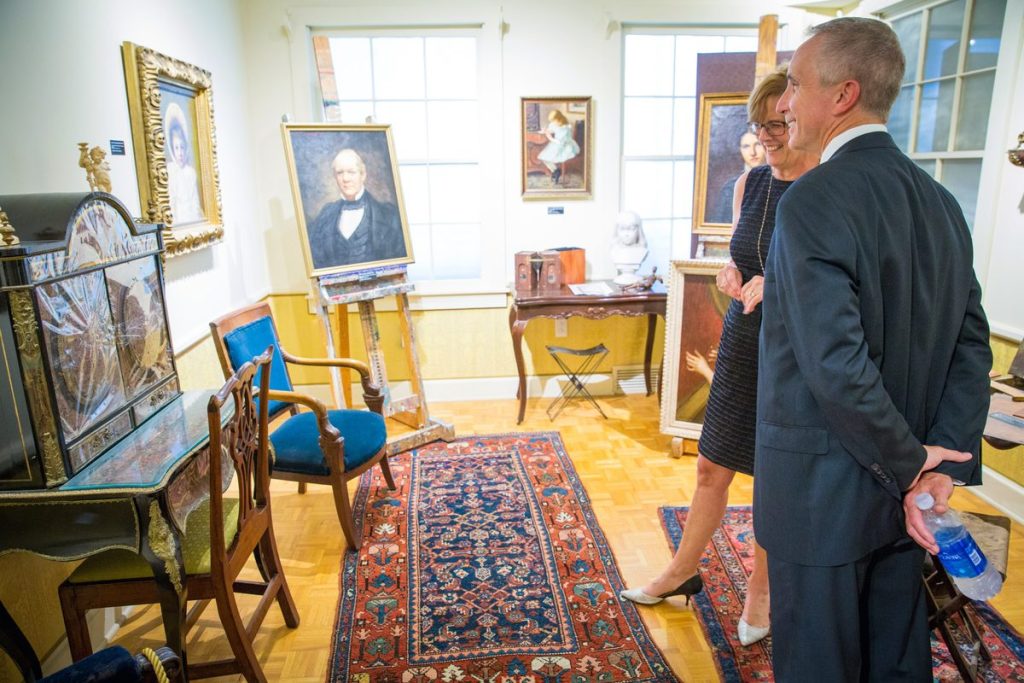
TODD WEDDLE/NORTHWEST MISSOURI STATE UNIVERSITY
Lynne Gilbert, left, administrative assistant to the president, and Northwest Missouri State University President John Jasinski view a representation of Percival DeLuce’s New York studio during a tour of the newly installed Percival DeLuce Memorial Collection on the Northwest campus.
MARYVILLE, Mo. — The name DeLuce has been associated with the fine arts at Northwest Missouri State University since Olive DeLuce became the school’s first art instructor in 1915.
Now works created and collected by DeLuce’s father, Percival DeLuce, a noted American painter who lived from 1847-1914, are being restored to prominence on campus.
Olive DeLuce established the fine arts department at what was then Missouri’s Fifth District Normal School and served as its chair until her retirement in 1959.
After she died in 1970, then-Northwest President Robert Foster, on behalf of the university, accepted a collection of drawings, paintings, prints, and furniture dating back to the 18th century from the DeLuce estate.
In acquiring what came to be known as the Percival DeLuce Memorial Collection, Northwest also agreed to maintain and exhibit the works. Accordingly, in 1971, an exhibit featuring parts of the bequest was installed in the Olive DeLuce Fine Arts Building.
The late Robert Sunkel, an associate professor of art, curated the exhibit and started to inventory the collection, but the effort was never completed. During the 1980s, the artworks were placed in storage in the DeLuce building basement where they remained until recently.
Interest in the collection began to revive several years ago when Professor of Art Phil Laber received a phone call from a woman in Nebraska who wanted to offer the university a painting believed to be by Percival DeLuce.
The work, titled “After the Harvest Belgium,” now rests on an easel within a remodeled exhibit space housing the collection, which has been placed on limited-access display.
“This whole act of resurrecting the collection came out of an awareness that some things in the collection had gone astray,” said Laber, who retired last summer. “For the first year we were just trying to figure out what we had, where it was, how it compared to the documentation that Mr. Sunkel had left behind, and then I went about recreating a new database.”
With the help of a small group of students, along with Lynne Gilbert, President John Jasinski’s administrative specialist, the collection of more than 800 pieces has now been photographed and documented.
In addition, the university is developing an online database to enhance the collection’s accessibility to both scholars and the public.
“The work we’ve done … was to discover the magnitude of the collection and then also put it contextually into the larger picture of the university (art) collection,” Laber said. “When we started going through that, we discovered that there’s so much more outside of the Percival DeLuce collection.”
Significant artworks owned by Northwest include a pair of Rembrandts purchased by Percival DeLuce during the 1800s, a Thomas Hart Benton lithograph, two Mary Cassatt paintings, and a signed work by Paul Klee.
Benton presented the lithograph “Cradling Wheat” to Northwest’s Class of 1939. Today the print is displayed in Jasinski’s office in the Administration Building.
Laber described the collection, some of which has been basically out of sight for decades, as “ripe for research.”
During his lifetime, Percival DeLuce was a successful portrait artist and illustrator who worked mostly in New York. A part of the collection bearing his name is now on restricted display in the DeLuce building and features a representation of the artist’s studio.
Among other things, the exhibit contains several Percival DeLuce paintings, two Napoleonic chairs, the artist’s easel, and a 17th century desk. There are also depictions of a young Olive DeLuce, who was born in 1888.
Laber said his favorite part of the collection consists of Percival DeLuce’s sketchbooks, which hold pride of place in a gallery room of their own. The books contain drawings DeLuce made as a young man studying in Europe.
“Those sketchbooks are jewels of all kinds of information about history, subjects, his ability to draw, modes of transportation, horseback, trains, ships,” Laber said. “We are so accustomed to having mass communication instantly. To look at these sketchbooks and realize that they are a form of information much more than just drawings, they are a wealth of information about him in that period.”
The Percival DeLuce Memorial Collection is housed on the first floor of the Olive DeLuce Fine Arts Building. For more information or to schedule a viewing, call the Department of Fine and Performing Arts at 660-562-1326.