Bocce court to serve Special Olympians
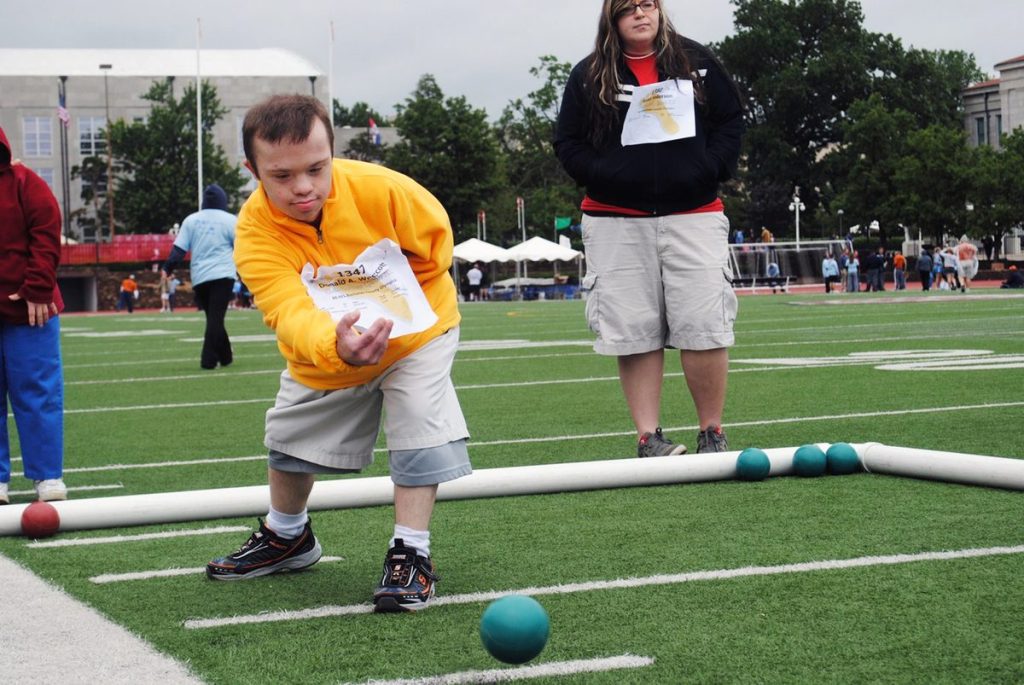
COURTESY OF SPECIAL OLYMPICS MISSOURI
A Missouri Special Olympics athlete tosses a bocce ball during a recent competition. North Missouri Special Olympics officials have been working with Maryville Parks & Recreation, which plans to construct a bocce court this spring in Franklin Park. The court will be open to the public, but priority for use will be given to Special Olympics practices and events.
Maryville Parks & Recreation and the North Area of Missouri Special Olympics are partnering to provide a new competitive sports opportunity for local athletes with cognitive and developmental disabilities.
Using funds from a $1,200 grant obtained by Special Olympics, the Park Board has agreed to construct a bocce court at Franklin Park north of the downtown square.
Parks & Recreation Director Aaron Dobson said that bocce, which is similar to lawn bowling and shuffleboard, is “one of the fastest growing sports within the Special Olympics community,” and that about 10 local Special Olympians currently pursue the game.
In the past, however, those athletes have been forced to travel to other communities in order to compete or practice on a regulation court.
Thanks to the grant and an assist from Northwest Missouri State University, that will soon no longer be the case.
Northwest has donated a portion of the old artificial turf, now replaced, that formed the playing surface of Mel Tjeerdsma Field at Bearcat Stadium.
This spring, Parks & Rec personnel plan to use that turf to construct a wood-bordered court on the current site of “Santa’s Cottage,” which will be moved to a new location inside the park. Bocce courts are about 90 feet long and between 8 and 13 feet wide.
Since the sport is traditionally played on packed soil or asphalt, Dobson said the court may require some sort of underlayment so that the grapefruit-sized bocce balls, which are partly thrown and partly rolled at a smaller target ball, move with the requisite accuracy and speed.
While the court will be open to the public at no charge, Dobson said Special Olympics athletes will have priority and are likely use the court a couple of evenings a week during nice weather.
The court will also be reserved for Special Olympians during occasional weekend competitions.
Dobson said the court’s cost should be easily covered by the grant, and that the only expense to Parks & Rec will be the staff time required for construction, which is to take place sometime this spring.
He said Franklin Park was chosen for the court due to its central location and ease of access from the street for players coping with mobility issues and other physical challenges.
Games similar to Bocce have been popular across Europe since the time of the Roman Empire. The sport in its current form was popularized by Italian immigrants and has spread to Australia, North America, and South America.
The sport is played with eight large balls — four to a team — and one smaller target ball called a pallina.
Competition generally takes place between two four-player teams with the game divided into frames during which only one team can score. One point is awarded for each ball rolled closer to the pallina than the closest ball of the opposing team.
The first team to score 16 points is usually considered the winner.
North Area Program Coordinator Alyssa Cress said there are about 50 Special Olympians in and around Maryville and at least 1,000 across the region, which embraces 27 north Missouri counties.
She added that a significant number of the area’s athlete population is aging, which has created demand for less-strenuous “lifetime” activities such as bocce.
The highest-profile Special Olympics event in Maryville is probably the annual North Area basketball tournament, which attracts more than 200 players each January and takes place in Northwest’s Bearcat Arena.
Other local Special Olympics competitions regularly include track and field and bowling.
Cress said the Franklin Park court will be the first she knows of in northwest Missouri, but that the sport appears to be growing in popularity. Other bocce facilities, she said, exist in Columbia and Kansas City.