City sales tax renewal headed for voters
TONY BROWN/DAILY FORUM
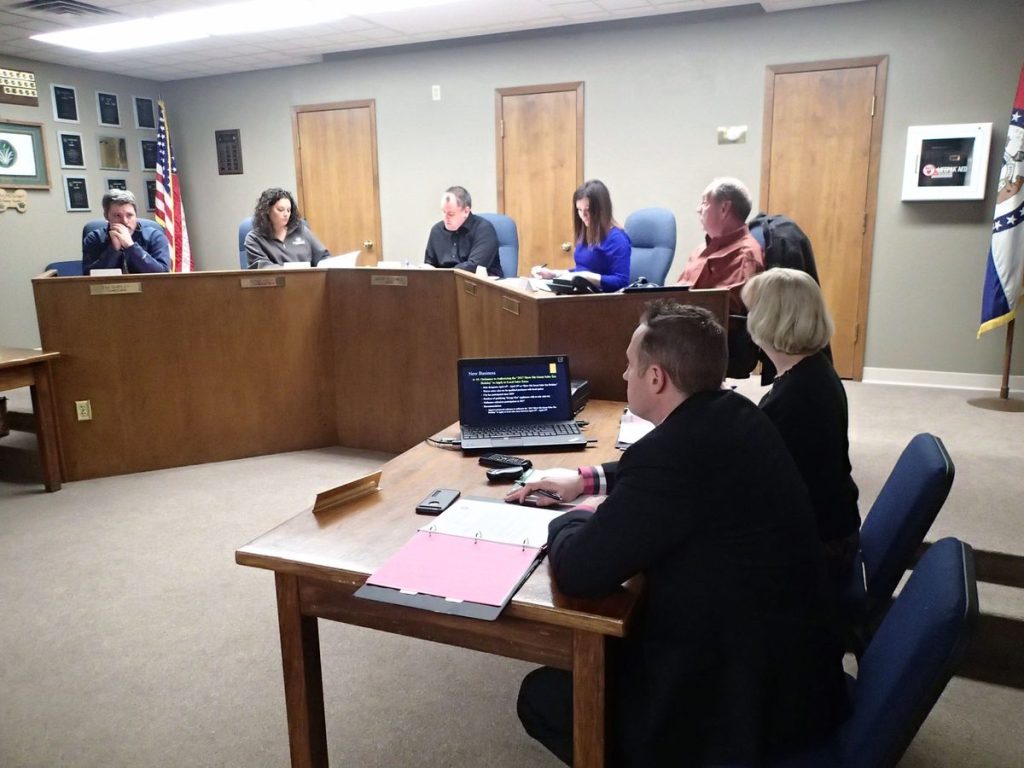
The Maryville City Council this week approved an ordinance placing proposed renewal of the city’s half-cent capital improvements sales tax on the April 4 municipal election ballot. A majority of “yes” votes will renew the tax, which sunsets in 2018, for a term of 20 years. Council members seated at the dais from left include Tim Shipley, Renee Riedel, Mayor Jason McDowell, Rachael Martin, and Jerry Riggs. Shown seated at the table in the foreground are City Manager Greg McDanel and City Clerk Sheila Smail.
When it comes to producing revenue to pay for large-scale projects, City Hall is hoping to win Maryville citizens over one more time and will seek voter approval April 4 on the fourth of four tax questions proposed over the past 10 months — three of which were adopted at the polls.
The first three tax measures included renewal of a 20-year, half-cent-on-the-dollar sales tax that provides revenue for operations and development at Mozingo Lake Recreation Park.
Also green-lighted by voters during the past two elections were an eighth-of-a-cent sales tax, which is being used to fund construction of a $4 million lakeside conference center at Mozingo, and a 5-percent “bed tax” on nightly hotel stays, with proceeds going for a new multipurpose athletics facility at Northwest Missouri State University and various citywide promotional and tourism initiatives.
Now, in this spring’s municipal election, Maryville residents will be asked to renew or reject an existing half-cent city sales tax dedicated to capital improvements and major equipment purchases.
During this week’s regular City Council session, City Manager Greg McDanel called the tax, which went on the books in 2008 and expires in 2018, “critical” to a number of major projects and purchases identified by the council as leading budget priorities.
In addition to renewing the tax, the city also wants voters to extend its term from 10 to 20 years.
McDanel said the longer term is needed due to the length of debt service that will be necessary to pay for such big-ticket projects as a proposed new police and fire headquarters and the transformation of the South Main Street retail strip into a smooth-flowing, pedestrian-friendly boulevard.
Renewing the tax for a shorter term, he said, would place the city in much the same situation as a homeowner who acquires a short-term mortgage but lacks the income to pay it off in time.
In the past, the city has undertaken a number of smaller capital improvements, such as street overlays, on a pay-as-you-go basis. Larger projects, however, like building two new water towers or turning South Munn Avenue and South Depot Street into permanent concrete streets, have been financed by entering into some form of debt.
This means that while the existing sales tax brings in around $920,000 annually, revenues over the past few years have gone largely for debt service.
In his report to the council, McDanel said that debt, in the form of certificates of participation used to pay for the Munn and Depot projects, will be retired in 2018 in conjunction with the tax’s sunset date.
Given the scope of projects like the police/fire station and South Main, similar timing will be possible only if the renewed tax — assuming it is renewed — has a longer term.
Other projects funded at least in part with capital improvements revenue over the past decade include the resurfacing of Main Street between First and Halsey; the Fourth Street pedestrian corridor; reconstruction of Sixteenth Street; storm water infrastructure associated with retail development along East First Street; seven new pedestrian/bicycle trails; a new storm siren system; new dump trucks and snow plows; and two new fire trucks.
In seeking a capital improvements tax renewal, the council has set the following priorities should the measure pass: the police and fire headquarters, which has an estimated cost of around $5 million; three phases of planned improvements along South Main, each costing about $3 million; and a largescale asphalt overlay project scheduled for 2018, which would embrace 11 miles of city streets and cost approximately $2 million.
Lesser priorities over the proposed 20-year life of the tax include a $1.5 million aerial ladder truck for the Maryville Public Safety fire division that would replace an existing unit; a second general response fire truck; upgraded 911 equipment; storm water collection improvements; deteriorated concrete street replacements; extension of the downtown streetscape; and various equipment replacements, including patrol cars, a dump truck/salt spreader, rubber-tire loader, and tracked skid steer.
Following McDanel’s remarks during Monday’s meeting, the council unanimously passed an ordinance approving the sales tax proposal for inclusion on the April ballot.