Insurance costs rise for Maryville schools
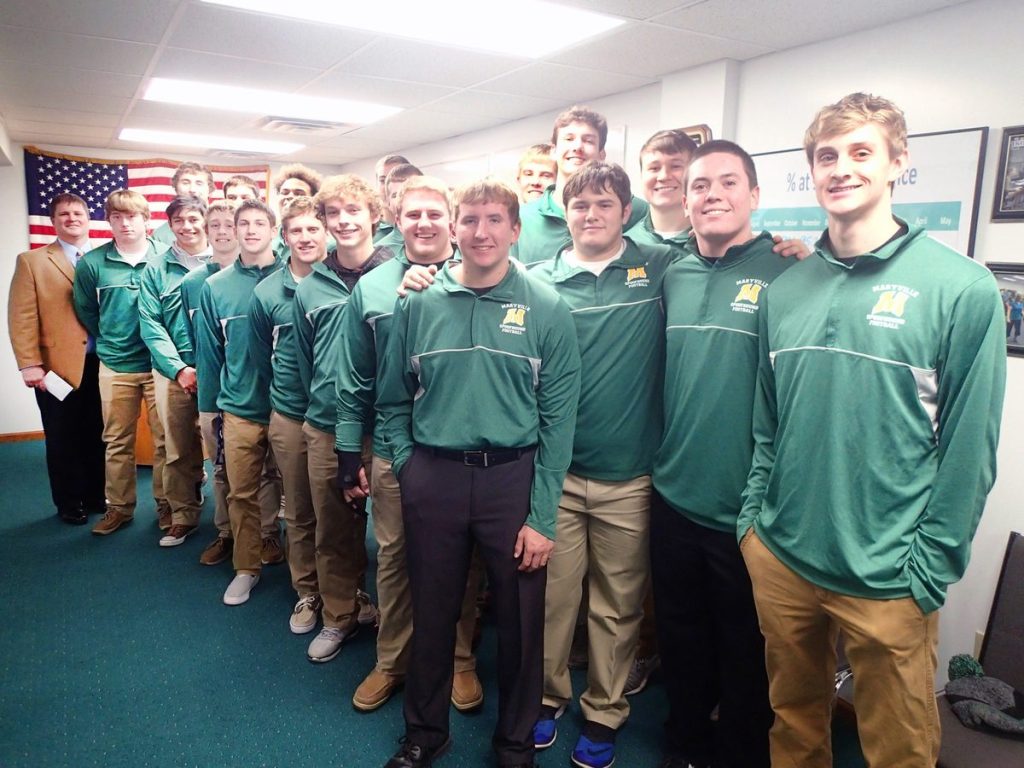
TONY BROWN/DAILY FORUM
The Maryville R-II Board of Education took time out during its regular session this week to congratulate seniors and all-state athletes from the 2016 edition of the MHS Spoofhounds’ football team. Lead by Head coach Matt Webb, this year’s squad finished 14-1, its sole loss coming in the Class 3 state championship Show-Me Bowl against the Monett Cubs.
During its final session of 2016 this week, the Maryville R-II Board of Education spent most of its time getting briefed on issues likely to affect the district’s future, including the state of its information technology systems, possible changes with regard to how non-exempt employees are compensated, and a proposed expansion of the summer school program.
Leading off the meeting, however, was a presentation by the district’s property and liability insurance provider, John Southard, owner-broker of CPSK Insurance in Harrisonville.
Sothhard told the board that its overall premium for the coming year would increase by more than $75,000, a price hike related to a pair of major workers’ compensation claims in 2014 and 2015.
Workers’ comp premiums, Southard said, are figured on a rolling three-year average, which means that, excluding the possibility of additional large claims, coverage costs incurred by the district should begin to drop toward more normal levels in 2018.
Assistant Superintendent Steve Klotz said that R-II’s total workers’ compensation premium for 2016-2017 will be around $126,000, compared to approximately $67,000 this year.
Adding to R-II’s insurance outlay, he said, is the additional square footage associated with recently completed capital improvements, including the $9.5 million Schneider Performing Arts Center at Maryville High School and a $2.5 million cafeteria addition at Eugene Field Elementary School.
The district’s total property and liability package for next year carries a total premium of $237,381, compared to $161,841 in 2016-2017.
Other business before the School Board included presentation by Superintendent Becky Albrecht on the possibility of replacing “annualized” pay for the district’s non-exempt workers, such as custodians and paraprofessionals, with “actualized” compensation based on hours worked within a specific pay period.
Under the current system, non-exempt, or hourly, personnel are paid on a prorated basis 12 months a year, even though they may only work when school is in session.
In addition, rather than paying overtime to such employees, the district often allows workers to take compensatory time off at the rate of one and a half hours for each extra hour worked.
For most private-sector businesses, the use of “comp time” is illegal under federal wage and hour laws. However, local governments, such as school districts, are excepted from the regulation.
If the district switches to an actualized wage system, non-exempt employees would be paid strictly for hours on the job, meaning that most would make more money during the school year and little or nothing during the summer when school is out.
In eliminating annualized wages, Albrecht said, the district would also get rid of “comp time” and replace it exclusively with overtime pay.
Albrecht told the board there were advantages to both systems. She said moving to strictly hourly pay would likely make it easier for the district to accurately track wages and maintain appropriate staffing levels, but that annualized compensation gives workers more flexibility with regard to personal budgeting and time off.
The board was not asked to make a decision on non-exempt compensation, and Albrecht said she merely wanted to begin a “conversation” on a topic that has become an issue for a growing number of school districts across the state.
Turning to summer school, Albrecht said the R-II administration has been talking with Catapult Learning, a private instructional solutions provider, about the possibility of expanding the K-8 program in terms of academic content and number of students served.
In the past, she said, summer school has consisted of two weeks of half-day instruction revolving mostly around “enrichment” activities rather than formal classwork.
If the district hires Catapult to provide curriculum content and other resources, summer school would be expanded to nearly five weeks of instruction spanning seven and a half hours each day.
That day would be divided into fours hours of classroom learning during the morning in such subject areas as science, mathematics, language arts, and social studies and three afternoon “enrichment” sessions embracing various special activities.
Albrecht said the goal is to enroll at least 300 students able to attend class at least 80 percent of the time. Past summer sessions, she said, have served about half that many children.
In addition to enhancing summer learning opportunities, the program holds the potential for boosting the district’s average daily attendance numbers, which would result in additional funding.
Finally, Albrecht briefed the board on the results of a technology assessment conducted by K12itc, a Kansas City company specializing in tech and help-desk services for both public and private schools.
Following a walk-through inspection and interviews with staff, the company reported that R-II administrators and faculty have succeeded in making technology a priority for the district, and that students and staff alike have access to a wide variety of computing devices. The assessment further noted that the district has worked to expand bandwidth and add access points.
As for possible improvements, K12itc cited a need for increased expertise with regard to infrastructure and server management; standardization, acquisition planning, and automated management tools; more opportunities for professional development; and an updated communications system embracing telephones, intercoms, and security cameras.