Tool store tractors stir memories of farm life
TONY BROWN/DAILY FORUM
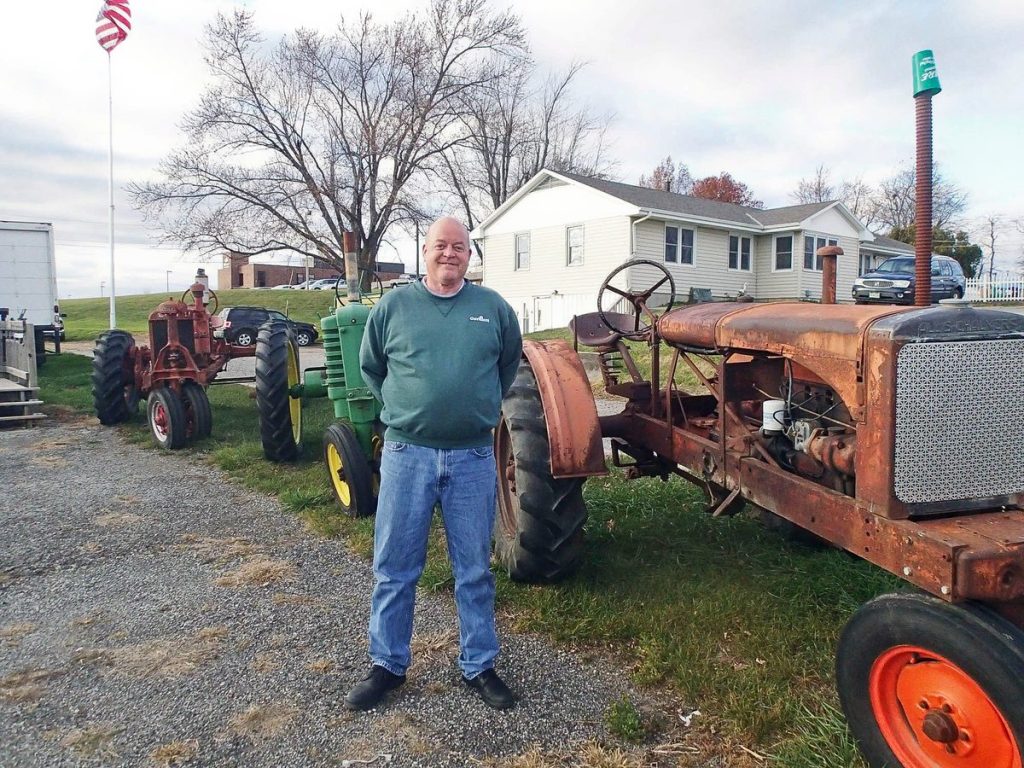
James Hassenkamp stands beside a small collection of old tractors parked outside his business, Maryville Tools, located at 2126 S. Main St. in Maryville. Hassenkamp, who is neither a farmer nor a mechanic, said he acquired the machines over the years simply because they speak to a fading era of American agriculture. “People come in and reminisce about the first tractor they ever drove,” he said. “They draw attention, they’re neat, they’re fun to look at.”
When it comes to agriculture, James Hassenkamp, owner of Maryville Tools at 2126 S. Main St., is the man who gives Nodaway County farmers what they need to keep the wheels rolling, the belts and gears turning, and the big engines purring during planting and harvest seasons.
From socket sets to pneumatic wrenches, from drills to jacks, from pliers to log chains, and from screwdrivers to angle grinders, Hassenkamp provides row crop and livestock producers with the right stuff to get the job done both in the shop and in the field.
But the Brooklyn, New York-born Hassenkamp — who set up shop in Maryville 10 years ago after operating a van-based tool business in another mammoth metropolis, Los Angeles — offers his customers something else as well.
Memory.
Anything but a farmer himself, the burley, shaved-headed Hassenkamp, whose quick, clipped accent betrays his urban East Coast roots, has discovered a sure-fire way to make his store a welcoming beacon to farmers who have spent their entire lives working lonely, quiet fields where the sky is wide, the people are few, and the tradition of tilling the soil runs black and deep.
You can’t really call it a gimmick because it’s so doggone Midwestern, and you can’t really call it a hobby, because by his own admission Hassenkamp is neither a mechanic nor a country boy.
What you can call it is quirky and fun.
Outside Hassenkamp’s bright yellow store building is a small collection of old tractors — not vintage, just old. Very little, if anything, has been restored or even painted up.
These are simply and honestly old pieces of battered iron and rubber that stand out like lighthouses, illuminating a rural way of life that has largely disappeared in an era of precision farming, GPS units, and high-tech field implements that drive themselves.
“Somehow the tractors find me,” Hassenkamp said. “I’m a very low-budget tractor buyer.”
Sometimes he trades tools for the old machines, sometimes he sweetens the deal with a little cash. And he’s found over time that the minimal investment is worth it, since nothing draws farmers into a tool shop like the sight of an old tractor like the one they drove “farming with Dad” when they were 14 or 15 years old.
“Almost all my customers are farmers,” said Hassenkamp, who also provides tools to a couple of local manufacturing operations. “Farmers are my bread and butter, and if it wasn’t for them, Maryville Tools probably wouldn’t be here. I appreciate everything they’ve done for us.”
So parking a few old tractors in front of the store isn’t so much advertising as doing his customers a favor.
“People come in and reminisce about the first tractor they ever drove,” Hassenkamp said. “They draw attention, they’re neat, they’re fun to look at.”
Right now Hassenkamp has three tractors parked in his store lot: a 1935 Farmall F-20, a 1949 John Deere “B”, and a 1936 Allis-Chalmers WD. None of the machines are in what one could call pristine condition, but “they all run,” claims Hassenkamp. “They all start right up.”
And sometimes they actually do start up, like when a customer comes by and wants to hear the old hoss he grew up with rumble to life just one more time.
Not that the tractors pique the interest of farmers only.
Hassenkamp said that, sometimes, parents with small children stop by so their kids can catch a glimpse of what farming used to look like in northwest Missouri.
Other young visitors have included preschoolers from the SSM Health St. Francis daycare center located next door.
While the current collection consists of just four tractors, one of which, a 1965 Allis-Chalmers D-19, Hassenkamp is trying to sell for a friend, the genial tool man is seeking additional acquisitions. Eventually he’d like to have one each of the major makes from the 1930s, ’40s, ’50s, and ’60s.
An old Ford or Oliver would be nice, he said, and during the interview for this story a customer walked into the shop and mentioned a 1949 Case that might be available for sale or trade.
“People just come in,” Hassenkamp said. “They tell me everything about them, and they always have a story. You look at those things and you realize that they were cutting-edge technology back in the day. It’s a fantastic conversation generator.”
Asked why he thinks the old motorized mules have such appeal, Hassenkamp speculated that, for many, the past simply has a very strong attraction as life on the farm moves relentlessly into a complicated, technology-driven future.
“It’s looking back into an old era,” he said, “like barnstorming airplanes or antique cars. There’s a comfort zone there.”