Gravel tax funds to help pay off TIF debt
TONY BROWN/DAILY FORUM
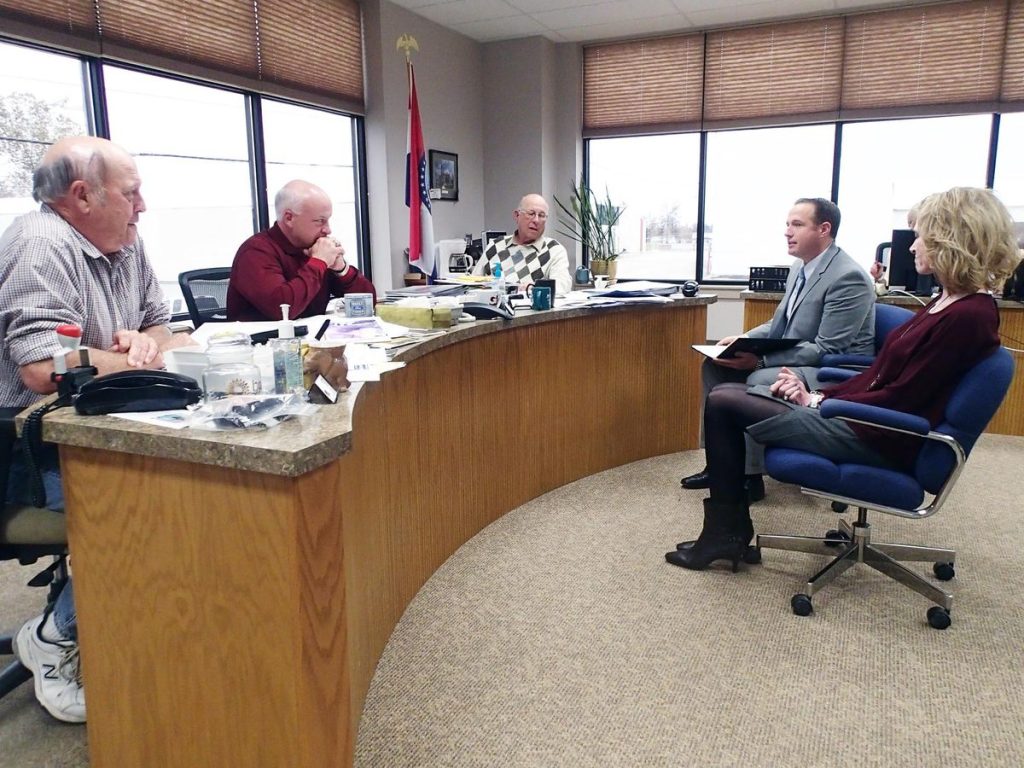
Maryville City Manager Greg McDanel, second from right, and municipal Finance Director Denise Town, right, speak with the Nodaway County Commission on Wednesday about the required diversion of a portion of the county’s half-cent-on-the-dollar road gravel sales tax toward repayment of TIF debt incurred to develop Town Center, a South Main retail complex anchored by the Hy-Vee supermarket. Also pictured from left are North District Commissioner Robert Westfall, Presiding Commissioner Bill Walker, and South District Commissioner Robert Stiens.
A portion of a half-cent-on-the-dollar sales tax approved by Nodaway County voters in April 2014 and earmarked for the purchase of additional gravel for roads maintained by the county’s 15 townships is to be set aside to pay off Tax Increment Financing bonds used to build the Town Center retail complex in Maryville anchored by the Hy-Vee supermarket.
Classed under state law as an “economic activity” levy, the gravel tax was always subject to TIF requirements. However, according to City Manager Greg McDanel, who met with the County Commission on Wednesday, the city neglected to ask for its share of the tax after it went into effect two years ago.
The gravel tax brings in a little less than $1 million a year, and McDanel estimated the county will now hand over around $30,000 of that total in TIF payments.
Two other county half-cent sales taxes are already subject to the Town Center TIF, as is the city’s half-cent capital improvements levy and a new eighth-of-a-cent sales tax approved by voters for construction of a conference center at Mozingo Lake Recreation Park.
The diversion of gravel tax funds toward TIF debt service will begin in 2017, according to McDanel, who said the city obtained an attorney’s opinion on the matter before informing the county of its obligation.
As for the period between October 2014 and the end of this year, when the gravel tax was collected but no TIF money disbursed, McDanel said the city has no intention of seeking any sort of back payment.
“It is not our intention to go back and fix what we missed,” McDanel told the commissioners.
Tax increment financing is a form of economic development incentive commonly used by governmental entities to redevelop “blighted areas.” In the case of Town Center, Maryville sold $2.5 million in TIF bonds back in 2005 that were used to pay for various infrastructure improvements associated with the new shopping complex.
The borrowing capacity for TIF projects is established by estimating future real estate tax increases for the affected district over 20 or 25 years, along with anticipated tax revenue growth from the development or enterprise itself.
In Maryville’s case, the bond financing was originally to be repaid over 20 years. However the bonds were refinanced in 2015 for $1.7 million, which municipal Finance Director Denise Town said could shorten the term of repayment by a year or so.
McDanel added that anticipated modest increases in sales tax revenues, plus the addition of gravel tax funds, will likely shorten the repayment period even further.
This is partly how TIF districts are supposed to work: increased sales tax income, new jobs, public and private investment, and higher assessed property values combine to generate increased revenues — the “tax increment” theoretically used to finance debt incurred for new development.