Trump victory spotlights role of Electoral College
J. SCOTT APPLEWHITE/ASSOCIATED PRESS
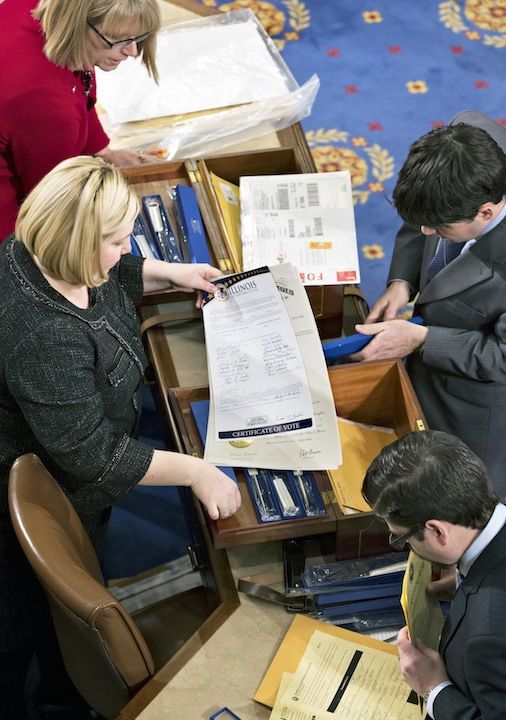
In this Associated Press file photo taken in Jan. 2013 at the Capitol in Washington, D.C., clerks unseal certified Electoral College results from all 50 states. The constitutional formality affirms the election of the new U.S. president, who must capture 270 votes out of 538 cast. The vice president, as president of the Senate, presides over the count and announces the results. The vote count certifying the results of this year’s presidential election is scheduled to take place during a joint session of Congress on Jan. 6.
The stunning outcome of this month’s presidential election is a rare example of a race decided in the Electoral College in favor of a candidate who failed to win the popular vote.
Though Hillary Clinton won the popular vote by more than 650,000 ballots, Donald Trump won where it mattered most — by picking up more than 270 probable electoral votes to be cast next month by electors in each state.
It is the fifth time in U.S. history that the Electoral College has loomed large in a presidential race. In two of those cases, the presidency was ultimately decided by Congress. A third — the razor-thin 2000 Gore-Bush contest — went to the Supreme Court.
While the 2016 campaign was perhaps the most bitter since 1900, several races in the 19th century may have been even more acrimonious.
The 1824 campaign featured four candidates — Andrew Jackson and John Quincy Adams, as well as Speaker of the House Henry Clay and ex-Georgia congressman and cabinet member William Crawford. Jackson polled the most popular votes, defeating Adams 42-32 percent, while Crawford and Clay each earned 13 percent.
None of the four, however, had a majority of electoral votes. In keeping with the 12th Amendment, the matter was sent to the U.S. House of Representatives, which had the task of choosing from the top three Electoral College finishers.
The fourth-place finisher, Clay, threw his support to Adams, a move that secured his victory. In return, Adams named Clay secretary of state.
Enraged, Jackson backers screamed that a “corrupt bargain” had been made, and the 1828 rematch between Adams and Jackson was even more bitter than in 1824.
Fifty-two years later, Republican Rutherford B. Hayes prevailed in the 1876 election, but returns from four states were contested.
The Democratic candidate, Samuel Tilden was leading in the popular vote, but without the four key states was left with a 184-166 lead in the Electoral College, one shy of a majority.
An electoral commission consisting of five senators, five representatives, and five Supreme Court justices was created by Congress to decide the matter. In a strict vote along party lines in February 1877, the commission voted 8-7 to award the four disputed states to Hayes, giving him the election by a count of 185-184.
Some Democrats in the South were outraged at the decision. To pacify them, Hayes offered the Compromise of 1877, which withdrew federal troops from the South — placed there after the Civil War in part to protect the civil rights of African Americans — and sought to improve Southern schools and transportation systems.
Hayes also appointed a Southern Democrat to be postmaster general, then a cabinet post.
The Electoral College proved decisive again in 1888, though with less controversy. In that race, Republican incumbent Grover Cleveland edged out Democratic challenger Benjamin Harrison by more than 100,000 votes, but lost in the Electoral College, 233-168.
The scenario denied Cleveland re-election, though he would triumph in a rematch with Harrison in 1892.
As a result, Cleveland is one of only two presidents, the other being Franklin D. Roosevelt, to win the popular vote in three or more consecutive elections.
After 112 years, the Electoral College took center stage again in 2000, when the Gore-Bush race broke down into a battle over hand recounts and dubiously marked ballots. Gore collected more than 51 million popular votes, then the second-highest total ever, and was 500,000 votes ahead of Bush. But he fell short by a few hundred votes in Florida, the decisive state.
After weeks of legal wrangling, the Supreme Court decided on Dec. 12 by a 5-4 vote that the recounts should end. Bush won by 271 Electoral College votes, one more than he needed.
Electors are not bound by either the Constitution or federal law to vote for the candidate of their party, though defections are rare. In several cases, an elector has cast a vote for someone other than the party nominee, but that has never affected the outcome.
Examples include the 1988 race, when a West Virginia Democratic elector chose Lloyd Bentsen for president and Michael Dukakis for vice president, flipping the ticket.
Ronald Reagan received a single vote from a Washington state elector in 1976, while in 2000 a Gore elector from the District of Columbia submitted a blank ballot to protest the district’s lack of representation in Congress.
In addition, Sen. Harry Byrd (D-Virginia) received 15 electoral votes in the 1960 Electoral College, which gave him the majority in both Alabama and Mississippi.
Again, however, the outcome was not influenced, as John F. Kennedy defeated Richard Nixon in both the popular and electoral votes.
EDITOR’S NOTE: Tom Emery is an Illinois writer and researcher who occasionally submits articles to the Daily Forum on topics of historical and political interest. Following is a look at the role of the Electoral College, which will cast votes on Dec. 19 in a constitutional procedure expected to ratify the election of Donald Trump as the next president of the United States.