EEZ Board seeks to expand tax abatement list
TONY BROWN/DAILY FORUM
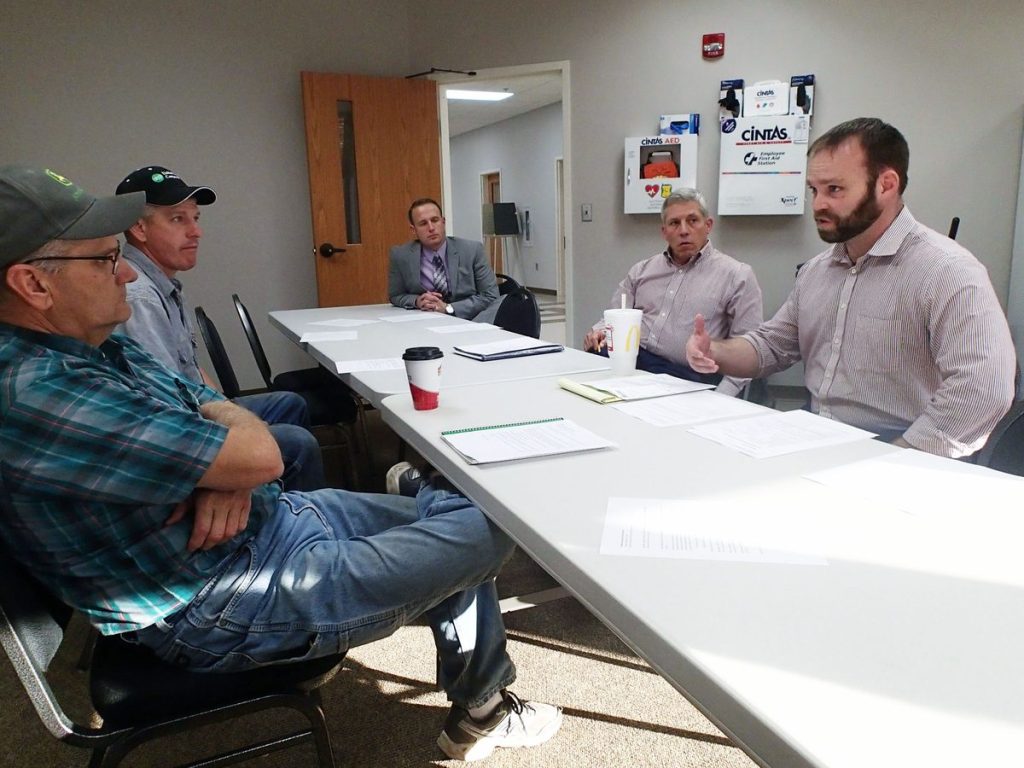
Nodaway County Economic Development Executive Director Josh McKim, right, speaks to members of the Nodaway County Enhanced Enterprise Zone Board last week. The board granted tentative approval for adoption of three new “mix codes” embracing enterprises eligible for partial tax abatements on real property over a 10-year period. The codes apply to enterprises engaging in hydroponics, aquaculture, data center services, call center operations, and “back office” functions such as technology support, accounting, and human resources.
The Nodaway County Enhanced Enterprise Zone Board met last week for the second time in two months to reconsider a delayed attempt to add categories embracing hydroponic farming and aquaculture to a growing list of industries that could qualify for tax abatements on real property in return for initiating economic investment and job growth.
The so-called EEZ, which covers virtually all of Nodaway County with the exception of an area surrounding the communities of Burlington Junction, Clearmont, and Elmo — included in a separate “Northwest” zone — was created in 2011 in hopes of attracting additional wind-farm development.
Though a second Nodaway County wind farm has so far failed to materialize, officials have stated that more turbines are likely on the way, and that construction could begin sometime in 2017.
In addition, the Nodaway Enhanced Enterprise Zone was expanded a few years ago to include manufacturing, wholesale trade, transportation and warehousing, and professional, scientific, and technical services.
As of Friday, that list has been tentatively expanded to include hydroponics (the cultivation of fruits and vegetables in nutrient-rich water rather than soil); aquaculture (the raising of fish and other aquatic animals for food); data centers; call centers; and “back office” operations that provide companies with such functions as technology support, accounting, and human resources.
Josh McKim, executive director of Nodaway County Economic Development, said his office has received an inquiry with regard to a hydroponic-aquaculture operation interested in locating in Nodaway County. There have been no inquiries, he said, with regard to businesses that would fall into the three remaining categories.
The expanded EEZ list won’t be official until it is approved by the Nodaway County Commission and each of the incorporated municipalities within the zone.
McKim said he decided to request the new categories after determining that the industries they include would be good fits for the Nodaway County economy.
Essentially having a “mix code” in place for a given industry serves economic development professionals like McKim as an inducement that can be held out during the recruitment process. However, the tax break, even for an included enterprise, isn’t automatic and must be approved by the EEZ Board on a case-by-case basis.
The codes are standardized across the nation in accordance with the North American Industry Classification System, or NAICS.
Assuming approval by the requisite political subdivisions, the Nodaway EEZ Board is empowered to offer a 50- to 70-percent abatement of taxes on new real property over a period of 10 years.
The percentage of abatement is tied to such factors as the number of new jobs created and the level of investment in land and buildings. At a minimum, businesses must employ two full-time workers and provide $100,000 in capital investment.
In addition to green-lighting the approval process for the five new code categories, the EEZ Board accepted a request for manufacturing-code tax abatements submitted by Houston Polytank of Hopkins.
The locally owned and managed plastic tank company is seeking EEZ status for its new 10,000-square-foot expansion.
According to the application, the facility represents a $750,000 investment, $250,000 of which is real property covered under the EEZ eligibility guidelines. In addition, the expansion is to create two new jobs initially and up to five jobs at full production.
The maximum abatement would total 55 percent of taxes on real property over the next 10 years.