Maryville chows down on Lettuce Dream produce
TONY BROWN/DAILY FORUM
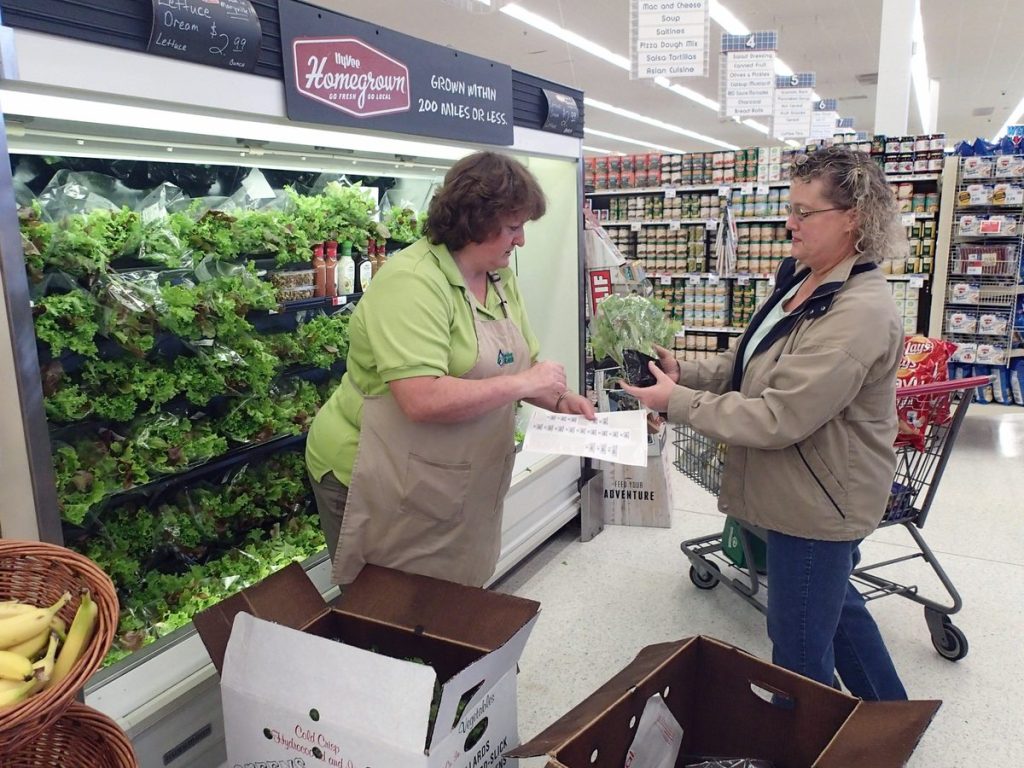
Diane Francis, left, board president of Lettuce Dream, a vocational training non-profit seeking to serve people with developmental and cognitive disabilities, talks with Hy-Vee customer Cecily Lanier on Friday as Lanier selects a head of hydroponically cultivated lettuce grown at the newly completed Lettuce Dream greenhouse.
In press releases and other marketing materials, the local Hy-Vee supermarket likes to style itself “your Maryville Hy-Vee.” Well now, at least in one small section of the produce department, it really is.
And that heralds the beginning of new opportunity for area residents seeking to build lives as productive citizens while coping with the burden of a cognitive and developmental disabilities.
On Thursday, in a prominent refrigerated “end cap” toward the front of the store, Hy-Vee began selling hydroponically raised lettuce produced at the newly completed Lettuce Dream greenhouse complex located just northwest of the Highway 71/East First Street interchange.
The brainchild and passion of Diane Francis, the mother of a grown son with special needs, Lettuce Dream is a non-profit organization seeking to provide folks with disabilities the post-high school vocational training, skills, and experience they need to hold down a job.
Those skills are to be taught, in true north Missouri fashion, by planting seeds and harvesting a crop.
Scores of local residents have joined the effort to turn Lettuce Dream into reality. Over the past three and a half years, through a combination of grants, gifts, and fundraisers, the grassroots organization has raised the more than $600,000 to get the project off the ground.
Francis and her fellow board members, including vice president Wayne Pierson, a retired Army general, and Rego Jones, a horticulturist at Northwest Missouri State University, used a business model established by Wendie Blanchard, founder of Arthur & Friends, a New Jersey-based non-profit with a greenhouse operation serving wholesale and retail markets across greater New York City.
The ultimate goal is a year-round produce growing operation that will eventually include up to 16 greenhouses and support facilities on the existing Lettuce Dream property.
But first things first.
A two-bay greenhouse was completed this summer, and with a hands-on push from Jones, Executive Director Jackie Allenbrand, and a couple of Northwest Missouri State University horticulture students, has produced the crop of “Five-Star” mixed lettuce currently on sale at Hy-Vee.
No “trainees,” that is people with disabilities, have been taken on yet because Francis and the board decided to get the agriculture part of the operation going before moving on toward fulfillment of Lettuce Dream’s core mission.
However, the organization is currently accepting applications from area families. Potential trainees will be screened by a panel consisting of a state vocational rehabilitation professional and Lettuce Dream volunteers with backgrounds in social services and special education.
Francis said the plan is to accept trainees “two or three at a time.” Those selected will then spend a few days at the greenhouse observing the operation and maybe taking on a few simple chores.
“We want to give them time to see what this is all about and decide if they want to do this,” Francis said.
Applicants who stay will then start working through four or five training modules designed to identify vocational strengths while teaching basic job skills.
However, all that is for later. Right now, so far so good. Fresh, locally grown lettuce — fresh as in picked just a few days ago — is on sale in a Maryville store, and customers are buying it. About a hundred parcels, at $2.99 each, were purchased on Thursday alone.
“It has been above my expectations,” said Hy-Vee Produce Manager Cory Frank. “This is a win-win for Maryville. The newest, latest trend (in retail food sales) is locally grown produce. People want to know where their food comes from.”
Heretofore, the Maryville Hy-Vee store hasn’t sold a lot of Maryville-grown food, though it does frequently stock produce from an orchard operation near St. Joseph and Mennonite garden farmers in Gentry County.
“This is just good all the way around,” Frank said. “It’s good for us and good for the community.”