DWI Court offers hope to offenders willing to change
TONY BROWN/DAILY FORUM
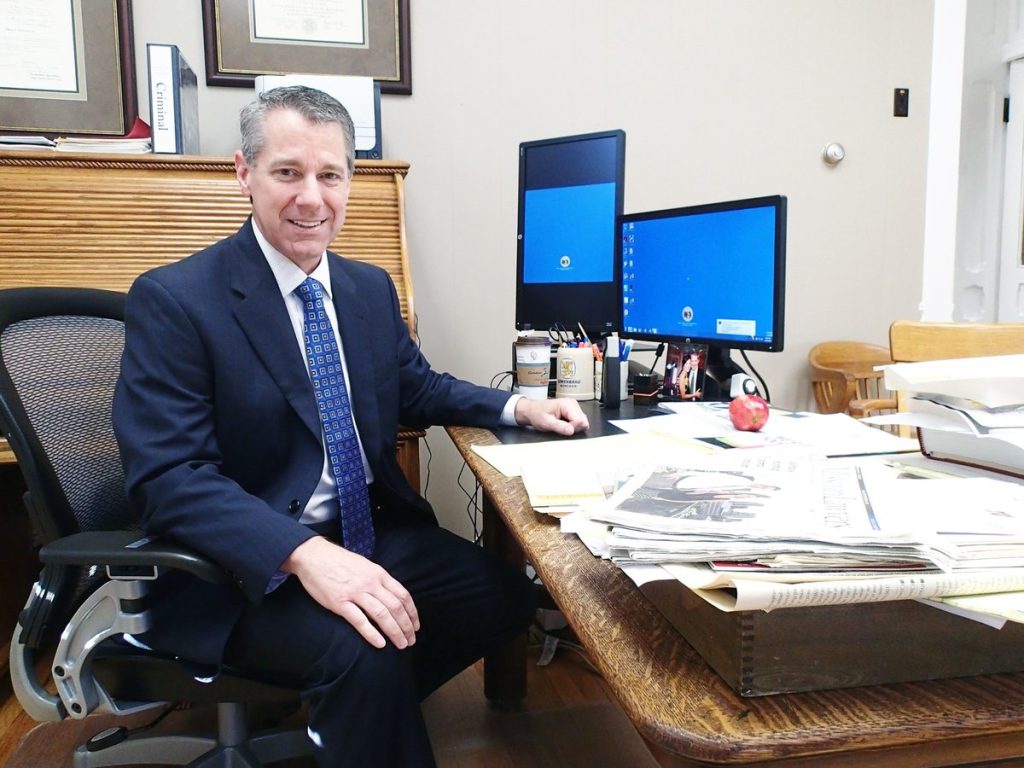
Associate Circuit Judge Doug Thomson is shown Wednesday in his office in the Nodaway County Courthouse. Beginning next month, Thomson will lead a new initiative in the 4th Judicial Circuit designed to give persistent DWI offenders on probation a chance to earn back limited, work-related driving privileges. Completing the program, known as DWI Court, will require a minimum of 12 months, during which offenders must abstain from alcohol use, undergo counseling, and make regular court appearances.
When it comes to even “minor” instances of drunken driving, Missouri is a three-strikes-you’re-out state.
That means a third arrest on what would normally be a misdemeanor driving-while-intoxicated charge is treated as a felony punishable by prison time and 10-year revocation of the offender’s driver’s license.
While few would quibble that persistent DWI offenders need to pay a price, and should certainly be prevented from climbing behind the wheel while impaired, trying to hold a job in rural Missouri while being barred from operating a motor vehicle can pose a genuine hardship.
So, in an effort to throw an employment lifeline to three-time offenders who demonstrate a genuine desire to turn their lives around, Missouri’s 4th Judicial Circuit, which includes Nodaway County, is introducing a new program next month called DWI Court.
The initiative, which will offer multiple offenders on probation a chance to earn back limited, work-related driving privileges, is similar to the “drug court” program that has operated here for several years.
Associate Circuit Judge Doug Thomson discussed the effort Wednesday during the quarterly elected officeholders meeting at the Nodaway County Administration Center.
Thomson said it was important for the public to recognize that the “post conviction” program will be open only to offenders who have been found guilty and placed on probation, probably after serving at least some time in jail or prison.
“They have to take their medicine,” the judge said, explaining that DWI Court represents not so much a second chance as a last chance.
Program completion, Thomson said, requires a minimum of 12 months, during which offenders must maintain total abstinence while showing up for counseling sessions and regular court appearances. They must also submit to continuous electronic monitoring for alcohol consumption and participate successfully in Alcoholics Anonymous or some similar program.
The process, Thomson said, aims at nothing less than transformative personal change and the adoption of an alcohol-free lifestyle. Some allowances will be made for slips and setbacks, he said, but those who continue to come up short will ultimately have to leave the program and serve out their full driving suspension.
“This will change lives if folks want to take advantage of it,” Thomson said, “and it’s a heck of a lot cheaper than incarceration.”
Once the initiative gets under way, the judge is to serve as presiding officer of a DWI Court committee that will consist of representatives from both the criminal justice and social services systems. Others on the panel will include local defense attorney Samuel Scroggie, Maryville Public Safety Officer Mike Stolte, Atchison County Prosecuting Attorney Brett Hurst, Probation Officer Melinda Adams, and a representative from the Family Guidance Center in St. Joseph.
The center, which will provide counseling for participants, is receiving funding in support of the program through the state Department of Mental Health.
Cindy Vandike, the administrative assistant for presiding Circuit Judge Roger Prokes, will serve as committee coordinator.
Eligible offenders are to be told about the program as they become eligible for probation and participate on a voluntary basis. Among other things, those who enroll will be required to wear an electronic ankle bracelet capable of detecting any alcohol intake.
In addition, participants must undergo eight hours of counseling a week, attend regular 12-step meetings, meet with their probation officer at least weekly, and appear in court before a judge twice a month.
Thomson said the court proceedings will follow a meeting of the committee, during which members will discuss individual cases and make recommendations for rewarding success and penalizing failure.
Court sessions will take place in Maryville, Thomson said, which could pose a challenge for offenders — all barred from driving — who live in other parts of the circuit, which includes Nodaway, Worth, Atchison, Gentry, and Holt counties.
Relying on families and friends for help, making arrangements for rides, and otherwise taking responsibility for their lives and meeting daily challenges is considered part of the process, Thomson said.
“This requires a change in lifestyle,” he said. “If you’ve always been a taker we want you to start thinking about how you can give back and how you can become a productive citizen.”