Lessons of 9/11 linger for city’s top firefighter
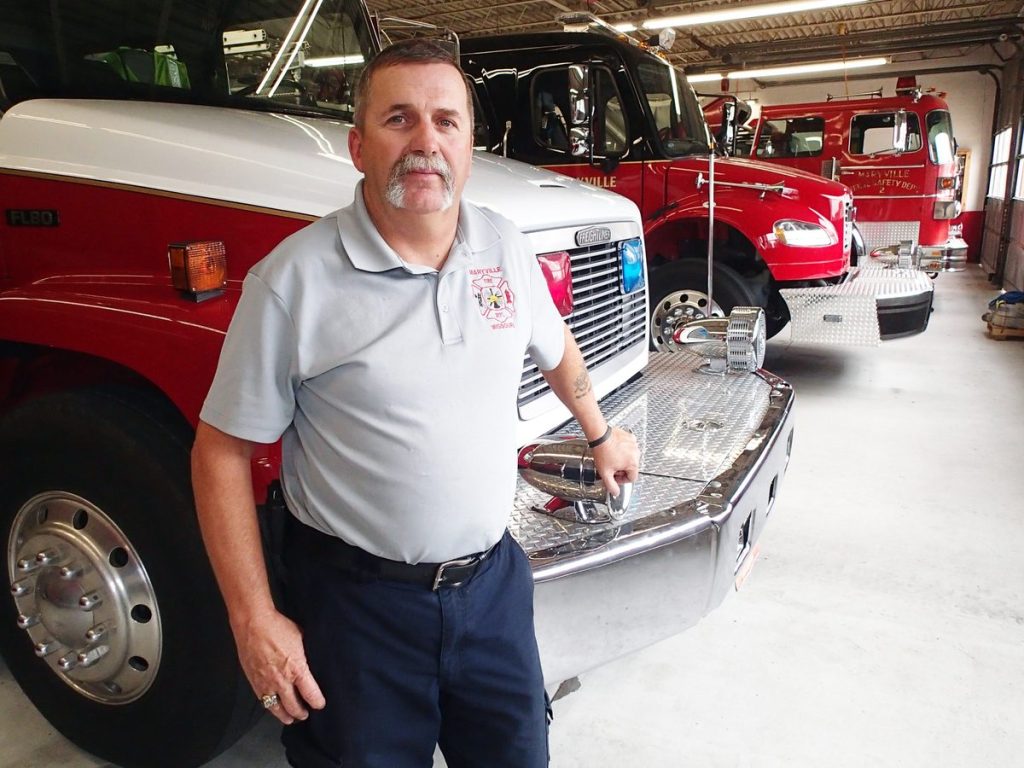
TONY BROWN/DAILY FORUM
Fifteen years later, Maryville Public Safety fire division Capt. Phil Rickabaugh said the terrorist attacks on New York City and Washington, D.C., on Sept. 11, 2001, changed forever the way firefighters feel about their profession and do their jobs. “It was an eye-opener for all the emergency services,” he said. “Before 9/11 I don’t think any of us were really prepared for the things we might have to face.” The attacks were and remain the deadliest episode for firefighters and law enforcement officers in the nation’s history, with 343 and 72 killed respectively.
Time, it seems, eases even the deepest and most heartfelt loss. And so this Sunday in Maryville is likely to be much like any other and nicer than most.
The sun is supposed to shine, and temperatures are forecast in the mid-70s — the kind of weather that is just about as perfect as weather ever gets in north Missouri.
Children will play in the parks, students will stroll across campus, and families will crank up backyard grills for perhaps the last time in the lazy post-Labor Day ambience of approaching autumn.
But for some, though the shock may be long faded, Sunday will sharpen a lingering sadness and offer a reminder of how the nation was plunged into a collective abyss of fury and grief exactly 15 years ago when a pair of pirated jetliners crashed into the World Trade Center towers in New York City.
A third terrorist-hijacked plane slammed into the Pentagon in Washington, D.C., while a fourth — also initially steered toward Washington — crashed into a field near Shanksville, Pennsylvania, after passengers tried to recapture the cockpit.
No one in any of the planes survived, and nearly 3,000 innocent people lost their lives, most of them in the dramatic collapse of the twin towers.
The attacks, as everyone now knows, were masterminded by Osama bin Laden, leader of the radical Islamic organization al-Qaeda. After evading capture for almost a decade, bin Laden was finally tracked down and killed by a team of U.S. Navy SEALs in May 2011.
For most Maryville residents, of course, whatever their level of outrage at the time, 9/11 was mostly a television event, something terrible that happened in an unfamiliar city hundreds of miles distant from the peaceful row-crop fields of Nodaway County.
But for a few — especially local police officers and firefighters — the carnage was deeply felt and personal.
9/11, after all, was and remains the deadliest episode for firefighters and law enforcement officers in the nation’s history, with 343 and 72 killed respectively.
“It was an eye-opener for all the emergency services,” Maryville Public Safety fire division Capt. Phil Rickabaugh said this week. “Before 9/11 I don’t think any of us were really prepared for the things we might have to face.”
In a physical sense, the years since that fateful September, Rickabaugh said, have been transformational for fire departments and other first-responder agencies nationwide, and in some respects that hasn’t been a bad thing.
During the interview for this story, Rickabaugh, who joined the Maryville fire department 31 years ago, picked up a thermal imaging device sitting on his desk. He explained that the gadget, which looks something like a digital camera, creates real-time images based on heat signatures. These images allow firefighters, for example, to see a human being laying on the floor in a smoke-filled room.
The device, purchased with funds allocated through the federal Assistance to Firefighters Act passed by Congress after 9/11, cost about $10,000 and represents the kind of technology that was generally unavailable to small-town departments before the attacks.
But more than funding and better gear, which in Maryville’s case has also included upgraded air tanks and turnout suits, 9/11 ushered in a new attitude with regard to the volunteers and professionals who answer the call in times of crisis.
“It has definitely changed public perception,” Rickabaugh said. “I think it gave people a greater appreciation for some of the risks that members of the fire service are willing to take.”
One of the things that haunts Rickabaugh about 9/11 is a thought he first had while watching television as members of the Fire Department of New York arrived at the feet of the smoking towers, two of the tallest buildings in the world.
“I think they saw those buildings and knew as they went in that there was probably a good chance they weren’t coming back out,” he said. “9/11 didn’t really change the way we do our business here, or even the way we think about doing it. But I do think it gave us some more situational awareness — more awareness about what’s going on around you both at a fire scene and for life in general.
“Who would ever have thought that could happen on U.S. soil?”
In addition to Rickabaugh, the Maryville Public Safety fire division includes professional firefighter Shawn Wiederholt, 20 Maryville volunteers, and 10 additional volunteers assigned to Polk Township.
While the contingent seldom fights large fires involving major structures, it does happen occasionally, and Rickabaugh said the lessons of 9/11 — both practical and emotional — are on everyone’s mind whenever a call comes in.
“There’s always the potential that it’s going to be dangerous,” he said, adding that since 9/11 a renewed emphasis on more and better training has reduced the likelihood of a firefighter death or severe injury.
Nevertheless, the veteran captain admits he always breathes a little easier — well, actually a lot easier — when the last tongue of flame flickers out and his people all leave the scene safely.
“It’s the best feeling in the world,” Rickabaugh said, “when everybody gets to come home at the end of an incident.”
Should there ever be another catastrophic fire in Maryville — the 1979 Administration Building blaze at Northwest Missouri State University comes to mind — Rickabaugh said he is certain, and maybe even a little afraid, that his people will respond with the same kind of courage and determination displayed by their FDNY counterparts 15 years ago.
Assuming that burden, that level of risk, he believes, is just something firefighters do.
“People say that firefighters are a brotherhood, and we are,” Rickabaugh said. “We look out for each other. To me, it’s just the greatest job in the world. It’s a position that’s still respected, still trusted. And it’s a cliché, but I think it’s true. You get to help people. You get to help someone on the worst day of their life.”
But as for the lessons and memories of 9/11, Rickabaugh said he still feels a core of sadness beneath his obvious pride in his profession.
“As a firefighter and as a citizen, I just hope people never forget,” he said. “We lost thousands of lives that day — and we’re still losing people over it.”