
Police urge counterfeit money awareness
TONY BROWN/DAILY FORUM
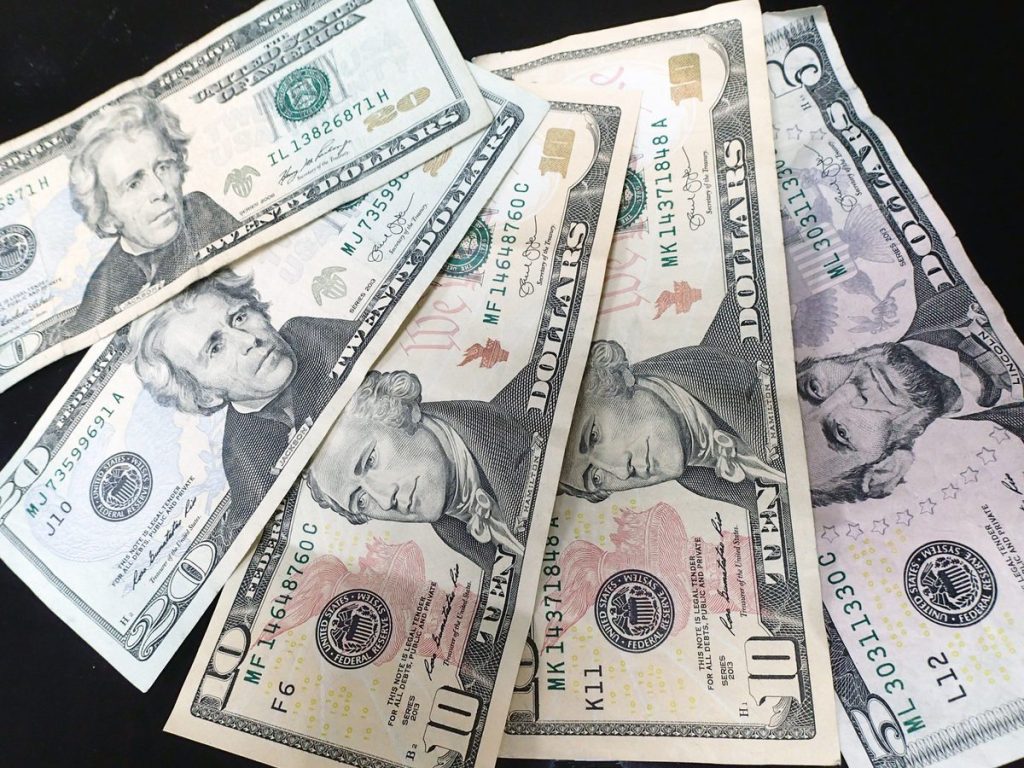
These bills are real, but some currency floating around Maryville may not be. Police are encouraging anyone who handles money to exercise heightened awareness after a pair of bogus $20 notes turned up over the weekend at a local fast food restaurant.
It’s a federal offense that comes to light in Maryville several times a year — and most recently last weekend. Someone prints and circulates bogus money, and the counterfeit bills turn up at a local business or in someone’s wallet.
And by the time the victim notices, the counterfeiter — if in fact he or she was ever here — is generally long gone.
But that doesn’t mean that employees, business owners, and other citizens who handle cash can’t protect themselves from getting duped.
The most recent incident involving counterfeit bills in Maryville occurred a few days ago when a customer at a fast-food restaurant used a $50 bill to pay for their order and received two fake twenties in return.
After the bad paper was discovered, the episode was reported to Maryville Public Safety, which notified the U.S. Secret Service, which is charged with tracking down counterfeiters nationwide and putting them out of business.
MPS Director Keith Wood said Tuesday that in many cases people who suspect they have received a bad bill can tell if the money is real or not simply by looking closely at the paper.
All genuine U.S. currency is printed on special stock embedded with tiny strands of red, green, and blue fiber. If the strands aren’t there, chances are excellent the money is bogus.
These days, Wood said, most counterfeiters are relatively unsophisticated and simply create facsimiles of real bills using a scanner, non-government paper, and a color printer, so the fiber test is going to work most of the time.
The police chief added, however, that some criminals are a little more subtle and use small-denomination bills — ones and fives — bleaching them to remove the ink and then running them through a high-quality printer in order to produce something that looks very much like a $50 or $100 note.
While fake bills, created by whatever method, are sometimes produced in quantity, Wood said there is no way to tell if the latest counterfeiting episode in Maryville was an isolated incident, or if a significant amount of bad currency is in local circulation.
Wood added that while he can’t recall any instances of large-scale counterfeiting in Maryville, the fact that two bills showed up at the same time is cause for concern, and he urged anyone handling cash to exercise increased vigilance.
“With the technology we have today, some of the printers produce pretty high quality stuff,” he said, noting that the era is long gone when counterfeiters painstakingly created hand-engraved plates then printed fake bills in ink using sophisticated presses costing thousands of dollars.
By comparison, today’s counterfeiter is usually a low-level criminal looking to make a few bogus purchases or exchange a few clumsily reproduced notes for legal tender.
But whether funny money takes the form of a crude copy or is expertly produced by a mastermind, whoever accepts it gets equally ripped off.
For details about how to detect counterfeit bills, go to uscurrency.gov. In addition, the Secret Service offers these tips:
• Hold bills up to a light and look for a holograph of the face, which should match the denomination. If a $5 has been bleached and turned into a facsimile $100 note, the hologram will show an image of Abraham Lincoln instead of Benjamin Franklin.
Also, looking at the bill against a light will reveal a thin vertical strip containing text that spells out the bill’s value.
• Tilt bills (except the $5 note) back and forth and observe the numeral in the lower right hand corner as it shifts color from green to black.
• Hold bills up to a light to view the watermark in the unprinted space to the right of the portrait. The watermark can be seen from both sides of the bill since it is imbedded in the paper.
Illumination will also reveal the security thread, a thin imbedded strip running from top to bottom on the face of a banknote. On the ten and fifty the security strip is located to the right of the portrait. On the five, twenty, and hundred it is located just to the left.
• If a bill is held up to an ultraviolet light, the $5 bill glows blue; the $10 bill glows orange, the $20 bill glows green, the $50 bill glows yellow, and the $100 bill glows red — if they’re real.
• Look for microprinting on the security threads. The $5 bill has “USA FIVE” written on the thread and so forth.
• Finally, compare the texture of the paper with bills you know are authentic. If the paper feels different, the suspect note is likely fake.
If you believe you have received a counterfeit bill, the Secret Service advises, do not put yourself in danger, and do not return the bill to the passer. Rather, delay the passer with some excuse, if possible, and try to get a description or license plate number. Then call the police.
Do not handle a counterfeit note more than absolutely necessary. Place it in a plastic bag or envelope and hand it directly to a police officer or federal agent.
Local counterfeit victims can call Maryville Public Safety at 660-562-3209.




