City aids humane shelter with washer, dryer purchase
TONY BROWN/DAILY FORUM
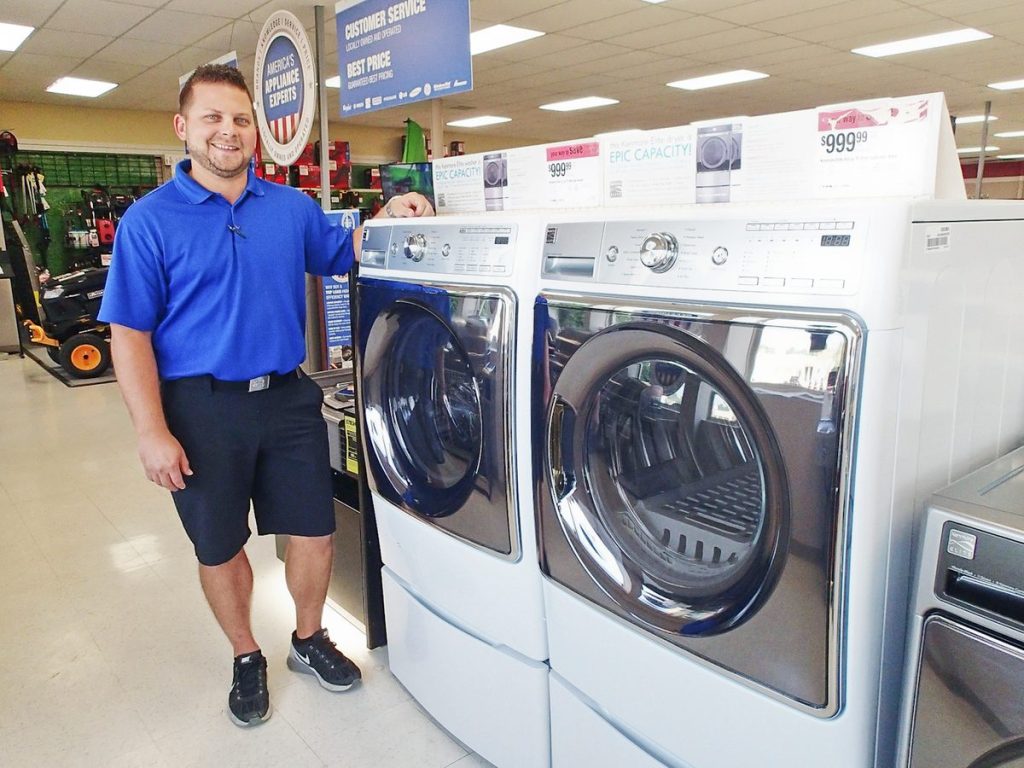
Maryville Sears store owner Ryan Gessert stands beside a large-capacity washer and dryer set purchased by the City of Maryville this week in order to replace a set of aging appliances that quit working over the weekend at the New Nodaway Humane Society animal shelter. The new machines, which were to be delivered to the shelter this morning, will significantly cut water and electricity usage while boosting capacity. Laundry is a constant chore at the shelter, where bedding, blankets, towels, and other items must be washed daily.
The Facebook plea that went out Sunday afternoon from the New Nodaway Humane Society animal shelter in Maryville contained what can only be described as a note of desperation.
“Our washer has quit spinning and draining properly. Also, in the same weekend, our dryer has quit heating and drying efficiently. For those who don’t know, the shelter goes through a lot of laundry!
“Over just the weekend we now have a mountain pile of probably 10 or more loads of dirty laundry! We are reaching out to the community to see if anyone has a working washer and/or dryer that they would like to donate to (the) New Nodaway Humane Society.”
It didn’t take long for the request to net a couple of offers for in-kind donations, but in the end, it was the City of Maryville and the local Sears store on South Main Street that stepped up to the plate.
After checking the city’s cash reserves for what little remains of the fiscal year, which ends Sept. 30, then touching base with members of the City Council, Maryville City Manager Greg McDanel decided purchasing a new washer and dryer for the no-kill shelter, which provides local animal control services, was the right thing to do.
McDanel then reached out to Sears owner Ryan Gessert and made arrangements to get shelter staff back on laundry duty as quickly as possible.
The upshot is that a new high-capacity, front-loading, energy efficient Kenmore washer and dryer set was to be delivered to the shelter, located near the south city limits on South Depot Street, sometime around 10 a.m. today.
Gessert, who discounted both machines, also threw in a smaller GE dryer at no charge. The appliance arrived at his store from the factory with a superficial defect and can’t be sold. However, the machine’s efficiency and capacity is unaffected, meaning the shelter now has a fully functional spare appliance should mechanical problems take its primary dryer offline.
After learning of the shelter’s plight, McDanel said he met with shelter staff on site and determined that getting its laundry operation up and running again was something that couldn’t wait.
“They have a lot of bedding, towels, and blankets that have to be laundered every single day,” he said, adding that the $2,500 or so needed to purchase and deliver the three new machines is within his office’s discretionary spending limit, which is set by the council.
Purchasing a new washer and dryer for the shelter, McDanel said, aligns with existing municipal policy, since when the council approved $60,000 at the beginning of the current fiscal year for shelter operations — a decrease of $20,000 from the year before — it also recommended assisting the facility, when practical, with any special needs or emergencies.
While not technically commercial machines, Gessert said the new washer and dryer are top-of-line products that will significantly increase the shelter’s laundry capacity. Heretofore, the facility had been using smaller appliances designed strictly for domestic use.
The new dryer can handle up to 9 cubic feet of laundry, Gessert said, and the washing machine a maximum of 5.2 cubic feet. Capacity for the spare dryer is rated at 6.8 cubic feet.
All three machines will save the Humane Society money by cutting down on electricity consumption. The washing machine also uses a lot less water than the old-style top-loader machines found in most homes only a few years ago.
Water used by the shelter is provided by the city at no charge but still represents an expense to taxpayers, since the cost is borne by businesses and homeowners who pay water/sewer bills each month.
Gessert said the shelter’s new washing machine uses about 16 gallons of water per 5.2 cubic-foot load, and that a traditional agitator machine needs between 50 and 60 gallons to cleanse 3.2 cubic feet of fabric.
While the city’s purchase of the washer and dryer will allow the shelter to function more efficiently and save a little money, it won’t do much to ease the society’s ongoing financial crunch.
Earlier this month, society board member Ray Courter requested restoration of the city’s 2015 funding level of $80,000 in the face of a projected $17,000 shelter deficit.
In making the request, Courter emphasized the shelter’s economic impact on Maryville, noting that the organization pays more than $100,000 in wages while purchasing $28,000 in veterinary services and $2,500 worth of supplies annually.
Local spending by the shelter, he said, totals around $140,000, which doesn’t count a similar positive economic impact created by pet owners who adopt animals.
Courter claimed the shelter facilitated 258 local adoptions over the past year, and that those owners spend an average of nearly $600 on their pets every 12 months, an investment representing $150,000 worth of economic activity.
In addition, he said, the shelter has been a good steward of public funds, having reduced expenses nearly $20,000 last year, when spending totaled $239,099 compared to $258,585 in 2014-2015.
However, for the second year in a row City Hall is looking at a tight budget for 2017 as revenue from a half-cent capital improvement sales tax levy, which sunsets in Sept. 2018, nears exhaustion.
While the sales tax produces something like a half-million dollars a year, most of that is obligated for debt service related to earlier expenditures such as street reconstructions and water and sewer system improvements.
McDanel said Monday that shelter funding, along with other proposed 2017 spending, is still under discussion. The City Council is expected to approve a new city budget in late September.