City Council unlocks budget goals for 2017
TONY BROWN/DAILY FORUM
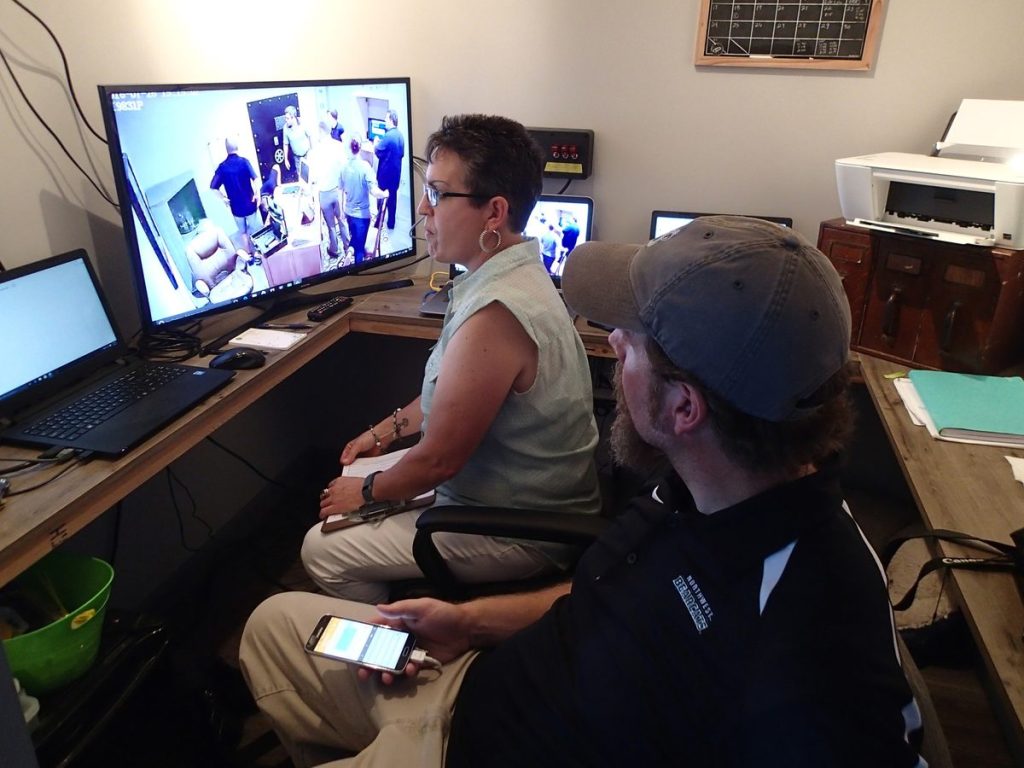
Dee Dino and Jeremy Baumli, owners of the Encryption escape game business at 422 N. Main St., use video monitors Tuesday to watch members of the Maryville City Council and municipal staff search for clues that ultimately allowed them to leave a locked chamber by punching in the correct keypad code. The team-building exercise preceded a two-hour special session at City Hall during which the council set priorities for the 2016-2017 fiscal year.
After indulging in some light-hearted team building — and taking a little less than an hour to make their getaway from the Encryption escape-game chamber a block west of City Hall — the Maryville City Council put on its collective thinking cap Tuesday during an extended special session that marked the beginning of this summer’s 2016-2017 budget planning process.
City Manager Greg McDanel said the visit to Encryption, a recreation-oriented business opened this earlier this year by local residents Jeremy Baumli and Dee Dino, was a good way to spotlight an enterprise established with the help of grant funding through Nodaway County Economic Development.
“We thought this was a great opportunity to help promote a local business with the council and staff,” said McDanel, who along with City Clerk Sheila Smail and Assistant City Manager Ryan Heiland helped the five-member governing board make its escape from a locked room by finding a hidden bar of (fake) gold and cracking a key-punch code needed to release the deadbolt.
Then, after the game was over, it was time to return to City Hall and start solving far more complex problems related to allocating millions of dollars in tax money that will be used to pay for municipal services and infrastructure.
Maryville’s fiscal year begins Oct. 1, and the council is expected to approve a new spending blueprint totaling between $25 million and $30 million during its regular session on Monday, Sept 26.
Between now and then several study sessions and workshops will take place, each designed to provide municipal staff with direction on how best to achieve a half-dozen broad goals hammered out during this week’s meeting.
Those objectives include implementing phase-one improvements along the South Main traffic corridor between South Avenue and the north entrance to Wal-Mart in an effort to ease traffic flow and increase pedestrian access.
The project, which is expected to cost more than $3.5 million, is part of a larger effort to transform the entire corridor into a boulevard-like trafficway that will add landscaping, sidewalks, aligned curb cuts, storm-water drainage improvements, and other features between South Avenue and the Kawasaki Motors manufacturing plant.
In addition to city funds, McDanel has applied for a grant in support of phase one that, if approved, would provide nearly $1 million through the Missouri Department of Transportation’s new Missouri Moves initiative.
McDanel said detailed planning for South Main does not currently extend beyond phase one, and that completing work along the entire corridor could take 20 years or more and cost at least $12 million.
A key piece in moving forward with a revamped south-end strip involves the council’s second major goal for fiscal 2016-2017: mounting a successful campaign for voter renewal, probably in April 2017, of the city’s half-cent-on-the-dollar capital improvement sales tax.
The tax, which sunsets in September 2018 after 10 years on the books, brings in about $1 million annually and has been used over the past decade for such large-scale projects as the construction of permanent concrete streets, including South Munn Avenue and South Depot. Revenues have also paid for major equipment purchases, such as a new fire truck and the city’s share of a wildfire “brush truck” co-owned with Polk Township.
McDanel said remaining discretionary revenue from the tax will be limited to around $100,000 over the coming year since most of the proceeds are earmarked for servicing debt acquired to carry out past projects.
In addition to continued asphalt street overlays, the South Main project, and more efforts to reduce storm water infiltration into the sanitary sewer system, capital spending on the horizon includes the purchase of a new ladder truck for Maryville Public Safety’s fire division, which MPS Director Keith Wood said carries an estimated cost of $1.25 million.
Besides pledging to sell voters on the importance of renewing the capital improvements levy, the council also directed McDanel and his staff to continue discussions with local leaders about the possibility of implementing a “transient guest tax.”
Sometime referred to as a bed tax, the measure would create a surcharge on hotel bills that, in many communities, is used to foster economic development related to tourism and other destination-oriented business.
The third goal adopted by the council calls for the maintenance and improvement of city infrastructure with a continued emphasis on streets and water/sewer service. In order to spend infrastructure funds and other capital projects money more efficiently, McDanel has proposed compiling a rolling five-year capital improvements plan that would be reviewed annually and revised as needed.
A fourth goal for fiscal 2017 involves addressing staff salary and professional development issues, including striking some sort of policy balance between cost-of-living wage increases and merit pay. Another concern is the impact of new federal wage and hour legislation that goes into effect in January, which McDanel said could affect whether some city workers are classed as hourly or salaried employees.
Turning to Mozingo Lake Recreation Park, the council directed staff to continue implementation of the lake’s master plan with an emphasis on maintenance next year as opposed to development. Though the decision has yet to be made, that could mean delaying construction of a proposed “welcome center” near the park’s main entrance in favor of continuing efforts to line portions of the lake’s 25-mile shoreline with rock.
Councilman Jerry Riggs said such anti-erosion efforts are crucial to ensuring that Monzingo continues to adequately fulfill its primary function as the city’s source of drinking water. He added that erosion control is a top goal of the Mozingo Lake Advisory Board.
Finally, at the urging of McDanel and Wood, the council dedicated itself in 2016-2017 to coming up with financing and construction plans for a new police and fire division headquarters.
McDanel said constructing the headquarters is “one of staff’s top priorities” and could cost $4 million or more.
He said paying for the structure will likely require voter approval of a bond issue with the debt to be repaid from capital improvement sales tax revenues, assuming citizens renew the tax this spring or in some subsequent election.
The existing police-fire building, located at 222 E. Third St., was the subject of a “facility needs assessment” completed earlier this year by North Kansas City architectural firm of Williams, Spurgeon, Kuhl, and Freshnock, which noted a severe lack of space along with deficiencies associated with security, equipment storage, and fire truck access.
Public Safety has been housed in the structure, a converted grocery store built in the mid-1960s, since 1976.
TONY BROWN/DAILY FORUM
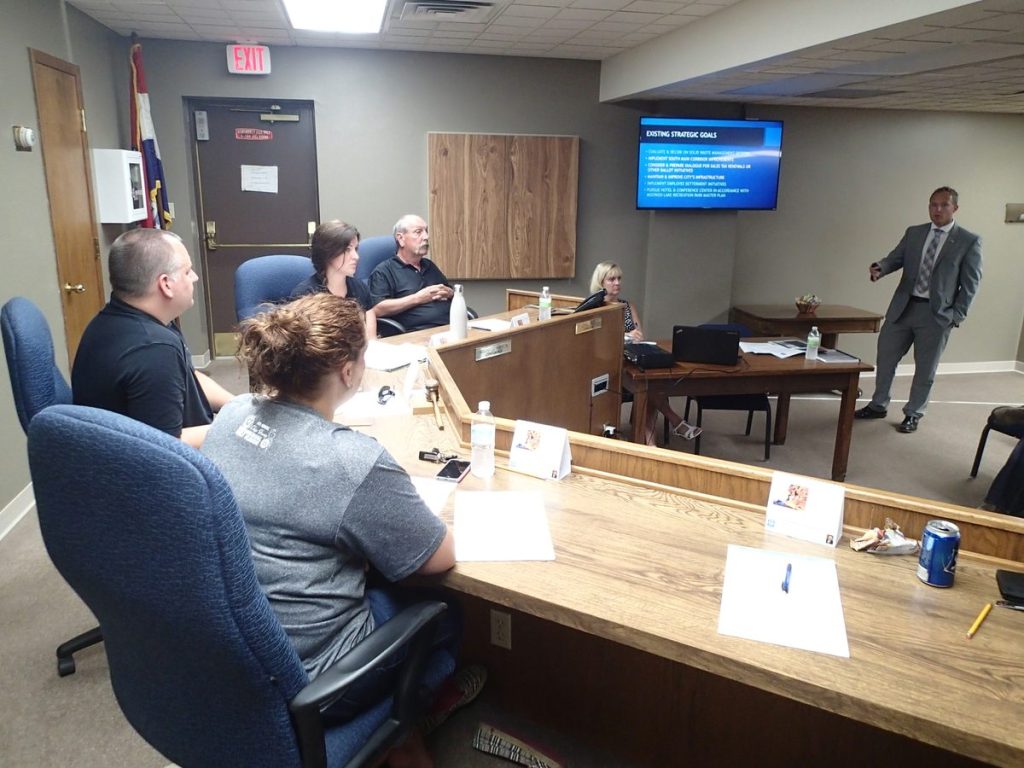
Members of the Maryville City Council listen to comments by City Manager Greg McDanel near the start of Tuesday night’s goal-setting session, during which the governing board set overall priorities that will guide this summer’s budget process. Maryville’s fiscal year begins Oct. 1, and the council is expected to approve a new spending blueprint totaling between $25 million and $30 million during its regular session on Monday, Sept 26.