Maryville native Hatfield roped into rodeo as child


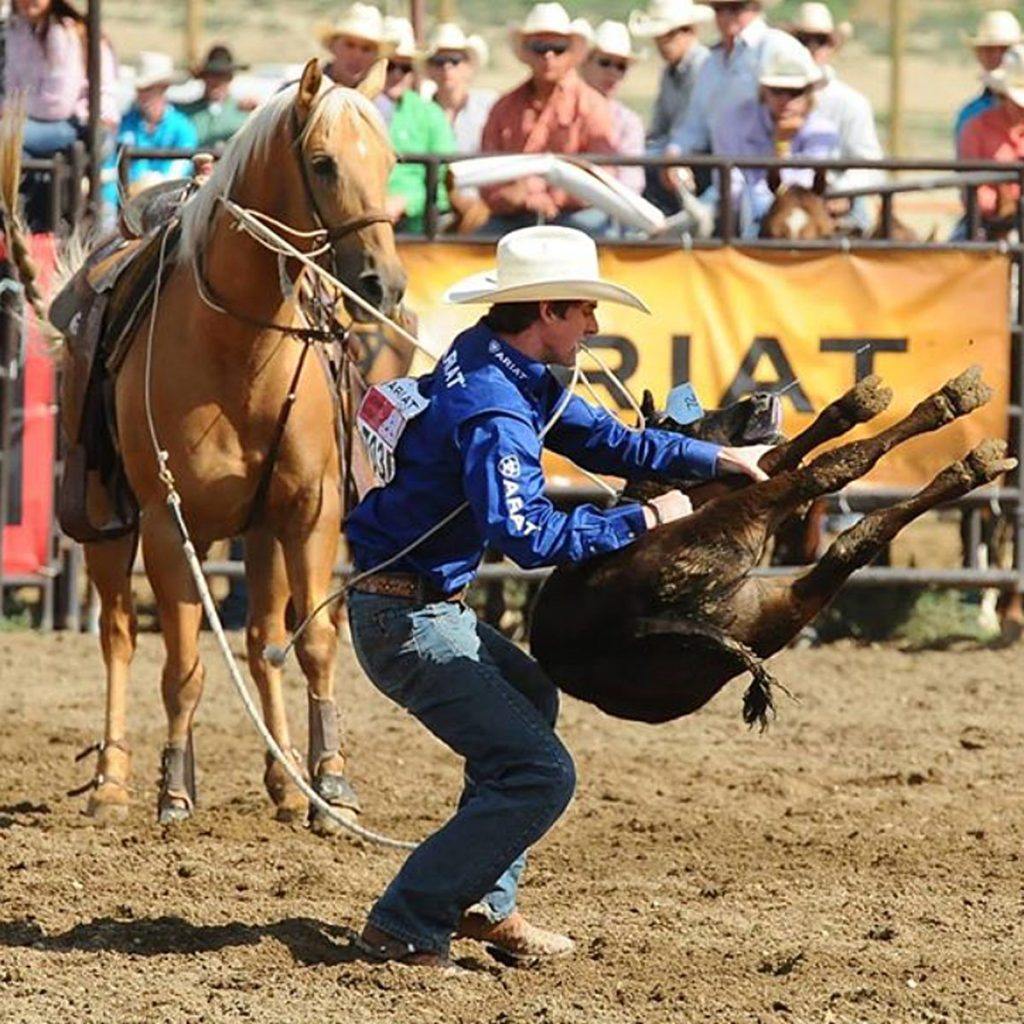
Maryville native Henry Hatfield competes in a calf roping event during the high school national rodeo competition his junior year. The event takes place in Rock Springs, Wyoming.
By DAVID MERRILL
Sports Editor
FORT SCOTT, Kan.— After spending his freshman year of college at Missouri Valley College, Maryville High School graduate Henry Hatfield transferred to Fort Scott Community College in Kansas to continue his rodeo career.
The team and calf roper got hooked on the sport by the time he was 6 years old.
As he grew older, he spent summers in Cleveland, Missouri with an experienced roper and also received training from Roy Durfee — one of the best calf ropers and tie down ropers (horses) in the country.
He qualified for the National High School Finals Rodeo six years straight — two years in junior high and all four years of high school.
As a junior. he finished 10th in the national standings in calf roping.
“It’s just something I fell in love with and I kept at it as I got older,” Hatfield said.
There are plenty of events for a cowboy to choose from, but he stuck to the roping events to for two very clear reasons.
“I was never big enough to steer wrestle and I was never dumb enough to ride a bull, so I figured those two events would be the best fit for me,” Hatfield said.
While the bull riders get most of the glory (and seemingly the most dates), calf roping and team roping come with their own sets of challenges.
One of the more difficult parts about calf roping is the fact that there is so much that is out of the competitor’s control.
“Anything in rodeo, for the most part is 70 percent luck and 30 percent skill,” Hatfield said. “A lot of it is the luck of the draw on the animal. Sometimes they just don’t cooperate.”
Team roping is comprised of the “header,” in which one rider attempts to lasso the head of the calf, and the “heeler,” in which his teammate tries to rope the legs of the calf by the heel.
Teammates determine which one will be the header or the heeler based on experience and skill.
Both parts take a great amount of practice (Hatfield tries to work on his roping every day when he’s not competing), but roping the heel takes even more skill due to it being a smaller target.
It isn’t just the uncertainty inside the ring that challenges rodeo athletes, there is financial burden as well.
In most of the smaller circuit rodeos, sponsorships are hard to come by, so the care of the horses, the equipment as well as the event entry fees fall on the cowboys or cowgirls themselves.
This is part of the reason that Hatfield decided to transfer from MVC.
“This past season, I drove probably 12,000 miles just competing in rodeo events,” he said. “With Fort Scott, I’m on a different circuit, so we only compete in rodeos in Kansas and Oklahoma.”
Hatfield estimates that he spent over $4,000 on all expenses last season and only won about half of it back.
The obstacles don’t stop there. There’s also the matter of keeping up with coursework.
The solution to that is simple for Hatfield.
“You just don’t sleep a lot,” he said. “That and you just go get help with it and try to get caught up whenver you can. It’s really tough.”
Zach Oestmann, his most recent team roping partner, said Hatfield has the right personality for what it takes to be successful in rodeo.
“He’s really competitive in and out of the ring,” Oestmann said. “In the same breath he’s a really nice guy, a good sport and he’s never mean to anybody.”
During the summer months, when school is not a factor, Hatfield estimates he competes in 60 rodeos over a three-month span.
Once college is over, Hatfield doesn’t plan on trying to make a career out of rodeo.
He will instead help on the family ranch and with the family business — Hatfield Signature Beef Company.