County staff reviews active-shooter strategies
TONY BROWN/DAILY FORUM
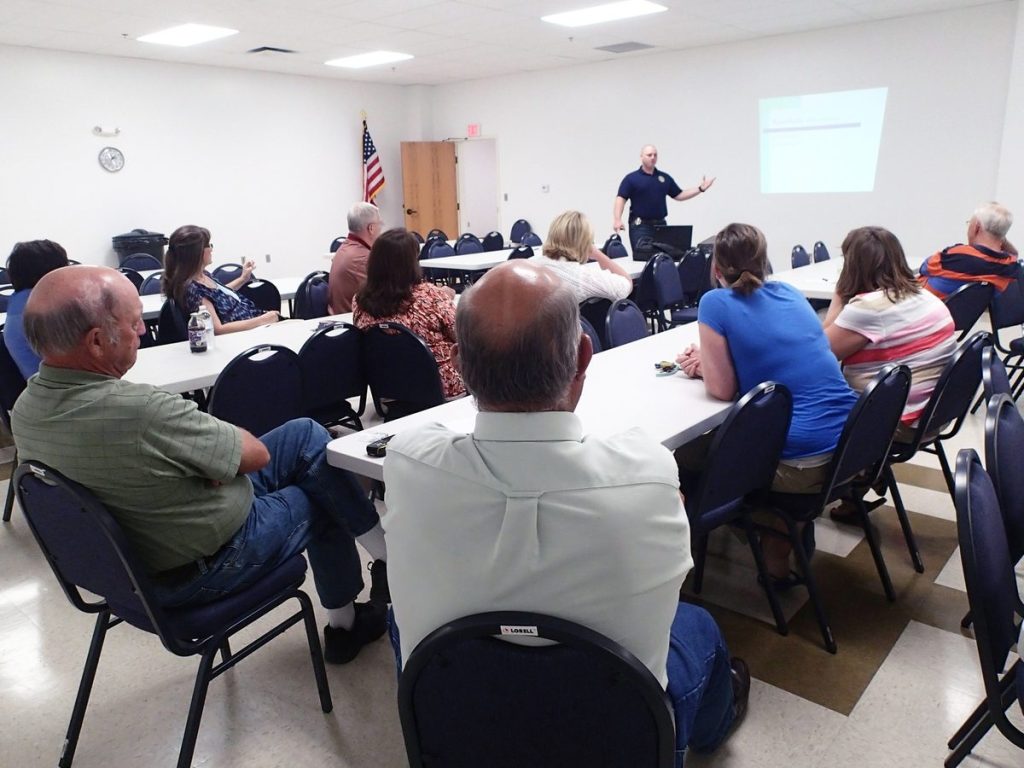
Deputy Sheriff Austin Hann talks to county employees and elected officials this week during a “violent intruder” presentation covering strategies for responding to a mass shooting or other criminal attack at the courthouse or Nodaway County Administration Center across the street. “You’re going to rise to the level of your training,” said Hann in urging the county to come up with a plan for dealing with an active-shooter scenario. “Not being prepared is having a plan to fail.”
At a time when the news media seems to report a fresh outbreak of gun violence almost daily, county employees and elected officials gathered at the Nodaway County Administration Center this week for a lesson on how to respond when the worst thing that can happen does.
The “violent intruder” session was led by Deputy Sheriff Austin Hann, who has been giving similar talks to area teachers and school administrators.
Hann developed the lecture after attending a workshop for peace officers and educators in Kansas City. While he’s become well versed in the theory and tactics associated with mass-shooter response, he warned county staffers that the only real certainty in such a situation is that the unexpected will almost certainly happen.
Which is why Hann said it’s important both to study mass attacks and constantly modify the strategies used to deal with them.
“These events are all different,” he said, “so every event allows us to learn something different.”
Just because such knowledge is useful, however, doesn’t mean it’s not grim.
The average “active shooter” episode lasts 12 minutes, Hann said, explaining that in the twisted mind of a mass murderer seconds are precious because the goal is to “get the most kills and have their name in the news.”
“These people want to cause the highest amount of death possible,” he said, explaining that anything one can do to slow the killer down, such as blocking a doorway with chairs and desks, can be surprisingly effective.
Shooters, Hann said, will sometimes just walk away from such barricades if they prevent him from taking life as quickly as possible.
By way of offering insight into how a mass killer thinks, Hann displayed a note written by Dylan Klebold, who along with classmate Eric Harris, killed 13 people during the Columbine (Colorado) High School massacre in 1999.
“Drive to clemete (Clement) Park. Gearup,” Klebold wrote. “Get back by 11:15. Park cars. Set car bombs for 11:18. Get out, go to outside hill, wait. When first bombs go off, attack. Have fun!”
Hann said people who commit mass shootings are themselves frequent victims of bullying or abuse and usually harbor deep resentments. This can result in odd, even bizarre, behavior that ought to serve as a red flag. Still, for whatever reasons, such signals are often ignored until it’s too late.
Seung-Hui Cho, for example, who killed 32 people in 2007 at Virginia Polytechnic Institute and State University, was known to go to a gun range and place targets on the ground, shooting at them as he walked past.
“People saw that and thought it was weird,” Hann said, “but the information never got to law enforcement.”
The deputy went on to say that one mistaken belief — perhaps more of a mistaken hope — is that random violence will probably take place someplace else.
But active-shooter scenarios can occur anywhere at any time, Hann said, including Nodaway County, where on June 10, 2002, a man named Lloyd Robert Jeffress carried a couple of rifles into the Conception Abbey monastery, where he killed two monks and wounded a third before turning one of the guns on himself.
Revisiting such tragedies is not pleasant, Hann said, but it’s a necessary exercise because the best way to avoid, or at least lessen, tragedy is to prepare for it.
“You’re going to rise to the level of your training,” he said. “Not being prepared is having a plan to fail.”
Close analysis of mass shootings has led to a number of improved procedures and responses, said Hann, who noted that new strategies are evolving all the time, some of them quite simple.
One trick is to apply a magnetic strip over the latch bolt of a doorknob, which remains set in the locked position.
The strip keeps the latch bolt from entering the slot so people can walk in and out of the room. In the event of an active shooter alert, however, the strip is removed, instantly locking the door from the inside.
In addition to the development of such gadgetry, Hann said the sheer number of mass shootings in the United States has led to a gradual shift in philosophy. Peace officers used to tell people to take “shelter in place” during an attack, which essentially means hide and wait for the police.
While this can be effective, Hann said, such responses have been linked to higher casualty rates in cases where the killer finds a way to breach the shelter, say a door or a desk, often by simply shooting through it.
More common these days, he said, is the “run, hide, fight” protocol, which encourages people to flee danger when possible but acknowledges that resisting sometimes boosts the odds of survival.
If one makes the decision to fight, Hann said, it’s important not to fight fair. Use any weapon, he urged. Pick up a pair of scissors, or a letter opener or a pen, and wield it viciously. Act like you’re fighting for your life, because you are.
On other fronts, the deputy said, people need to think beforehand about how to respond to police when they arrive on the scene.
Never under any circumstances, Hann said, run toward officers. Doing so can cause a couple of things to happen, neither of them good. First, police may assume you’re attacking them. Second, you can inadvertently place yourself between officers and the shooter. This gives the shooter two targets instead of one while blocking the officer’s field of fire.
Another scenario involves civilians who may be legally carrying concealed weapons. If you’re armed and an active-shooter episode unfolds, Hann said, do not try to communicate with officers while holding a gun.
Also, as officers work the scene, expect to be stopped, frisked, placed on the ground, and handcuffed. Do not argue with officers, Hann said, and do exactly what they tell you to do.
Finally, if possible, and if you have the know-how, be prepared to render first aid, since police are trained not to assist anyone who is wounded until the shooter is taken or killed.
“Their only job is to stop the shooter and lower the body count,” Hann said.
While experiencing a mass-shooting event may be unthinkable, Hann closed his presentation by urging his listeners to do just that.
Such attacks are “fluid, ever-changing events,” he said, but the best response is to have a plan in place that has been reinforced by the training necessary to carry it out.
“The body can’t go anyplace that the mind hasn’t already been,” Hann said.