Rice vows to crack down on violence against officers
TONY BROWN/DAILY FORUM
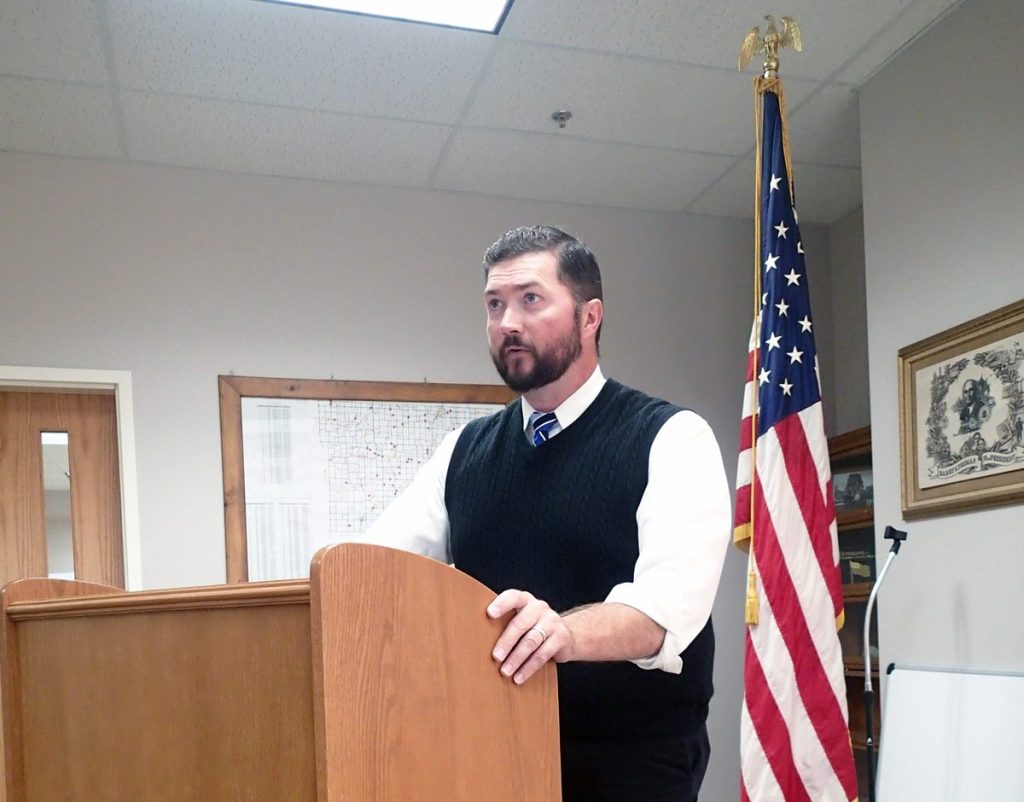
Nodaway County Prosecuting Attorney Robert Rice speaks Wednesday during a press conference at which he announced a new, tougher policy with regard to offenders who issue threats or commit acts of violence directed at peace officers. Even minor assaults, such as a drunk belching in an officer’s face, he said, will now be treated “as if they were hate crimes.”
During a press conference Wednesday at the Nodaway County Administration Center, Prosecuting Attorney Robert Rice declared that he intends to treat all violent offenses directed at law enforcement officers — including verbal insults and other misdemeanors — as if they were hate crimes.
As a practical matter, Rice admitted filing hate-crime charges in all such cases isn’t feasible, since Missouri statute limits the scope of those offenses, categorized as Class D felonies, to acts motivated by race, color, religion, national origin, sex, sexual orientation, and disability.
However, Rice said, state law also extends special protections to peace officers and sets forth tougher penalties for offenders convicted of assaulting them or otherwise trying to do them harm.
So in seeking convictions of criminals who even hint at threatening officers, Rice said, his policy henceforth will be to prosecute to the limit of his statutory authority.
Asked to clarify the policy, Rice said it is now the stated intention of his office to prosecute all offenses, no matter how minor, directed against police, deputies, jail guards, state troopers, corrections personnel, and others wearing a badge and to ask the court for the harshest possible sentences.
And if he feels the hate-crime standard can be met, Rice said he plans to invoke it.
The prosecutor said he decided to speak out on crimes against officers in response to a series of episodes in several states, including Missouri, in which officers have been killed or wounded.
He cited the July 7 rampage by a lone gunman in Dallas, Texas, which claimed the lives of five officers, and a similar attack on July 17 in Baton Rouge, Louisiana, during which two policemen and a sheriff’s deputy lost their lives.
Two other recent outbreaks of gun violence directed at police have taken place in Missouri and Kansas.
The day after the Dallas tragedy, Ballwin Police Officer Mike Flamion was shot in the back and paralyzed from the neck down while conducting a traffic stop. Then on Tuesday, Kansas City, Kansas, police Capt. Robert Melton was fatally wounded while trying to apprehend a suspect wanted in connection with a drive-by shooting.
Rice, who was elected Nodaway County prosecutor in 2010, said that during his tenure local officers have been bitten, spit on, and punched.
“One suffered broken ribs, and two officers were intentionally struck by a car,” he said.
Rice continued: “I am saddened and angered with the events unfolding against our law enforcement officials. As I monitor the events throughout the nation, it seems to me that there are organized calls for violence against police. This call for violence requires a strong, unequivocal, and consistent response from national and state leaders.
“Yet, as I look, those national and state leaders seemingly justify or excuse such aggression to our police. I am disappointed in those national and state leaders. With certain individuals’ defiance or violence against police seemingly deemed acceptable, others now feel they can do the same.”
Rice declined to name the specific officials he perceives as failing to adequately support law enforcement, saying only that he is concerned by what appears to be a tendency by some in public life to blame police for an atmosphere of distrust and anger.
While some calling the actions of police into question may be acting from “altruistic” motives, Rice said, others are “malicious” and intentionally working to “organize efforts that call for violence against law enforcement officers” based on “the color of their skin or the badge they wear or both.”
“This has weighed heavily on my heart, and I decided that it was time to do something” Rice said.
While the events in Dallas, Baton Rouge, and elsewhere have carried distinctly racial overtones, Rice said violence directed against local police and deputies is mostly carried out by offenders involved with or under the influence of drugs and alcohol.
But regardless of the underlying cause, Rice said he is no longer prepared to tolerate anyone whose actions constitute even minor infractions approaching the boundary of physical and verbal assault.
While offenders may be impaired or inebriated to the point they are not fully responsible for their actions, Rice said, they have still made the decision to do drugs or drink too much and should be held accountable.
“Whenever someone hurts or threatens an officer, there has to be a consequence for that,” he said.
“It is my duty as a prosecutor to make sure (peace officers) return home safe to their families after their shift. Therefore in response to violence against police I am announcing any act of violence toward our local law enforcement agencies, however slight, will be treated as if it is a hate crime.”
Rice added that the new, tougher stance embraces “anything from a drunk that belches on an officer to those that would lift a fist or worse,” and means that he will make “every effort” to ensure that offenders “serve a maximum punishment.”
In formulating the policy, Rice said he has not sought feedback from his fellow northwest Missouri prosecutors with regard to its practicality but is acting from a sense of “moral obligation.”
“The violence against police will stop, and it will stop right now,” he said.