
Local Pizza Ranch owner working to lessen concussions for athletes
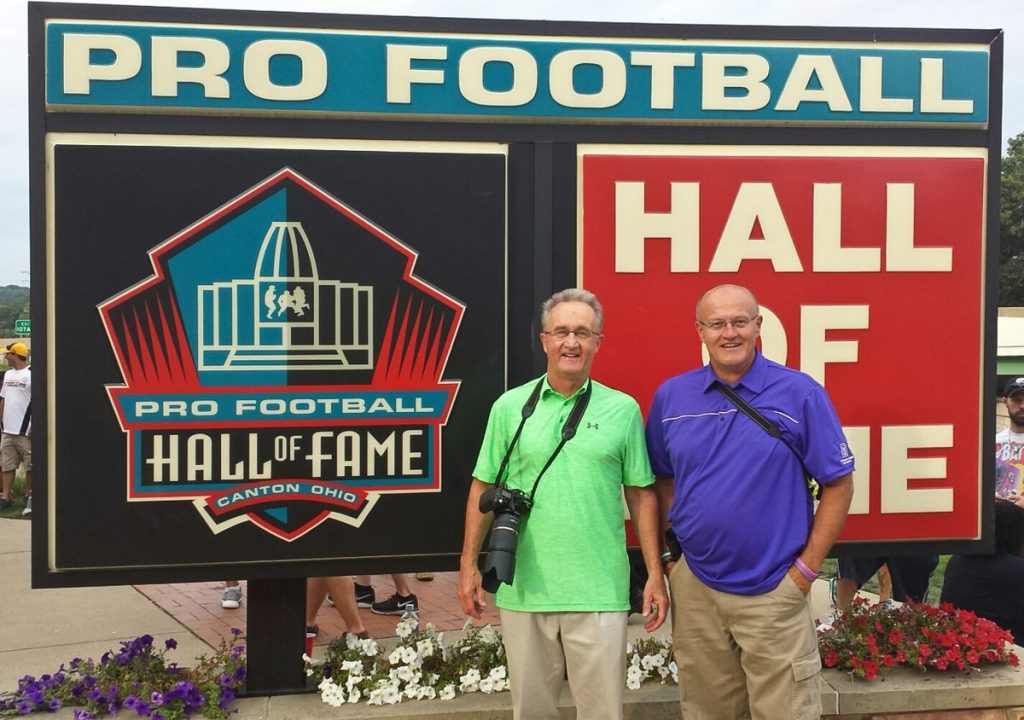
Jerry Janson and Kim Baker
Maryville Pizza Ranch owner Kim Baker, along with business partner Jerry Janson and members of Cross Over LLC at Iowa State University are in the process of designing material for football helmets that could lower the impact on the brain during hits.
In the testing stages, this material has shown great progress in dispersing helmet impacts away from the brain, reducing blows to the brain that could lead to concussions, or long-term damage to the brain.
“Jerry and I both played the game of football for a long time, and he has gone on to coach the Ohio Buckeyes so we are both familiar with the game,” Baker said. “We have made a lot of contacts and friends with current and former (National Football League) players, some of whom face long-term effects of brain injuries from the game.”
The game of football has always been thought of as the sport for tough guys, but in recent years it has come to light that even the tough guys can face long-term injuries from the game.
Chronic traumatic encephalopathy (CTE), formally known as dementia pugilistica, is a degenerative disease found in those who have had a severe blow, or repeated blows, to the head. Football players are known for having this type of condition along with athletes in rugby, ice hockey, boxing, professional wrestling, bull riding, and rodeo.
For a while, CTE could only be found in postmortem testing. NFL greats such as Mike Webster, Terry Long, Andre Waters, Justin Strzelczyk, and Tom McHale all had tests done by those in the Brain Injury Research Institute which found signs of CTE. Such diagnosis has recently been linked to domestic violence.
In December 2012 when Kansas City Chiefs linebacker Jovan Belcher killed his girlfriend and himself, CTE was looked to as the leading cause of Belcher’s behaviors leading up to the incident. Two years later it was confirmed that he suffered from CTE.
In 2013, the NFL reached a settlement with over 4,500 players or their families for damages caused by head trauma.
For Baker and his group researching head injuries and how to avoid them, the problem needs to be fixed at the younger levels to make the game safe for them first.
“When we first began looking into this situation, we talked to a number of our friends who played football in college and in the NFL,” Baker said. “Nearly every single one of them said they would never let their children play football because of the damage to the body and brain. We’re at a time where the game of football is at an all-time popularity high, but we’re seeing the lowest participation numbers at the youth level. That’s because parents are being made aware of dangers like head trauma.”
Baker said the difference between their research on helmet safety goes further than most because they are studying the brain and how it’s impacted during both big and repetitive hits.
“There are three types of concussions that athletes face which include large concussive blows, repetitive sub-concussive blows, and rotational blows,” Janson said. “If you take even the best helmets today, and we’re currently testing with all of them in our research lab, you feel vibrations on the head when you hit those helmets and that can’t be good for the brain. In our research, we are trying to look at all three types of impacts on the brain and how we can limit their impact on the brain.”
Baker described the material they use as Kevlar-like that is soft, yet durable in all types of conditions. And so far in their research, the material is achieving the results Baker and Janson were hoping for.
“We have a number of materials that we are using and have been happy with a number of them, and some of them are reducing the vibrations from those big and small impacts like what we’re looking for,” Baker said. “We’ve got to be able to disperse the energy so you can defend a heavy blow, but you also have to make sure you avoid any vibrations on the brain that can cause sub-concussive damage.”
Janson said that lineman are notorious for brain trauma even though they rarely receive concussion-like blows to the head because of the constant vibrations from the sub-concussive impacts they make in every play in a game or in practice.
Baker said that once a prototype is developed, it must go through rigorous testing by national safety institutes like the National Operating Committee on Standards for Athletic Equipment, before being allowed use by the public. Baker said many of the products tested don’t make it past this stage. Baker said that while these institutions are looked to as the national standard, he and his group at Iowa State University are in the process of developing a more thorough testing facility that provides a deeper understanding of impacts to the brain on all levels, not just heavy impacts.
“Right now NOCSAE and other institutions focus on concussive impacts and their effects, but as research shows, sub-concussive impacts over time can be just as dangerous to a person,” he said. “Our current testing facility looks at all types of impacts and how to limit their effects.”
Apart from the helmets themselves, something Baker and Janson would like to see changed is legislation on helmets to help with weight consistency.
“Even if you found the perfect material for a helmet’s inside and outside, you still have to consider what the athlete will be going up against,” Baker said. “Say you have a product that is lighter to reduce neck injuries at the same time protecting the brain. If your helmet goes up against a much heavier helmet, the results would not be in your favor. There needs to be consistency among helmets if we are going to get anywhere, and we’re hoping that legislation can get behind what we’re doing in our efforts to reduce head trauma. Right now the NFL is looking into legislation for consistency on the inflation levels of footballs, but we have nothing on the helmets that keep our players safe. That doesn’t make sense.”
Another local tie for Baker to Maryville is that Northwest Missouri State University is one of six schools in the country who have made helmet donations to the cause.
While there is no immediate timetable for Baker and his group to complete their prototype for testing, he is pleased with the progress being made.
“Ideally we would have a prototype out for testing during spring training camps,” Janson said. “But there is a lot that has to take place before then.”
“Our focus is obviously on the performance of the material and how it could be used for the safety of the player,” Baker added. “We want to initiate this product at the youth levels and work to the upper levels from there. This product we’re currently developing is going to benefit society as a whole, because while we’re putting our focus on football helmets right now, there are so many other sports that could benefit from this.”