Day in the Life: A legacy of hope and prevention
TONY BROWN/DAILY FORUM
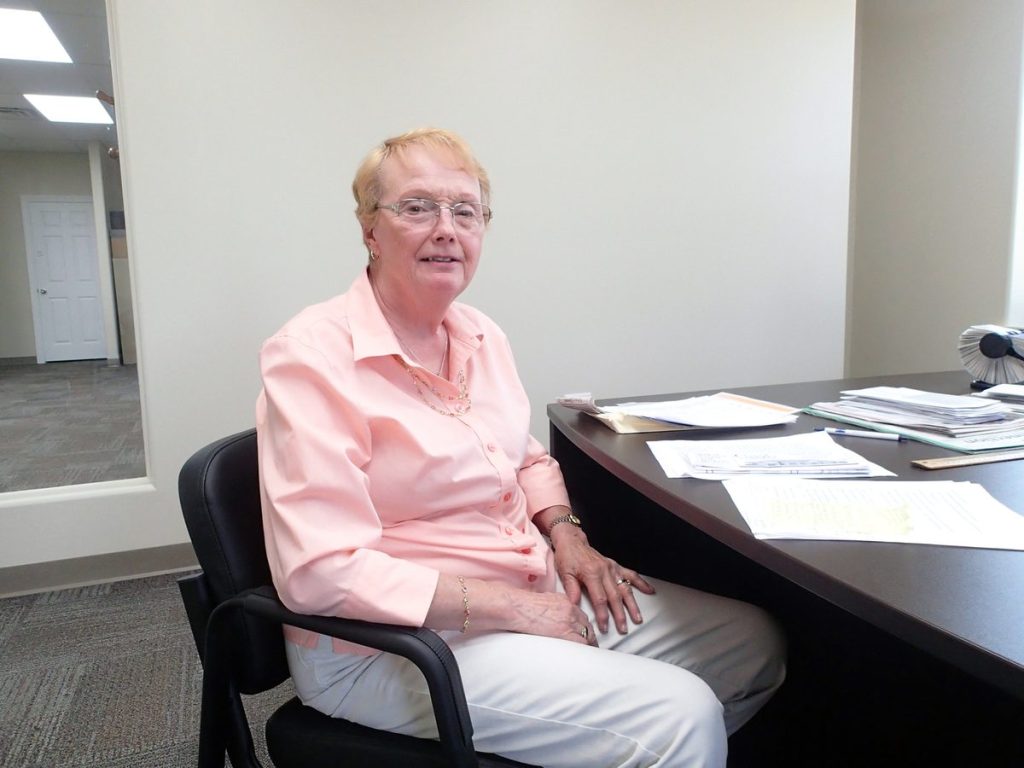
Sue Gille, who recently stepped down as the longtime president of the Nodaway County Crusade Against Cancer, has committed nearly 20 years of volunteer service to a successful campaign aimed at broadening awareness and reducing incidence rates with regard to various kinds of malignant disease. In a recent interview, Gille noted that the group’s efforts have yielded measurable results tied to more local residents eating better, exercising more, smoking less, and undergoing timely medical screenings.
Sue Gille isn’t exactly keeping a regular schedule these days, and at the moment she is traveling around the Baltic Sea with her husband, George, on a tour of Scandinavia and Northern Europe.
But for the past 18 years the retired nurse and emeritus Missouri Western State University professor has put in countless hours as a field general in the battle against cancer.
Back in 1998, five years before her retirement from Missouri Western, Gille was one of a half-dozen or so volunteers, most of them healthcare professionals, who decided the Maryville area could do better in reducing its incidence rate for various cancers.
What was needed, Gille said in a recent interview, was a sustained effort to promote awareness, lifestyle changes, and timely screening.
The result was the Nodaway County Crusade Against Cancer, which Gille led as president for 14 years before finally stepping down earlier this year.
Throughout that period a typical day in her life involved at least a few hours working to ensure that other people had the resources, knowledge, and motivation to live better and longer while lessening their risk of developing a malignant illness.
Other key players in the Crusade, which played a key role in making Nodaway statistically one of the healthiest counties in Missouri, included former St. Francis Hospital nurse and health educator Teri Harr, Sharon Neustadter, former County Health Center administrator Della Rhoades Watkins, retired nurse Della Rhoades, and Judy Frueh, a nurse practitioner at Northwest Missouri State University.
Once organized, the group decided its first priority should be raising awareness about the importance of preventive screenings for colorectal cancer, a disease that at the time had a significantly higher incidence rate in Nodaway County than across the rest of Missouri.
“We decided to concentrate on colorectal cancer because we saw a need in the community,” Gille said. “There were already breast cancer support groups and survivor support groups but no organized effort for colorectal. Nobody really wanted to talk about it.”
The challenge, Gille said, was to overcome the stigma attached to colorectal cancer while convincing more people to use home-screening kits then follow up by submitting the samples to St. Francis Hospital for testing.
At first, the Crusade convinced employers to insert screening awareness notices into paycheck envelopes. Then, as more workplaces moved to direct deposit, the organization varied its tactics, working with Wal-Mart and Hy-Vee to have fliers placed inside grocery bags.
St. Francis got on board in a major way, Gille said, providing the $10 home-screening kits and associated testing free of charge.
Between 1999 and 2016, Gille said, nearly 6,000 kits were distributed and tested in Nodaway County, where the incidence rate fell from 66 cases per 100,000 population to just over 31 cases over an eight-year period. The state rate per 100,000 population for the same period declined from 52.7 to 45.2.
Public health researchers refer to that kind of statistical improvement as “evidence-based intervention,” and Gille said producing numbers that actually demonstrated the Crusade’s positive impact over a number of years is perhaps the accomplishment of which she is most proud.
But there have been other milestones as well.
Thanks in considerable measure to a pair of municipal ordinances in Maryville that eliminated smoking in restaurants and then all workplaces, Nodaway County was determined to be the healthiest county in Missouri in 2014 and 2015 according to an annual survey conducted by the University of Wisconsin Population Health Institute and the Robert Wood Johnson Foundation.
In addition, because of its demonstrated success and relentless record-keeping by Gille and others, the Crusade was able to secure an $8,000 annual grant from the Centers for Disease Control and Prevention. Those funds have helped pay for more than $75,000 worth of local advertising, special events, and education/outreach initiatives over the last several years.
Gille said those efforts have yielded still more measurable results brought about by local residents eating better, smoking less, exercising more, drinking responsibly, and taking advantage of medical screenings and other opportunities to stay healthy and prevent illness.
Though she is quick to add there is still a lot of room for improvement.
More than 70 percent of all cancers, Gille said, are not diagnosed until the malignancy is beyond its earliest and most easily treatable stage.
“People don’t want to go to the doctor until it affects their daily life or until they’re in pain,” she said, adding that, “There are no early symptoms for colorectal cancer. If you start bleeding, that means it’s already spread.”
But working to reach the next level of success with regard to cancer prevention is going to be somebody else’s job, said Gille, who announced several weeks ago that the Crusade is disbanding.
“I’m just tired,” she said, adding that she and George want to spend more time traveling and otherwise enjoying their mutual retirement. Several other founding members are in the same boat.
Gille said she is confident, however, that the cancer awareness effort has reached a point where similar groups, in concert with St. Francis and the County Health Center, will be able to pick up the slack.
“Behavioral change takes a lot longer than education,” she said, reflecting back on the Crusade’s early emphasis on awareness and screening. “Now we’re seeing behavioral change. How many organizations have enough longevity to experience that?”
EDITOR’S NOTE: A Day in the Life is an ongoing feature written by Daily Forum staff and published weekly. Each installment details the daily work of someone in Nodaway County. Readers should submit ideas for subjects to [email protected].