Pocket monsters pop up in Maryville
By JENNIFER DITLEVSON HAGLUND Staff writer
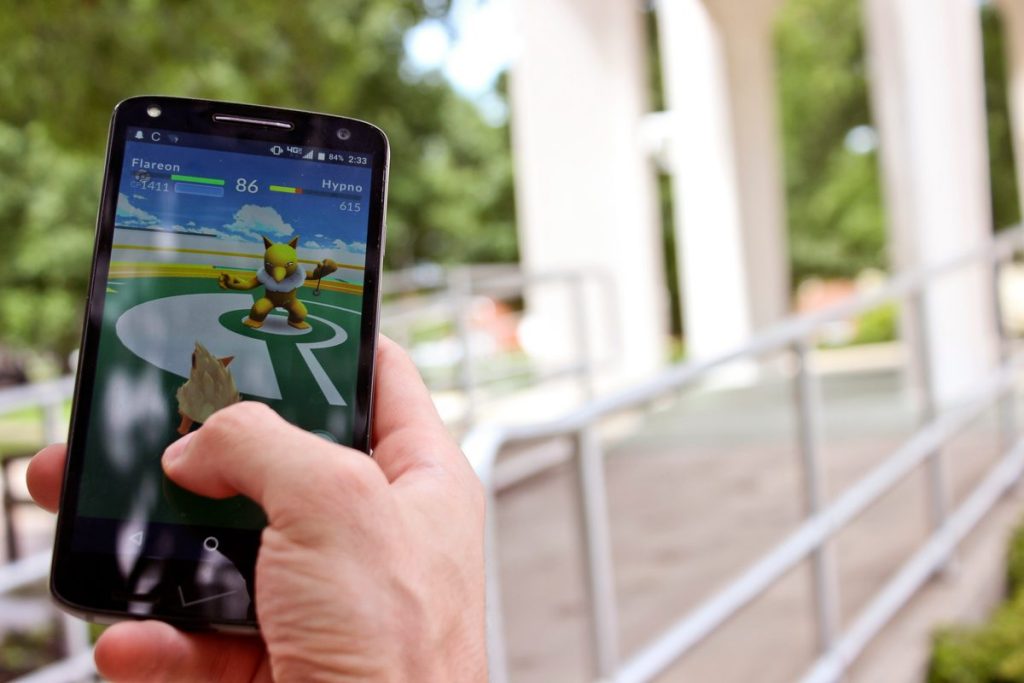
The Bell Tower at Northwest Missouri State University is a hot spot for Pokémon Go players. The center of the tower is a gym, an area where players battle their Pokémon for the right of ownership of the spot. Here, Iñaki Irisarri takes over the base by defeating another team’s Pokémon.
When the Pokémon craze had children battling for little monsters during recess 20 years ago, some of the game’s most loyal fans dreamed that one day they would actually find Pikachu or Charizard in the wild.
As of last week’s release of Pokémon Go, those dreams have come close to actualization.
“It’s s about as close as it gets,” said Iñaki Irisarri of Maryville.
Pokémon Go, an augmented reality game played on smartphones, blends technology from GPS and cameras to place the pocket monsters in real places. After players download the app, they can activate the cameras on their phones to find a map of their area and locate images of the monsters. To catch and collect them, players “throw” a Pokéball by sliding their fingers up the screen at the monsters.
Pokémon are sneaky, though. If players don’t catch them in time, they disappear from the screen. The chase continues, and players wander the streets with their phones out and cameras on to spy another critter to capture into their collection.
Since the game was released in the United States last week, downloads have sailed past 7.5 million. BBC News reported Thursday that shares for Nintendo, the parent company of the Pokémon Franchise, has increased 56 percent since the game’s release.
Effects of the game’s unexpected popularity have made headlines across the country.
People post photos on social media of the places they find Pokémon. These creatures have appeared on children, at the foot of a hospital bed when a woman is in labor, and in the middle of the road. Shayla Wiggins, 19, of Riverton, Wyoming, found a dead body in a river while playing.
Irisarri said his family in Peru has shared with him that people avoid playing in the streets because having their smart phones out makes them easy targets for robbery and assault.
On the positive side, the surprise element of the game has gotten some people out more than any aggressive fitness program ever could have.
Across Northwest Missouri State University’s campus at 7 p.m. Wednesday, more than 20 players ranging in age from 4 to mid-40s were walking and hunting Pokémon with their phones. At 9 p.m., even more people rode on their scooters and in their cars tracking the digital beasts.
Irisarri, 26, along with his friend Dennis Gatewood, 27, of Maryville, said the game holds sentimental and nostalgic value for them.
Irisarri recently moved to Maryville from Chicago. Before immigrating to Chicago at 11, Irisarri lived in Peru and Spain where he played Pokémon Master Trainer game as a little boy.
“It was a really big part of my childhood,” Gatewood said.
Gatewood said he’d seen rumors on Reddit that the game had been released in Australia and New Zealand, so on his day off work, he sat in front of his computer, periodically hitting the “refresh.”
Within minutes of the game’s availability, Irisarri and Gatewood downloaded it on their phones. Then they left the house to play. The pursuit of Pokémon lasted six hours that day. When Gatewood isn’t working, he’s playing.
Irisarri said playing has helped him get to know Maryville’s layout, and even a little bit of local history. Game makers determine PokéStops, which are places with resources to play. These stops can be found at various places, including historical markers and art. The Centennial Statue and the Nodaway County courthouse are two examples.
Gatewood grew up in Maryville, and his ambling has brought him to places he’d never visited, like Robertson-Crist Park on Prather Avenue.
As players level up, they can join teams, which introduces the social aspect of the game.
Wednesday evening, Northwest senior Jessica Coppock, junior Brad Crouse, and Northwest graduate Autumn Steinhardt were walking together while playing at Northwest. They work on a team, and Steinhardt, who teaches English at Nodaway-Holt High School, said she’s looking forward to finding out whether she stole any of her students’ Pokémon when school resumes.
Coppock said she’s met more people in the last week through Facebook groups related to Pokémon Go and out and about playing the game than she has all summer.
“People are giving tips to strangers who know they’re playing,” said Gatewood.
According to Irisarri, the app also appeals to people because it’s free. Players can purchase items if they want, but the game can be played for free.
“It uses very little data,” he said.
“But it does eat battery,” Gatewood added.
On his longer Pokémon hunts, Gatewood carries power banks in his bag to charge his phone in order to be ready whenever he encounters a monster.
By JENNIFER DITLEVSON HAGLUND Staff writer
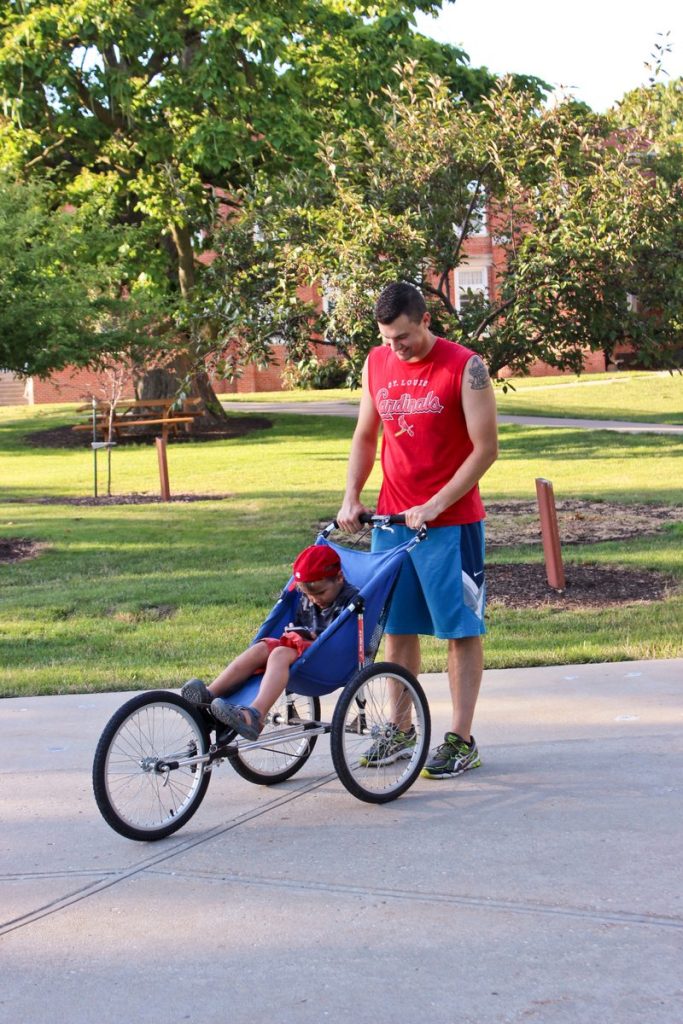
Justin Skaggs of Maryville stops in the middle of a run for his son Mason, 5, to capture a Pokémon he spotted near the Kissing Bridge on the Northwest Missouri State University campus. Justin said both he and Mason play the game.