Masonry problems continue for courthouse
TONY BROWN/DAILY FORUM
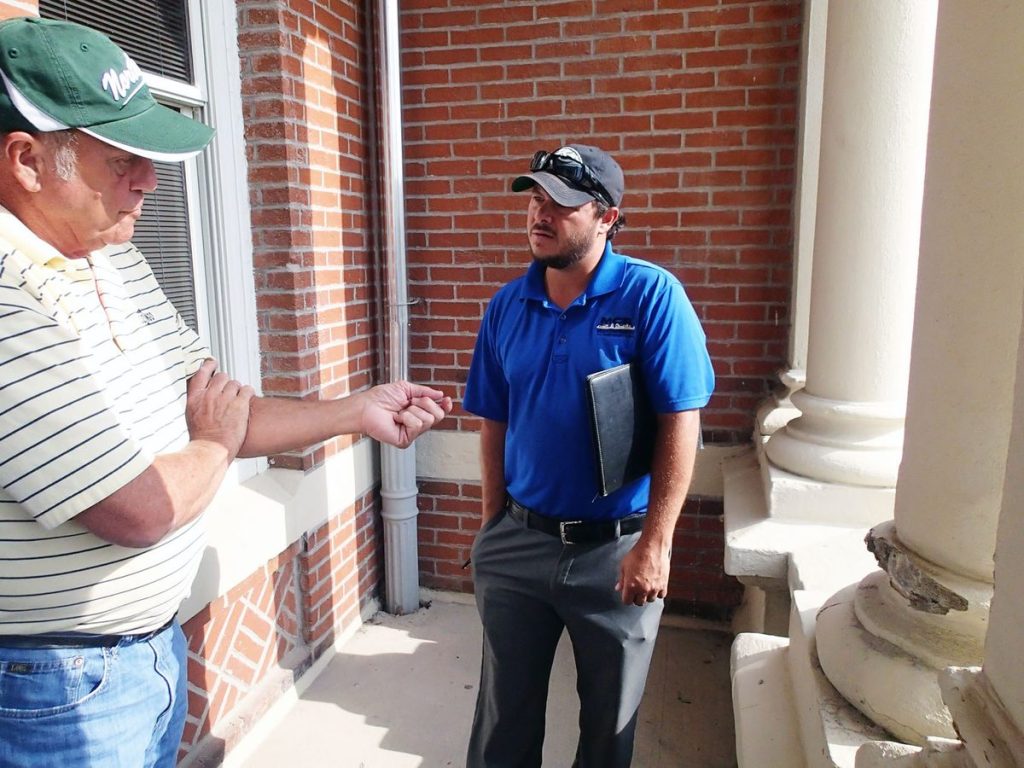
North District Commissioner Robert Westfall, left, talks with Chase Halsey of Mid-Continental Restoration about possible repairs to sandstone columns and other stonework at the 135-year-old Nodaway County Courthouse. Damage — caused by time and weather — to one of the columns supporting the east portico is visible at right.
The condition of Nodaway County’s 135-year-old courthouse was back before the County Commission on Wednesday as the three-member governing board met with a restoration consultant from Mid-Continental Restoration, a Fort Scott, Kansas company that specializes in rehabbing historical structures.
Though the courthouse has undergone extensive exterior renovations over the past six years, the towered, two-story Victorian edifice still has problems related to soft sandstone used to create columns supporting the east and west porticoes as well as ornamental trim tracing windows and other architectural features.
Though repaired back in 2010, small pieces of the columns have once again begun crumbling away, a problem that estimator/project manager Chase Halsey — whose great-grandfather founded Mid-Continental in 1946 — said is common to sandstone as it ages.
Sandstone trim along the base of the courthouse appears to be decaying as well, and frequently rang hollow as Halsey struck it with a metal knife handle.
Any new work, Halsey said, will carry only a one-year warranty due to the unstable nature of the original stone.
The problem, he said, is that sandstone absorbs water, and when the material is patched some of that water is often trapped inside. As the moisture freezes and thaws with seasonal changes in temperature, the resulting contraction and expansion causes the patch to fail.
Fixing diseased limestone, Halsey said will require power washing all affected areas and knocking away any loose stone or decayed patchwork. Small holes would then be drilled into the original stone and filled with epoxy-coated pins.
The idea is that the pins will give the new patching material, which is applied wet, something to hold on to.
While Halsey has yet to submit an estimate, the process, should the commission decide to proceed, is not cheap.
In 2012 Mid-Continental performed a large-scale masonry rehabilitation at the Buchanan County Courthouse in St. Joseph, which Halsey said cost around $200,000.
North District Commissioner Robert Westfall said Nodaway is unlikely to spend anything like that much money, and may well have to exercise what amounts to structural triage by addressing the most serious problems as money becomes available.
Westfall said there has been no real trigger forcing the commission to look at more courthouse repairs other than a sense that the old stonework is “getting worse.”
He said the three-member board is getting an estimate now so that it can plug in funding for structural restoration in the 2017 budget, which means any work approved by the commission would not be undertaken until next year.
Westfall has acted as the lead on courthouse maintenance issues over the past several years, but will retire at the end of December after serving three four-year terms. That means any decisions regarding the historic structure’s upkeep will be made on someone else’s watch.
The most significant courthouse project in recent memory was replacement of the original clock tower cupola, along with a good portion of the building’s decorative metal trim, in 2010.
A devastating hail and wind storm in the summer of 2011 meant that a second reproduction cupola, fashioned by Campbellsville Industries in Kentucky, had to be installed about a year later.
Total cost of replicating the original cupola and associated construction was around $600,000.
In addition, the commission spent just under $189,000 to replace the courthouse roof, a project carried out by Seaman & Schuske Metal Works of St. Joseph in 2014
Replacement of the cupola mostly brought to an end a two-year courthouse renovation that included installation of a new handicap-accessible elevator, creation of a third upstairs courtroom, interior painting and woodwork, and the repair of exterior stonework and ornamental window dividers.
Listed on the National Register of Historic Places, the current courthouse is the county’s third and was constructed in 1881 at a cost of $60,000.
An example of Second Empire style, a movement named for architectural elements in vogue during the Second French Empire (1852-1870), the building was designed by noted architect Edmond J. Eckel in association with George R. Mann.
The courthouse is considered one of Eckel’s finest surviving works, which also include the Carnegie Public Library building in Albany and the old Central Police Station at 701 Messanie in St. Joseph.
According to University of Missouri Extension, the first Nodaway County courthouse was a log cabin built in 1846. A second courthouse was completed in 1855 but proved inadequate and stood only 26 years before being razed the same year construction of the current building began.
The Extension article states that a new floor was installed in the main courtroom in 1932, and that the building’s exterior was renovated in 1950 at a cost of $15,000.