Rural mail route carrier brings surprises
By JENNIFER DITLEVSON HAGLUND Staff writer
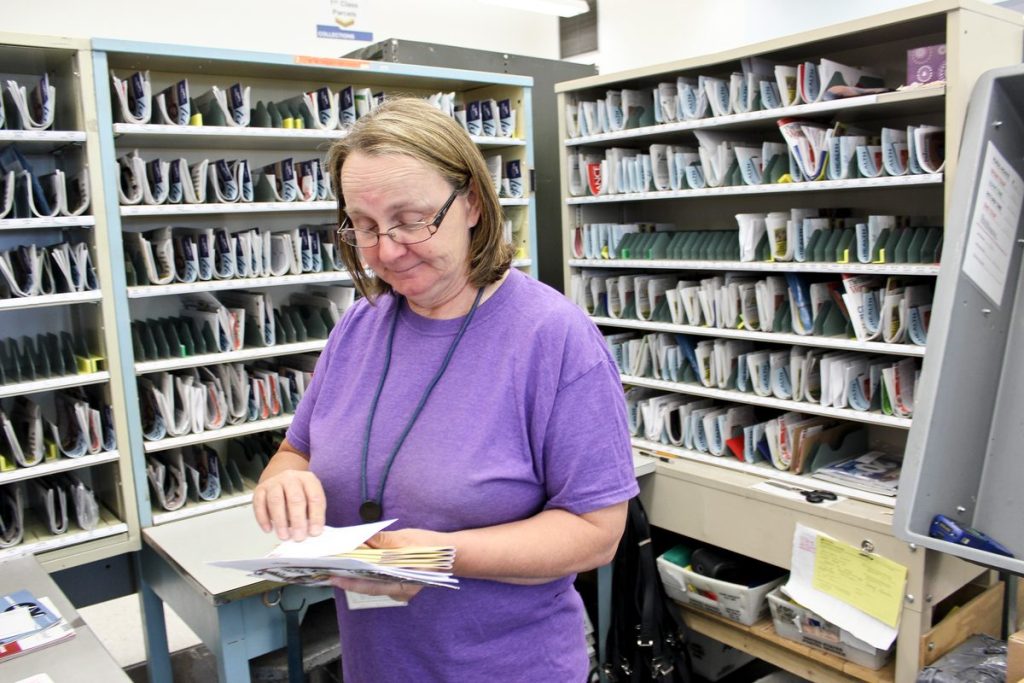
Kristi Hanna has delivered mail on a rural route on the northern and eastern edges of Maryville since 1996. She began as a substitute on the route, and after 10 years she joined the United States Postal Service full time. Before heading out on her route, she spends up to three hours sorting mail.
When Kristi Hanna graduated from Northwest Missouri State University and began teaching first grade in Iowa, she never thought she’d return to Maryville, and she never thought she’d transition from teaching children to delivering mail for the United States Postal Service.
Hanna taught full-time until she had her children, and then she worked as a substitute teacher at North Nodaway. While her children were young, she and her husband Gary owned Paradise Donuts. One day in 1985, a mail carrier came into the doughnut shop complaining that he didn’t have a substitute for his route. He recommended that Gary take the job. About a decade later, Hanna found herself agreeing to do the same to help for a short time. Now, after 20 years, Hanna is putting her teaching experience to use as a rural carrier academy trainer.
“I should’ve asked how long ‘a little while’ was,” she said.
At the time, working as a substitute mail carrier on a rural route earned more money than substitute teaching, but Hanna said she definitely worked to make up the difference.
“Most people have no concept how the mail gets there,” Hanna said. “I don’t think they understand how much work is involved.”
Every day is different, but Hanna spends anywhere from two and a half to three hours in the office sorting the mail for her route and loading it into her Jeep Cherokee.
Hanna said that although each day has the same routine of sorting mail, loading cases, and driving, carriers in the office do their job in their own unique way.
“Every brain works differently, and as long as we’re keeping the mail safe, it’s okay,” she said. “That’s what I like.”
Hanna’s route covers almost 65 miles, and she’s responsible for 585 boxes. Gary still carries mail. His route covers 107 miles and 490 boxes.
“We always argue about whose route takes the longest,” she said.
Spending hours on the road every day hasn’t gotten boring for Hanna yet. She can listen to the radio and she has 11 authorized dismounts where she delivers packages or gets mail to people who have difficulty getting to their mailboxes.
Rural mail carriers do not have to wear uniforms like in-town carriers. The dress code is relaxed, modest, and clean.
“But you learn not to wear expensive clothes because of the ink and the gravel,” Hanna said.
Mail carriers, by law, cannot open or look into the packages they deliver, but sometimes Hanna doesn’t have to peek when the cargo is obvious. Throughout the last 20 years, Hanna has delivered all kinds of things — bumpers, tires, an antique cash register, quail eggs, hula hoops, bees, and chickens.
“I’d have to say the oddest thing was when I delivered 4,000 earthworms in six big boxes,” Hanna said. “This guy’s house was four and a half hours into the route, and I kept thinking, ‘I hope that these things live.’”
The unofficial motto of the USPS inscribed on the James Farley Post Office in New York City promises that “[n]either snow nor rain nor heat nor gloom of night stays these couriers from the swift completion of their appointed rounds.”
In northwestern Missouri, snow, rain, heat, and gloom cause problems for mail carriers. Hanna said she carries a hay hook or rubber mallet to break ice from the boxes in the winter. Chipping ice from 585 boxes takes time, rendering “swift” subjective.
Any day directly following a postal holiday can also delay mail. According to Postmaster Becky Giesken, the day after Columbus Day is usually hectic because companies are gearing up for Christmas. Political years like this one also bring an increase in volume around that time.
As someone who began delivering mail in the mid-1990s at the beginning of the dot-com bubble, Hanna witnessed a decline in letter volume, but shortly after, there has been a huge increase in parcels since then. Hanna said she now delivers 20 more parcels per day than she did five years ago. She attributed the increase to Amazon and the USPS introducing the priority mail flat rate boxes.
Delivering packages, especially around Christmas, brings a smile to her face because she said she watches people anticipate her coming.
Serving this area for Hanna is a pleasure. When the weather gives her trouble, or if there is a problem with her vehicle, she said there’s always a farmer ready with an air compressor or a cold drink.
“I enjoy interacting with the customers,” Hanna said.
Hanna said no two days on the job are exactly the same, and that variety motivates her to see what might come down the line on her route.