Family health doesn’t have to cost too much time, money
By JENNIFER DITLEVSON HAGLUND Staff writer
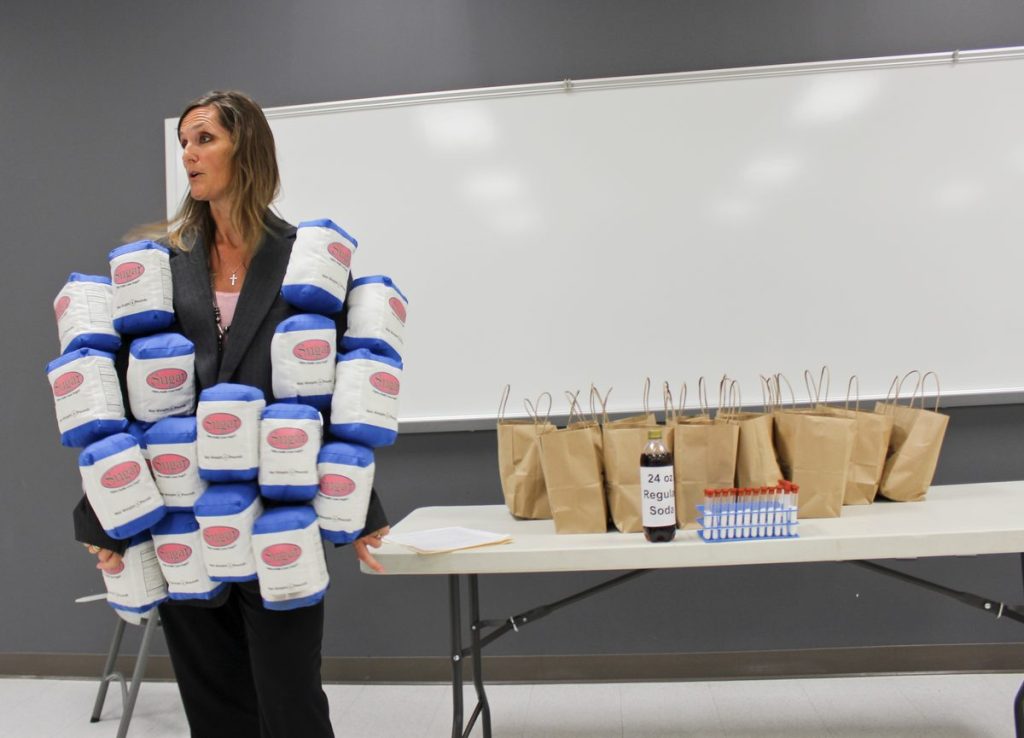
Julie Livengood, registered dietitian at SSM Health St. Francis Hospital, demonstrates how much sugar a person would ingest by drinking 24 ounces, or two cans, of cola every day for a year. On average, the soda alone adds 70 pounds of sugar to the diet.
During the three-part Lunch and Learn seminar hosted by SSM Health St. Francis Hospital, Hy-Vee Dietitian Deanna Bowers, along with St. Francis dietitian Julie Livengood and fitness instructor Erika Jeter shared how parents can help their families eat well without overspending, and find time to exercise.
Livengood offered several visuals and 10 tips about how parents can manage the menus in their homes.
“Parents are the gatekeepers,” Livengood said. “We control what comes into the house.”
Using herself as an example, Livengood explained that it’s easy to make the mistake of buying junk food, and then depend on willpower to restrain binge eating.
Pushing back against children who complain and request sugary snacks, she said, can be challenging, too. With time, parents can change bad habits of the whole household.
Trading soda, sports drinks, and juice for water and milk, for example, drastically reduces the intake of non-nutritional calories and saves money. According to Livengood, sometimes people don’t realize how much sugar they ingest through liquids. To illustrate the amount, she explained that people who drink 24 ounces, or two cans, of cola every day for a year adds about 70 pounds of sugar to their diets.
As much as parents might not like to hear it, Livengood said it’s parents who determine the majority of their children’s tastes, which is why she emphasized that parents evaluate the contents of their grocery carts.
Without unhealthy options, children must eat what’s offered, even when it isn’t their favorite.
“Kids will do as you do,” Livengood said.
Choosing to buy healthy food isn’t just a matter of changing taste preferences. For many, it’s a question of how it will affect their wallets. Bowers said she gets the same question nearly five times every month. Shoppers come to her asking how they can possibly eat healthfully on a budget.
“I can’t count how many times someone tells me they can’t eat healthy because it’s too expensive,” Bowers said. “But there are multiple ways to do it.”
When it comes to ready snacks, Bowers pointed out that the average candy bar at Hy-Vee costs 89 cents, but healthy alternatives cost less. A banana costs 31 cents, a box of raisins is 25 cents, and a golden delicious apple is 63 cents.
Planning ahead, buying in bulk, and exchanging private labels for store brands can save money, which Bowers said can help when some healthy items cost more money.
“If you want convenience, you’re going to pay for it,” Bowers said.
Chopping carrots or slicing cheese and putting them into plastic baggies instead of opting for baby carrots and prepackaged cheese sticks, for instance, saves a dollar or more.
Bowers anticipated some skepticism about the feasibility of remembering to plan ahead for snacks on long car trips and taking time to cook instead of eat out.
“Changing a habit doesn’t happen overnight,” said Bowers. “It takes almost six months to develop a habit.”
Keeping or getting active with a growing and busy family, Jeter said, is a common concern. During her presentation, she focused on how finding time for exercise requires creativity and consistency. Jeter said she doesn’t always have time to drive into town to get to the gym, and with children, it’s difficult to find time alone to lift weights or do cardiovascular workouts.
For people who shower in the morning, Jeter recommended doing a set of squats, push-ups- crunches, and holding plank. Completing even one activity, or increasing the number of repetitions completed, she said, is still valuable.
“Remember,” Jeter said. “Anything is better than nothing.”
Jeter also appealed to the ease and accountability factors in using apps like POPSUGAR Fitness, Nike Training Club, and Ballet Beautiful. Simple pedometers, she said, also introduce a competitive aspect to staying in shape.
Getting the whole family involved, she said, also demonstrates to children that exercise can be enjoyable. Jumping rope, playing catch, or walking the family dog together adds action to the day, and it doesn’t seem like exercise.
“It’s got to be simple, though,” Jeter said. “Don’t make it work; make it fun.”
For more information about how to keep families healthy, contact Community Health Nurse Jackie Ross at 660.562.7945.

By JENNIFER DITLEVSON HAGLUND Staff writer
Skyler Randall, 7, shares lunch with his mother Haily Randall, and younger brother Ethan Randall, 5, at the June Lunch and Learn event at the Maryville Community Center Friday afternoon. The seminar, hosted by SSM Health St. Francis Hospital, addressed how parents can manage a healthy home in buying nutritious food on a budget and finding time to exercise.