Lawmaker, judge salute police — pay tickets
TONY BROWN/DAILY FORUM
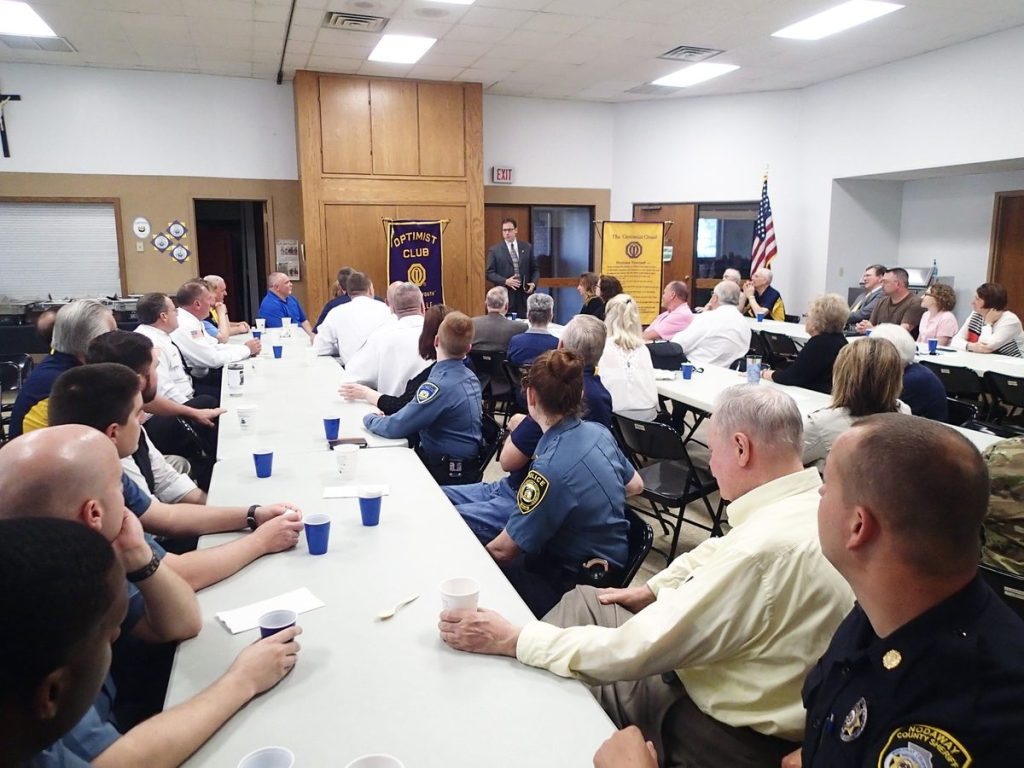
State Rep. Allen Andrews, whose 1st District includes Nodaway County, addresses law enforcement officers and members of the Maryville Optimist Club on Thursday during the service club’s annual Respect for Law Enforcement Breakfast. About 25 officers from more than a half-dozen agencies attended the event along with several National Guardsmen from the 129th Field Artillery Regiment.
Members of the Maryville Optimist Club gathered in the parish hall at St. Gregory Barbarigo Catholic Church Thursday morning for their annual Respect for Law Enforcement Breakfast, which was attended by about 25 members of local policing and corrections agencies as well as National Guardsmen from the 129th Field Artillery Regiment.
Also in attendance were Nodaway County Prosecuting Attorney Robert Rice and officers from the Maryville Treatment Center, Nodaway County Sheriff’s Office, Missouri State Highway Patrol, the Northwest Missouri State University Police Department, Maryville Public Safety, Missouri Division of Probation and Parole, and the Missouri Division of Youth Services.
The event was organized by Presiding Circuit Judge Roger Prokes, an Optimist member, who drew a laugh by admitting he recently received a traffic ticket — which he paid — from a Kansas City police officer after exceeding the speed limit in a school zone while running late to a meeting.
More laughter followed when the morning’s keynote speaker, state Rep. Allen Andrews, told the mostly uniformed officers that he, too, received a speeding ticket while driving through Chillicothe en route to Jefferson City during the now-ended session of the Missouri General Assembly.
Optimist member W. Dale Stewart, a retired minister who worked as a detective early in his career, couldn’t resist putting on a wry face and expressing mock concern that both the legislator and the judge introducing him were admitted lawbreakers.
Prokes and Andrews took the ribbing in good humor before the veteran judge, setting a more serious tone, said he understood better than most what a “tough, tough job” law enforcement officers face.
“I know that a lot of times you don’t get thanked for all the work you do,” he said, “but the minute you step out of line a little bit there are plenty of people there to criticize.”
During his more extended remarks, Andrews thanked the officers for their service and praised them for doing jobs that often require long hours under conditions that hold out the possibility of injury and even death.
He added that law enforcement departments and agencies frequently strive to fulfill their missions while coping with insufficient funding and manpower.
“Yet you persevere, and you serve as role models,” said Andrews, who quoted a passage from President Theodore Roosevelt’s “Citizenship in a Republic” speech, which reads, “It is not the critic who counts; not the man who points out how the strong man stumbles, or where the doer of deeds could have done them better. The credit belongs to the man who is actually in the arena, whose face is marred by dust and sweat and blood; who strives valiantly …”
Modern officers, Andrews continued, face ever-shifting challenges and have been forced to adapt to a new generation of technology-savvy criminals, and a new era in which highly organized drug and human trafficking rings prey on individuals and society as a whole.
“Too often you are undervalued, understaffed, and underpaid,” Andrews said. “There is a need for all of us to do more, and to make sure that we give law enforcement the effective tools you need to do the job.”
Aside from arresting lawbreakers and keeping the peace, Andrews said many officers make their most important contributions by simply setting a good example and “impacting our communities in a positive way on a daily basis.”
He said that while the word “hero” is often misapplied to athletes and celebrities, officers conduct themselves in a genuinely heroic manner every day by making sacrifices for the common good.
“We don’t have to escape to the ballpark or the movie theater to find heroes,” Andrews said. “In fact, we don’t have to look any further than the people in this room. You save people, and communities, and families, and ultimately you help save our world.”