Cornerstones of Care seeking foster families
By JESSICA ALLEN Staff writer
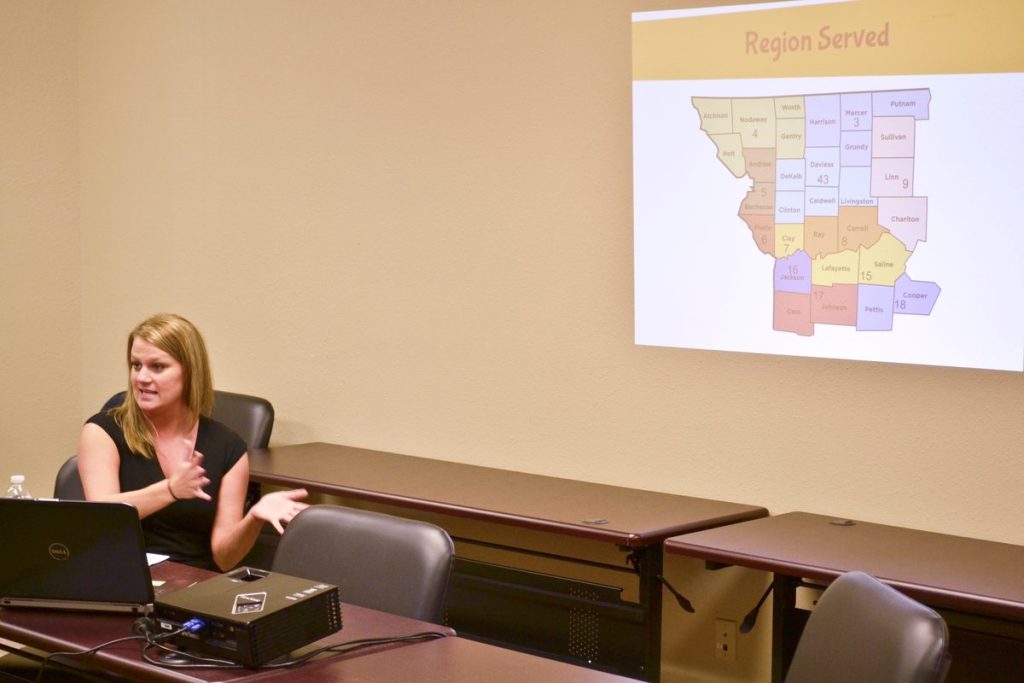
Resource Development Manager Valyn McClellan highlights the 30 counties in northern Missouri served by Cornerstones of Care. In 2015, judicial circuit four, which includes Nodaway, Atchison, Gentry, Holt, and Worth counties, had only 30 foster homes for more than 70 children.
The Maryville regional resource office of Cornerstones of Care held an informational meeting for prospective foster parents Tuesday evening.
Cornerstones of Care is a private, non-profit agency based out of Kansas City that contracts with the state of Missouri to provide licensing for foster care families.
Although Cornerstones provides service to 30 northern Missouri counties, the meeting focused on judicial circuit four, which includes Nodaway, Atchison, Gentry, Holt, and Worth counties.
Resource Development Manager Valyn McClellan presented sobering statistics about the overwhelming need for foster families in northwestern Missouri.
Physical and sexual abuse account for 57 percent of removals, and neglect—whether physical, emotional, medical, or educational—accounts for the remaining 43 percent.
The disparity is great between the number of children in state custody and the number of licensed foster homes in circuit four.
In 2015, there were 76 children and only 30 licensed homes in which to place them. Of those 30 homes, 20 are licensed “relative or kinship” homes, which are homes of grandparents or other relatives who are usually licensed to care for only their relations.
That leaves just 10 “true” foster homes available for children placed in state care in all five counties.
“The more homes we have, the better we can meet the needs of the kids,” McClellan said.
She said that the state always tries to place children with a blood relative first, or at least as close to their home community as possible.
“We want to keep them in their home communities because of their school, because of their friends…maybe they attend a church in their local community or they’re on a basketball team,” McClellan said.
In circuit four, less than half of foster children—just 42 percent—are placed in a home within the circuit.
McClellan said that the greatest need is for homes willing to accept larger sibling groups and older youth.
“Truth be told, we have a hard time finding homes willing to take three siblings,” McClellan said. “We very regularly get sibling groups of six throughout the 30-county area. More often than not we have to split those siblings up and we don’t want to do that.”
Most families look to foster younger children, and McClellan said that infants can be placed almost immediately.
However, the statewide average age of children in foster care is 9. Teenage boys are the hardest to place according to McClellan.
She added that Cornerstones is also looking for a variety of backgrounds in foster families because they prefer to place children in homes where foster parents match the child culturally.
“For instance, if we have a child who is Catholic, we would prefer the child to go to a home with that same faith,” McClellan explained.
All potential foster parents must meet certain criteria before bringing a child or children into their home.
In addition to being over 21 years of age, potential parents must pass an extensive background check, be evaluated for physical and mental health, complete 27 hours of training, and have a home that meets state requirements.
Potential parents will also be required to participate in home visits and assessments by a social worker.
“(The social worker) is going to be asking you a lot of personal questions, because we need to know our homes,” McClellen said.
Finally, foster parents must meet five “identified competencies,” which are to protect and nurture, to meet developmental needs and address developmental delays, to support relationships between children and their birth families, to work as a member of the professional team, and to connect children to relationships intended to last a lifetime.
Caring for a child who has experienced trauma is not an easy task, but McClellan said that committed foster homes make a world of difference for most children.
“We have some families that have fostered for 15 to 20 years and it’s their life work,” she said.
She added that anyone who may be on the fence about becoming a foster parent should consider first becoming a respite provider, another urgent need in circuit four.
The purpose of respite providers is to give foster parents a break from their duties, usually for just a couple of nights at a time.
“I think it’s a really great way to tip your toe in the water,” McClellan said.
Currently, she added, there are only three to four respite homes in circuit four.
Although the average length of stay in a particular home for foster children is around two years, McClellan said the time can vary greatly.
Foster parents are required to participate in continual training amounting to 30 hours every two years.
“We’re giving (foster parents) a state-issued license; just as a doctor has to have continued training and education to maintain a license, so do foster parents,” McClellan said. “Our parents are professionals.”
Anyone interested in learning more about foster care or adoption can visit www.healthyfamilies4kids.org. Healthy Families is an agency within Cornerstones of Care that focuses on foster care and adoption services in northwestern Missouri.
Those who want to initiate the process of fostering should call Healthy Families at 855-778-5437.
“The more homes we have, the better we can meet the needs of the kids,” McClellan said.