
Police propose mile markers at Mozingo Lake
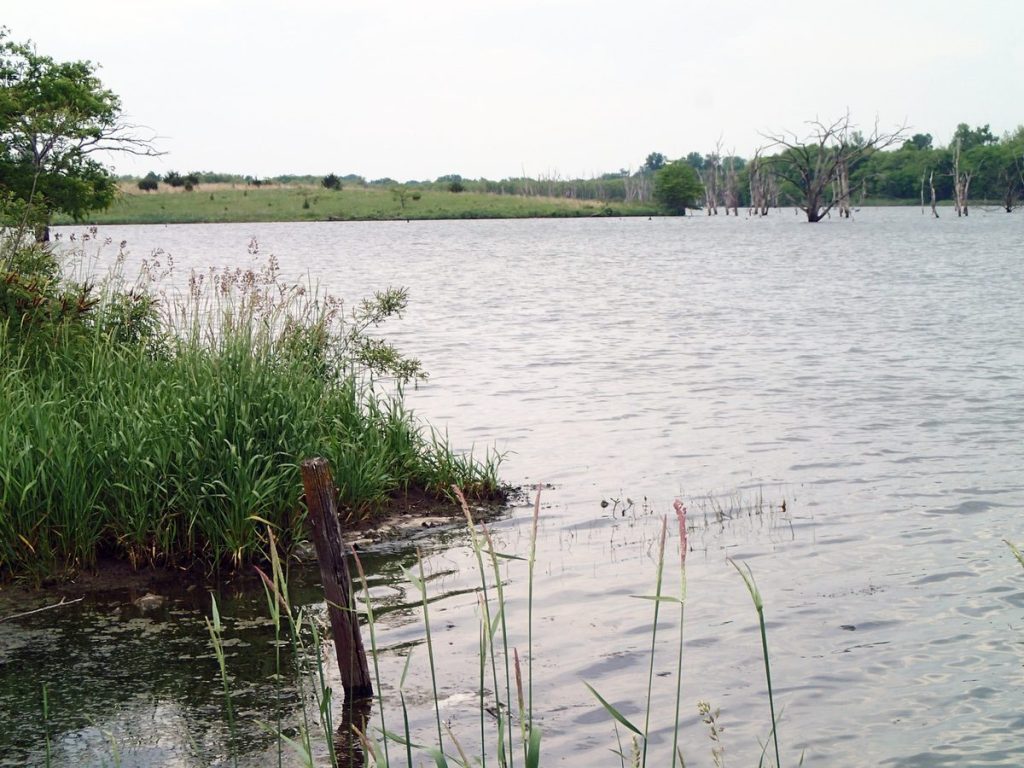
TONY BROWN/DAILY FORUM
As impoundments go, city-owned Mozingo Lake is on the small side. But it’s big enough that boaters and anglers in trouble sometimes have difficulty describing their exact location so that police or other rescue personnel can find them. In an effort to speed response times, Maryville police are requesting the installation of mile markers, or some other form a wayfinding signage, around the 6-mile-long reservoir, which covers about 1,000 acres of surface area.
While it offers ample opportunities for boating, tubing, skiing, fishing, and swimming, Mozingo Lake, with 1,000 acres of surface area, is fairly small as such things are reckoned in Missouri.
Perhaps three-quarters of a mile across at its widest end and about six miles long, Mozingo would be little more than a big cove if attached to one of the state’s giant impoundments like Bull Shoals, the Lake of the Ozarks, or Stockton.
So, since Mozingo boaters can basically travel in only two directions — north and south — and since they are never out of sight of land on either side, why is Maryville Public Safety recommending that the city install mile markers along the shore?
While such markers are familiar guideposts to anyone who has spent time cruising over southern Missouri’s big reservoirs, erecting them at Mozingo, at first blush, might seem a little like overkill.
But it’s not, says MPS Sgt. Rick Smail, who, along with Officer Josh McMillen, makes up Mozingo’s peak-season lake patrol.
While people don’t exactly get lost on the lake, Smail said Monday, they often don’t know precisely where they are. Or, more to the point, they don’t know how to tell someone else how to reach them if they get into trouble.
Already this spring, Smail said, there have been four boat-related incidents at the lake requiring a police response. In two of those cases officers were given faulty directions.
In one episode, an older fisherman fell into the water without a life jacket. The man’s partner telephoned for help, but told the dispatcher the boat was just offshore from the equestrian campground on the west side of the lake.
Actually the two men, while near the west shore, were across from what is known as the city boat ramp a good bit to the south of the equestrian area.
Police and rescue personnel eventually located the craft, and, as things turned out, the angler was able to climb back into the boat on his own, but not before everyone got a good scare.
A second occurrence involved a boat with a stalled motor on the undeveloped north end of the lake, which in spots can be fairly remote and hard to access.
The boater called for help and described his location by telling police he had seen a semi-trailer parked near the shore on private property. Fortunately Smail, who knows the lake backwards and forwards, had noticed the trailer earlier and was able to reach the stranded man with little difficulty.
But if the sergeant had not been on duty that day, a routine rescue might well have turned into a lengthy search.
“Not everyone knows the landmarks out there,” Smail said. “I know the lake pretty good, and so does Josh, but some of the other officers don’t.”
Smail acknowledges that placing wayfinding signage around the lake isn’t a cure-all for the tight spots boaters and anglers sometimes get themselves into, but markers could well give officers a crucial edge when someone’s safety — or even their life — is imperiled.
Like any large body of water, Mozingo can be a dangerous place, especially when the wind comes up, and two people have drowned there over the past decade.
“We’re afraid that one of these days we’re going to have a serious incident when minutes — when seconds — matter,” Smail said. “And if we go to the wrong place, we’re not going to do anyone any good.”
Just what form shore markers at Mozingo might take, along with how many there will be and when they will be installed, has yet to be determined.
Smail said Public Safety plans to submit a proposal to the City Council this summer so that the governing board can consider it during the budgeting process for the coming fiscal year, which begins Oct. 1.
Cost will likely total only a few hundred dollars, and Smail said it’s the kind of job that could be taken on by a volunteer, perhaps a Scout in need of a community service project.
“At Mozingo we prefer to err on the side of caution,” he said. “We just don’t want to see anybody get hurt.”




