Lunch and Learn promotes benefits of 3-D mammography
PUBLIC DOMAN
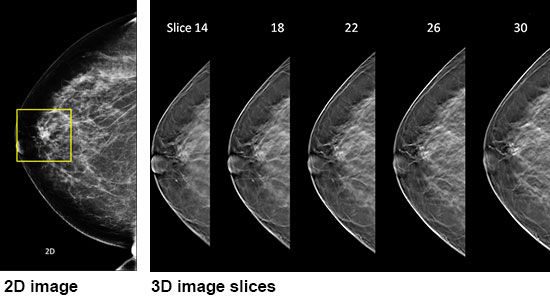
This image comparison demonstrates the difference between 2-D and 3-D mammograms. The bright white spot in image on the left makes it look like there is a cancerous mass, but the multiple slices on the right show that there is not. Dense breast tissue, according to radiologist Ben Saverino, can make it difficult to read mammograms. Combining 2-D and 3-D technology, however, reduces false positive results. SSM Health St. Francis Hospital in Maryville has the only 3-D mammogram machine available in northwestern Missouri.
SSM Health St. Francis Hospital hosted its first Lunch and Learn educational hour at the Maryville Community Center Friday afternoon, using the time to introduce its latest imaging technology.
Ben Saverino, a radiologist at St. Francis, highlighted the prevalence of breast cancer and described how the hospital’s new 3-D mammography machine can help. American Cancer Society data show that 2016 will see an estimated 249,260 new cases in the United States this year. With such high numbers, Saverino said it’s important to use the best means of detection available.
Conventional 2-D mammograms have been available for about 100 years, making them one of the oldest forms of preventive screenings. Although they can reduce fatalities because of early detection anywhere from 15 percent to 50 percent, Saverino said there are some shortcomings to the imaging.
Up to 20 percent of the instances of breast cancer are missed.
If a woman has dense breast tissue, for example, 2-D imaging doesn’t provide a clear picture for radiologists to interpret. With a 2-D scan, the breast tissue is smashed and it’s not always clear whether the white spots on the image are cancer or just really dense fibroglandular tissue.
According to Saverino, the 3-D mammography machine works like a CT scan because it takes multiple “slices” from different angles. This enables radiologists to read cleaner images and eliminates unnecessary follow-up work.
“We’d like to cut down on anxiety and expense this way,” Saverino said.
Saverino also explained that using ultrasound and MRI technology for breast screenings doesn’t pay off because it’s more expensive and also leads to more false positive results.
False positives lead to more biopsies, which not only lead to higher expenses and frayed nerves, but also possible complications such as bruising, infection, and bleeding at the biopsy site.
Saverino clarified that the 3-D mammography machine will not take the place of the 2-D machine, but it will be available to St. Francis patients who would like to take advantage of having both scans. Combining the two technologies, Saverino said, increases radiologists’ effectiveness.
Currently, Medicare covers 3-D screens, but St. Francis Hospital Foundation Development Officer Megan Jennings said it is possible that not all private insurance companies have the same policy. Before agreeing to the 3-D scan, patients will have the opportunity to review the costs.
The recently acquired 3-D mammography machine at St. Francis, according to Jennings, is the only one available in northwest Missouri.
The Lunch and Learn programs are open to the public and take place in the large conference room at the Maryville Community Center. Free lunch and childcare are provided.
“We want Nodaway County to do well,” said Jackie Ross, community resource nurse.
For more information, contact Ross at 660.562.7945. Registration is helpful, but not necessary.