Northwest to hire vice president for diversity
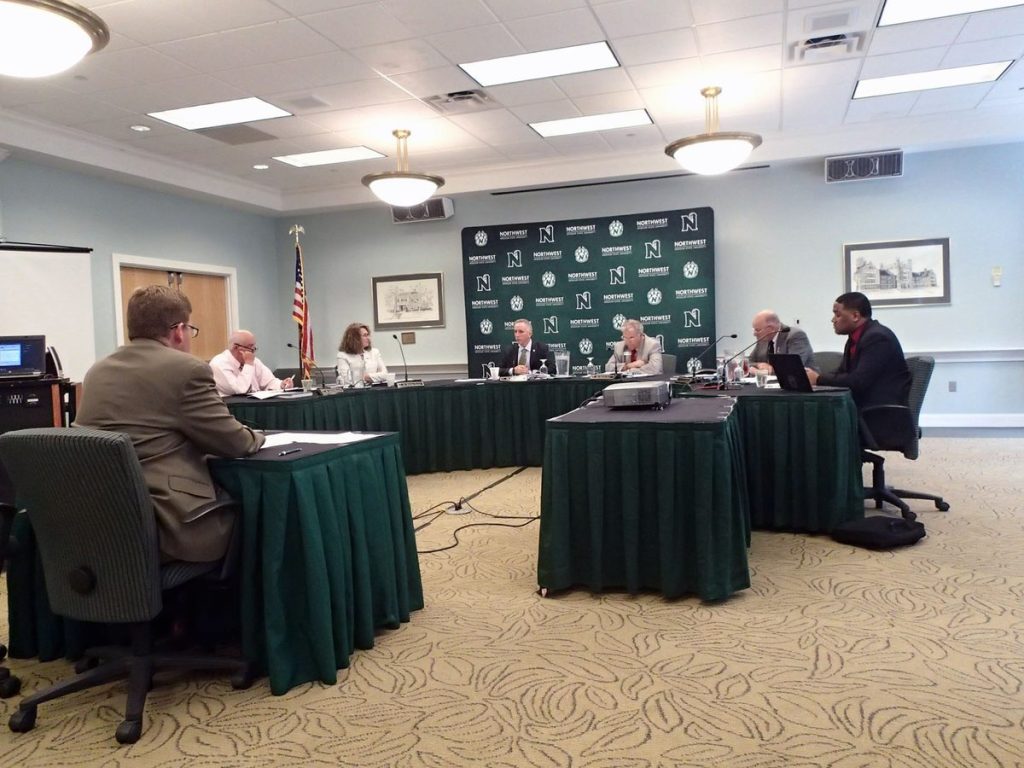
TONY BROWN/DAILY FORUM
Matt Baker, vice president for student affairs at Northwest Missouri State University, is shown addressing the Board of Regents Friday when he proposed creation of a new vice president’s position charged with the administration of programs related to cultural diversity, equity, and inclusion.
By unanimous vote the Northwest Missouri State University Board of Regents on Friday approved a staff proposal to create a top-level administrative unit to be led by a vice president and charged with running programs related to “diversity, equity, and inclusion.”
The new VP, who has yet to be hired, will report directly to Northwest President John Jasinski and lead a six-member team consisting of a director of diversity and inclusion, two coordinators of diversity and inclusion, a director of equity and accessibility, a coordinator of equity, and an accessibility coordinator.
Four of the positions — the director of diversity and inclusion, director of equity and accessibility, coordinator of diversity and inclusion, and the accessibility coordinator — already exist and will simply be shifted from their current organizational slots beneath Vice President of Student Affairs Matt Baker.
Northwest has been aggressively moving toward expanding administrative resources and programs designed to assist “underrepresented or marginalized” students since last November when then-19-year-old freshman Conner B. Stottlemyre was arrested after using the Yik Yak social media platform to threaten African American classmates.
Stottlemyre pleaded guilty in January in Nodaway County Circuit Court to a felony charge of making terroristic threats and was sentenced to 30 days in jail and 5 years’ probation.
The incident closely mirrored a case that occurred about the same time in which a former Missouri University of Science and Technology student, Hunter M. Park, made similar online threats aimed at African Americans on the University of Missouri’s Columbia campus.
Park has also pleaded guilty and is awaiting sentencing.
In making the proposal for the new unit to Northwest’s governing board, Baker said he believed that creating a senior post dedicated to racial harmony, handicap accessibility, campus diversity, and related issues is “the right thing to do” in terms of creating an “inclusive environment” that will give all students “a chance to succeed.”
He added that such an organization was important in terms of preparing students for careers with corporations doing business in a global economy.
Thirdly, Baker said demographic trends indicate people of color will constitute a majority of the U.S. population in 15 to 20 years, and that increased sensitivity toward minorities constitutes a sound “business model” for the university.
When Northwest Regent John Richmond asked what qualities the new vice president should possess, Baker responded, “leadership with a capital L,” adding that whoever is hired will also have to be a “content expert who has the ability to see the big picture.”
Richmond then inquired if “all things being equal” Northwest should “hire someone who is a member of one of these affected groups.”
Baker responded, “Absolutely.”
Dr. Pat Harr, who chairs the university’s governing board, said hiring a vice president for diversity was “absolutely … the direction to go.” He added that finding the right person would be a challenge, and hinted the university might have to consider expanding the recommended salary range in order to attract the best candidate.
According to Jasinski and other Northwest officials, one of the main reasons for working to make the campus more diverse and inclusive has to do with retention and graduation rates, which can affect state funding under Missouri’s achievement-based appropriations system for higher education.
Northwest’s six-year graduation rate data indicates for the period beginning in 2008 that 53 percent of white students earned degrees while only 27 percent of black students left the university with a diploma.
In addition, the 2015 Campus Climate Survey showed that while 88 percent of white students felt they were treated fairly regardless of race, only 48 percent of black students agreed with that statement.
The survey also showed that only 55 percent of black students believed the university implemented policies to prevent discrimination compared to 74 percent of white students.
Cost of implementing the new administrative structure is an estimated $264,000, of which $139,000 is to be reallocated from other areas. The remaining $125,000 will come from a student-approved “culture and climate” fee expected to generate $316,000 a year.
Baker said that leaves about $190,000 to support new diversity, equity, and inclusion programs above predicted administrative costs.
On other fronts, the regents approved a $3.3 million emergency expenditure for repairs to the Administration Building, which had been undergoing $1.1 million in state-funded deferred maintenance upgrades — largely for new windows — when a number of structural deficiencies were uncovered.
Stacy Carrick, vice president of finance, said most of the problems involved worn-out window lintels as well as weakened gables likely damaged in a catastrophic 1979 fire.
To make up the difference, Northwest is dipping into its $8.5 million capital plant reserves and hopes to receive as much as $1 million through an emergency appropriation scheduled to be voted on by the state Legislature as early as next week.
In the meantime, huge fabric coverings have been hung over the southwest and northwest wings of the structure in order to keep falling masonry from striking passersby. Also, heavy steel plates have been bolted onto the building to enhance structural viability.
Originally only about a third of the Administration Building’s 250 windows were to be replaced, but Carrick said “life safety” issues mean new windows will be required throughout the structure.
Completed in 1910, the Administration Building has for decades served as the university’s landmark structure. It was badly damaged in 1919, when a tornado ripped off part of the roof, and again on July 24, 1979, when a fire destroyed 60 percent of the building, including the north wing, which was never rebuilt.
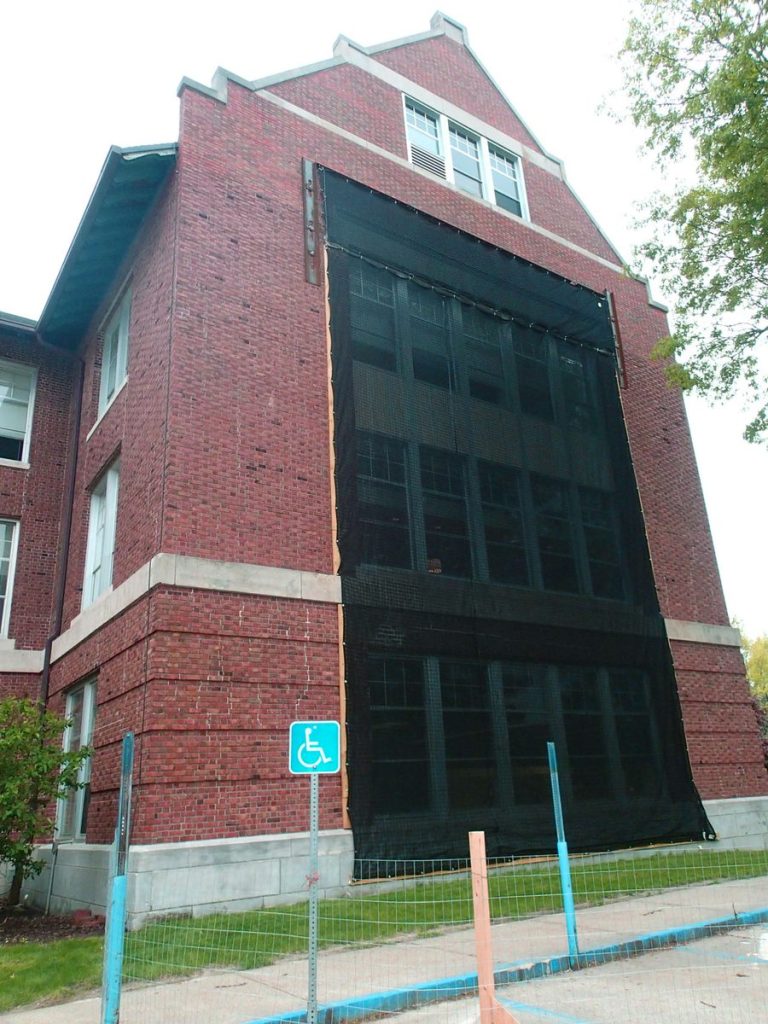
TONY BROWN/DAILY FORUM
Structural issues affecting windows, lintels, and gables of the Northwest Missouri State University Administration Building will require the possible expenditure of more than $2 million in emergency funds. The school’s Board of Regents approved the spending Friday and is seeking fiscal assistance from the Missouri Legislature. Large sheets of fabric have been spread over parts of the building in order to protect passersby from falling masonry.