
City Council approves water meter audit
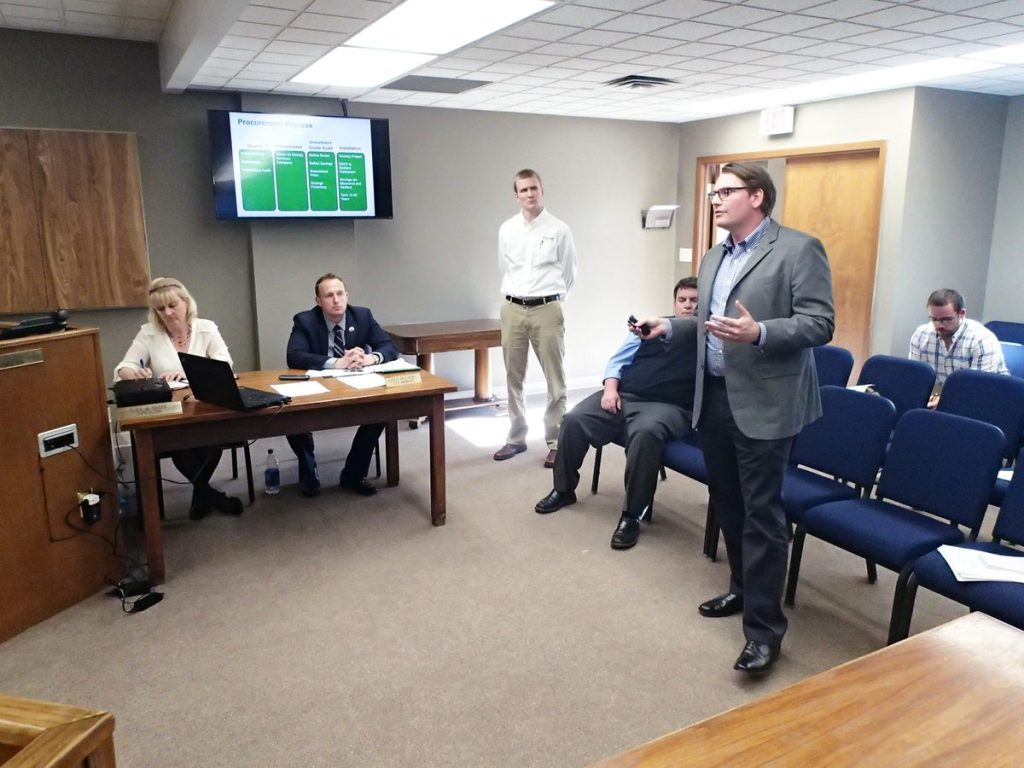
TONY BROWN/DAILY FORUM
Peter Hinkle, standing at right, a sales team leader for Schneider Electric, speaks before the Maryville City Council this week in connection with a proposal to conduct an efficiency audit of the city’s water meter system. The audit could ultimately lead to replacement of more than 4,000 water meters, perhaps as early as next year, if the data indicates such an investment, estimated at around $2 million, would prove cost effective.
The Maryville City Council this week gave the go-ahead to Schneider Electric, a multi-national company specializing in energy efficiency and automation, to proceed with an “investment grade” audit of the city’s water meters.
Maryville’s drinking water delivery system contains just over 4,000 meters of various makes and models, many of which are at least 20 years old. About 2,400 of those meters, all of which must be manually read, are hooked up to homes and apartments.
Public Works Director C.E. Goodall and his staff have been discussing the possibility of a large-scale meter upgrade for some time, but thus far the city has lacked funding to move forward on a project that will cost an estimated $2 million.
Now, a solution may be at hand.
Peter Hinkle, Schneider’s Midwest sales team leader, told the council that, pending results of the audit — which will entail the removal and inspection of about 80 water meters citywide — the company is prepared to guarantee recovery of municipal investment in meter replacement over a period of seven to 10 years through reduced water waste and more accurate billing.
Should the payback fail to materialize during the agreed upon time, Schneider would be obligated to write the city a check for the difference.
The guarantee, Hinkle said, effectively “shifts the risk” of recovering funds from a major capital investment from City Hall to the contractor.
It is likely the city would cover the initial cost of replacing meters with some type of debt financing.
After consulting with Public Works staff and comparing the amount of water treated with the number of gallons paid for by water service customers, Hinkle estimated that Maryville has an unmetered or incorrectly metered wastage rate of around 13 percent.
While some wastage is inevitable due to pipe breaks, firefighting, hydrant flushing, and other activities, Hinkle said Maryville’s rate is on the high side, and that the city should be able to lower its percentage of lost gallons into single digits.
The municipal treatment plant currently produces about 550,000,000 gallons of drinking water each year.
Schneider has undertaken similar projects in other Missouri communities, including Kirksville, where the initial wastage rate exceeded 17 percent, and Richmond, which was losing an estimated 43 percent of its treated water to leaks and other inefficiencies.
Aside from more accurate billing, Hinkle said replacing virtually all of the city’s water meters would result in other advantages as well, including the addition of “automated metering infrastructure,” technology that would allow municipal staff to read every meter in the city from a single location at the touch of a button.
This is a bigger plus for the city than one might think, since it takes three weeks worth of eight-hour days for a worker to manually read each of the city’s 4,080 meters. If meters were read remotely, that employee could be reassigned to maintenance tasks that have a direct impact on system performance.
Automated metering technology would also collect usage data that homeowners and businesses could use to detect “pinhole” leaks, running toilets, and other problems related to higher-than-expected water bills. Currently, Goodall said, it is often unclear if the responsibility for such issues should be assigned to the city or the property owner.
Of course, new meters will mean more expense for customers now being under-billed due to inaccurate or malfunctioning devices. However, Hinkle said replacing meters will ensure “a level playing field” where everyone pays their fair share.
As things stand now, the city is committed only to the meter audit, which is to be carried out this summer at a cost of $22,500.
Money for the audit is available because a bid for water tower maintenance, budgeted at $250,000, came in at only $147,000. The bid includes inspections of the city’s north and south water towers, meaning that another $20,000 set aside for that purpose can be spent on other water system projects.
Should the City Council elect to proceed with townwide meter replacement, Hinkle said the cost of the audit would be rolled into the overall financing package.
In other business this week, the council:
• Approved an amended request for this year’s Special Olympics Torch Run on Tuesday, May 17, which once again is being organized by James Runde of the Maryville Treatment Center.
The time for the run, which will begin on the west courthouse lawn and proceed south on Main Street to the Kawasaki Motors plant, has been moved up to 9 a.m. In addition, the event will include a walk that will also start at the courthouse, move west on Fourth Street to Northwest Missouri State University, turn east on Seventh, and return to the courthouse via North Main.
• Approved a resolution declaring the city’s intention to issue a maximum of $4.5 million in certificates of participation financing for construction of a new conference center and clubhouse at Mozingo Lake Recreation Park.
The debt is to be repaid over 20 years using proceeds from a one-eighth-cent on the dollar sales tax that goes into effect Oct. 1 plus funds currently earmarked for debt service on paved cart paths at Mozingo’s Sechrest 18 golf course, an obligation that ends in June 2017.




