
CTRIP-driven demolitions continue
TONY BROWN/DAILY FORUM
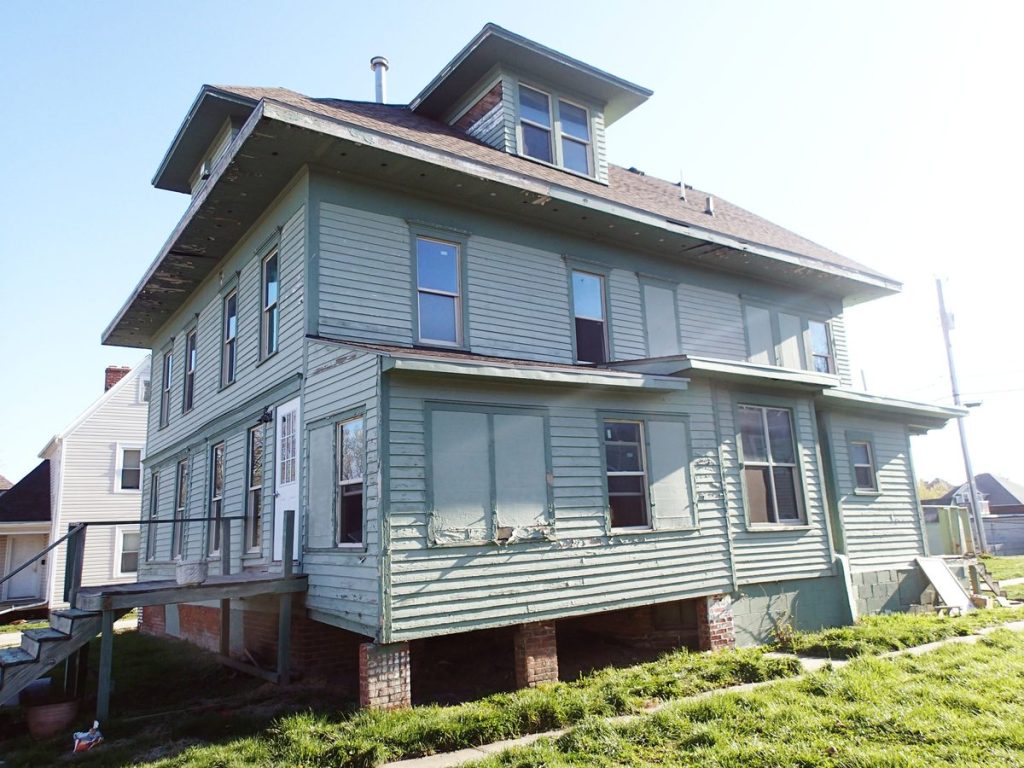
This derelict two-story house, long divided into apartments, will soon be among the growing number of substandard structures demolished in order to make way for new development under the City of Maryville’s Campus Town Redevelopment Incentive Program.
More new apartments in the central Maryville neighborhoods west of North Main Street are on the way under the city’s Campus Town Redevelopment Incentive Program.
City Manager Greg McDanel said this week that local developer Curt Tobin recently acquired a derelict two-story house, which had been divided into several apartments, at 611 N. Buchanan Street and plans to demolish the structure in order to replace it with new multi-family construction.
McDanel said the clapboard structure will be demolished within the next few months, and that the new apartments should be completed within a year to a year and a half.
Tobin previously took advantage of the CTRIP program to remove substandard buildings at Eighth and Walnut streets and replace them with duplexes.
The CTRIP process allows landowners and potential developers working within the Campus Town zoning overlay district to submit an application and development plans that, if approved by the city, result in the waiver of demolition debris “tipping fees” at Maryville’s solid waste transfer station as well as all construction permit fees associated with redevelopment.
Applications are considered in light of a number of factors, including condition of existing structures, quality of the redevelopment plan, tax base impact, and improvement to the overall appearance of the neighborhood.
In early 2015, the City Council renewed CTRIP for an additional two years and, on the recommendation of municipal staff, eliminated a $20,000 cap on the tipping fee waiver, since it was feared leaving the cap in place might, at some point, discourage large-scale development.
The Campus Town overlay district was created in 2012 and designated in the city’s comprehensive plan as an area suitable for “infill and redevelopment” in the form of high-density rental housing.
The overlay — an area to which special zoning restrictions or exceptions apply — comprises about 40 blocks generally east of the Northwest Missouri State University campus and stretching north to south from Twelfth Street to just north of Second Street and east to west from Main Street (excluding downtown) to the university.
In February of this year the council, at McDanel’s urging, further expanded CTRIP by providing incentives for redevelopment in all parts of the city, including downtown.
The new efforts include the Revitalizing Maryville 2016 initiative, which applies to all residential, commercial, and industrial properties outside of Campus Town. Eligible property owners receive a discount on tipping fees at the transfer station along with fee waivers for demolition and construction permits.
A related townwide single-family residential program waives all tipping and permit fees, and is designed to encourage developers to build more “entry-level” homes priced under $150,000.
A third area of the development incentive expansion pertains to downtown, an area defined in the city’s comprehensive plan as running north to south from Seventh to Jenkins streets and east to west from Vine to Fillmore.
Property owners in those blocks are now able to build new structures or remodel existing buildings without paying either debris disposal charges or permit fees.
While the original CTRIP initiative has been extended, the three newer programs will likely expire Aug. 13 when control of the transfer station passes from City Hall to a consortium of private haulers who have agreed to lease the facility and run it as a private business.
That means the city will control tipping fees at the station — the per-ton charge for dumping — for only another four months.




