A Day in the Life: Rego Jones, plant specialist
By JENNIFER DITLEVSON HAGLUND Staff writer
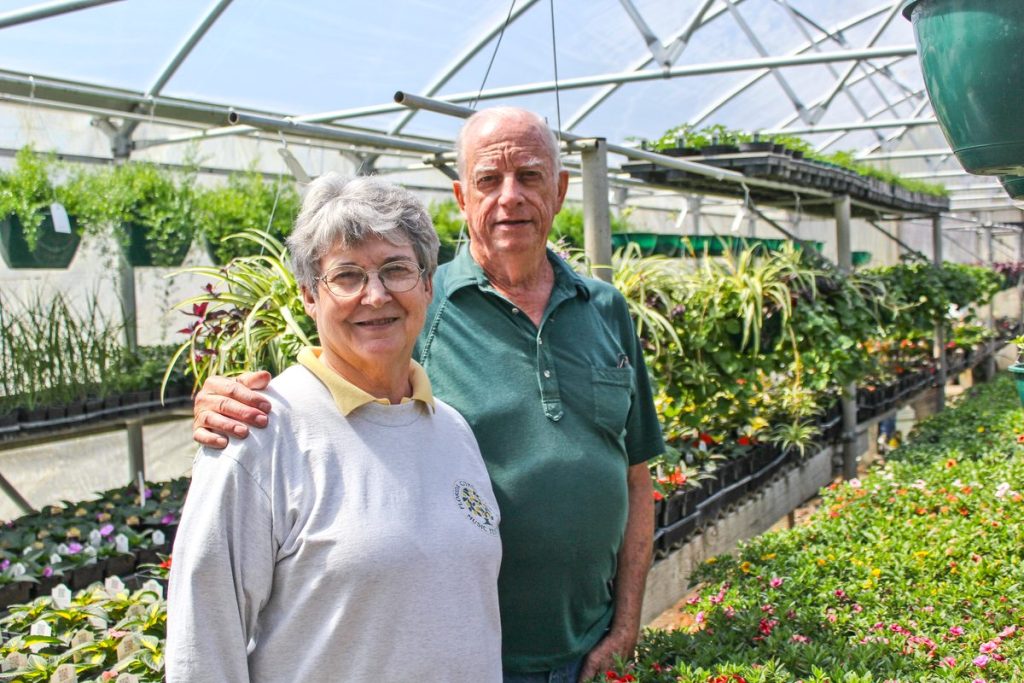
Rego Jones runs The Plant House with his wife Winnifred Jones. The Joneses celebrate 50 years in the plant business this year.
Between digging in books and in soil, Rego Jones has divided his time studying plants for 50 years.
Jones said his family always tended large gardens. When his parents purchased three small greenhouses in 1966, he had no idea it would change his life.
Fifty years later, those glass greenhouses that took up about 3,000 square feet have turned into a much bigger operation.
What was supposed to be a hobby for his mother turned into a family business on the north side of Maryville on Business Highway 71.
The Plant House, according to Jones, now has 10 times the capacity it had at purchase.
Since 1977, Jones has been teaching agricultural science at Northwest Missouri State University. For the last 14 years, he has been working at Northwest full-time.
When he’s not teaching, Jones gets his hands dirty working in a dozen greenhouses.
Monday through Friday, Jones teaches classes at 8 a.m. and 11 a.m. At noon, he heads to the greenhouses. During the growing season, he can be there from noon until after dark.
But long hours at The Plant House don’t bother him.
“It’s not monotonous,” Jones said. “There’s a lot of diversity in the work you do.”
Some daily duties could include repairing furnaces, potting plants, and ordering seeds.
“The most annoying thing is dealing with weather,” Jones said.
Being prepared helps, but it’s never a welcome surprise when the weather drops below 20 degrees Fahrenheit, and Jones has to answer alarms going off at the greenhouses. If a furnace goes out at that temperature, he has about 30 minutes before he loses an entire crop of plants.
Much has changed in the greenhouse industry since the 1960s when Jones began. All the glass has been replaced with polyethylene covers that can withstand hailstorms, snow, and heavy winds.
Also, Jones has noticed that people are less interested in buying plants from seed or at young stages. They, according to Jones, are less like gardeners and more like landscape artists.
“They want instant gratification,” he said.
Knowing which plants will sell can be tricky. Jones said that before social media took over, many of his customers took cues from Martha Stewart about what kinds and colors looked best around the house.
Over the years, Jones’ practices have changed, too. At the greenhouses, he used to do things mostly from seeds. These days, it’s a mix of seeds and unrooted cuttings.
There’s a lot to keep up with, though, when there are nearly 900 varieties of plants to tend.
Dramatic changes to his industry haven’t just affected the greenhouse business, according to Jones.
When Jones began as an adjunct instructor at Northwest, the agricultural science program at the college wasn’t as varied in course offerings. Now Jones teaches about plant diseases and landscape design and upper-level special interest topics like herbacious perennials and woody plants.
Jones’ interest in plants grew from his love of natural sciences. While Jones was serving in the military as a Chinese translator in Japan for four years, he learned more about different species of plants and horticultural practices.
As an instructor, he’s taken classes to Puerto Rico, Florida, Hawaii, and California to study plants and farming techniques there.
“We want to expose students to all the facets of agriculture,” Jones said.
Jones admits he’s old enough to retire, but he has no immediate plans to do so. In fact, he’s organizing curriculum for a new course.
This fall, Jones will pass teaching duties for applied entomology to a new hire, which will enable him to teach a new class about food as it relates to culture, processing, and marketing.
“When you talk to people, they have no clue where food comes from,” said Jones. “I think it will be an interesting course.”
Not even out of his office yet, still sitting behind stacks of bug collections from last semester, Jones said he was thinking about the few thousand sweet potato cuttings he had to get to that afternoon. The books would have to wait a little longer.