Woman’s martial arts journey leads to black belt
TONY BROWN/DAILY FORUM
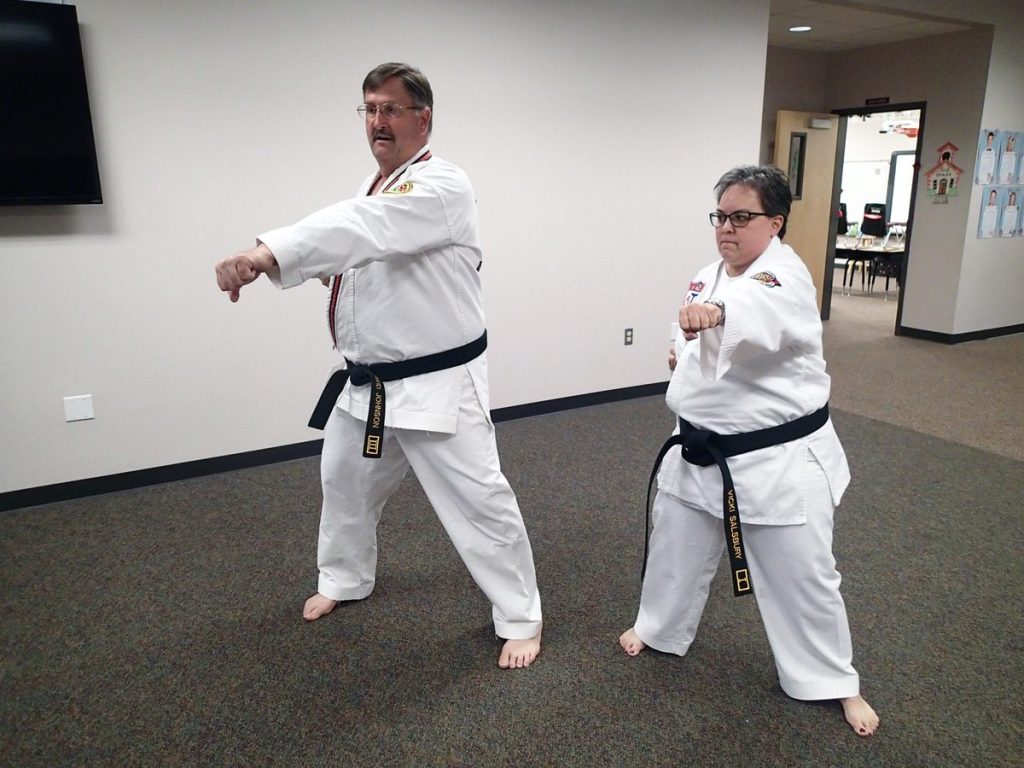
Instructor David Johnson and newly elevated Taekwondo black belt Vicki Salsbury go through some moves during a recent martial arts session at the South Nodaway R-IV School in Barnard. “Certainly we can defend ourselves if we’re challenged,” said Salsbury, who can break a 1-by-12 board with her bare hands, “but it’s much more about discipline. We’re supposed to be disciplined enough to avert any situation we find ourselves in.”
Though she’s just earned her first-degree black belt through the American Taekwondo Association, Vicki Salsbury, Maryville, says she is still just a traveler on a never-ending path followed by those who seek, but never achieve, perfection by studying a martial art.
To me it’s very humbling,” Salsbury said during a recent evening practice session led by ATA instructor David Johnson at the South Nodaway R-IV School in Barnard.
“I was pretty surprised by some of the emotion that I felt (upon receiving a black belt). It’s definitely a milestone. But I’m not done. I’m not stopping.”
Salsbury, 53, who lives in Maryville, began her Taekwondo journey four years ago simply because she was looking for a new hobby. She thought getting a little exercise wouldn’t be a bad idea either.
What she found instead was a passion, a different way of seeing the world that encouraged her to take a hard look at who she is and what she wants to be.
“Respect, loyalty, perseverance, discipline — those are all qualities that have been meaningful to me,” said the Northwest Missouri State University graduate and former physical education teacher. “Martial arts just keeps that in your face, and I never want to misrepresent what this belt means.”
Although practitioners trace Taekwondo’s roots back to ancient Korea, the history of this particular martial art is modern and begins in the mid-20th century.
Taekwondo became a recognized self-defense style in 1955 when South Korean Gen. Hong Hi Choi organized a movement to unify Korea’s various martial arts systems.
The phrase is actually a combination of three Chinese/Korean words: Tae, meaning to kick or jump; Kwon, meaning fist or hand; and Do, which means “the way.” The coinage is loosely translated as “the way of the hand and foot.”
In the 1960’s Taekwondo began to spread internationally, becoming especially popular in the United States. In the 1980s and ’90s it evolved into what was considered primarily a combat sport, although self-defense, fitness, and a philosophy emphasizing self-discipline and self-knowledge remained crucial elements of Songahm Taekwondo, the style supported by the ATA.
When she took up the sport in 2012, Salsbury began climbing a nine-belt ladder leading to the hallmark black sash, which bears her name embroidered in gold. She now begins a similar trek through the nine ascending black-belt degrees.
Belt colors preceding black include white for beginners, orange, yellow, camouflage, green, purple, blue, brown, and red.
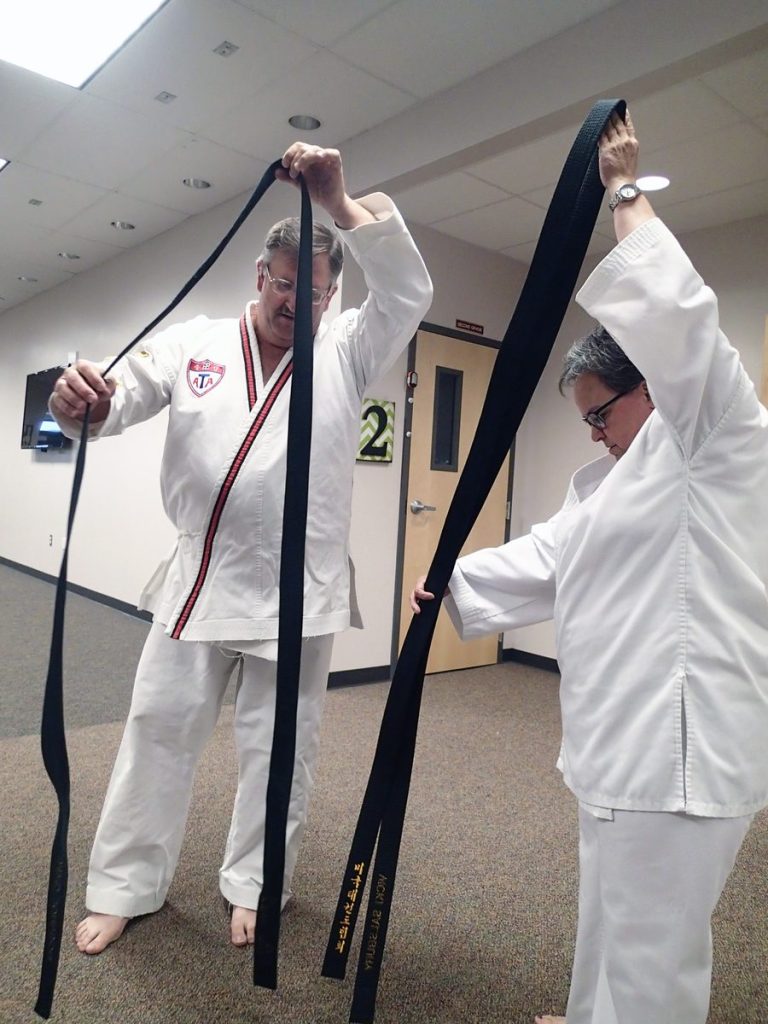
Unlike earlier belts, black belts are long enough to circle the waist twice. Johnson explained this symbolizes the path of the black-belt practitioner being “twice as difficult, twice as long, and requiring twice the responsibility to teach others and to give back.”
Black-belt holders, Johnson said, are “charged with planting seeds for the future, of finding that person with a white belt” and helping them.
“It’s quite a lengthy journey, and it means something different to everybody,” Salsbury said. “People ask, ‘How long does it take the average person to get a black belt?’ The answer is that the average person doesn’t get a black belt.”
While the uninitiated may see Taekwondo and other martial arts as primarily about fighting, Salsbury said there is a lot more to it than “just punching and kicking.”
Indeed, Taekwondo students begin each practice session or competition with a pledge that reads in part: “I shall live with perseverance in the spirit of Taekwondo, having honor with others, integrity within myself, and self-control of my actions.”
“Certainly we can defend ourselves if we’re challenged,” said Salsbury, who can break a 1-by-12 board with her bare hands, “but it’s much more about discipline. We’re supposed to be disciplined enough to avert any situation we find ourselves in.”
Another part of that discipline involves making one’s body do things it doesn’t necessarily want to do — especially in one’s early 50s.
“Hands down, the physical aspect is the hardest,” Salsbury said. “To do it at the standard that I want to do it, my body just doesn’t want to cooperate.”
But besides discipline Taekwondo masters also counsel patience. Top-degree black belts are not earned in a day.
“You don’t have to be perfect,” Salsbury said, “but you do have to have the heart. You have to do your best. Sometimes I tell David, ‘That’s not possible,’ and he says, ‘No, it’s not possible today, but it may be possible tomorrow.”
Salsbury’s advice to anyone curious about the martial arts is to try it and not get discouraged.
“Don’t be intimidated,” she said. “You see the movies with Bruce Lee and Chuck Norris, and they are very schooled and very controlled, but it doesn’t start that way, and it doesn’t have to. I can look back at 2012 and do a front kick and not feel like I’m awkward anymore.”
TONY BROWN/DAILY FORUM
Taekwondo instructor David Johnson shows student Vicki Salsbury how to tie her newly bestowed black belt. Unlike lesser Taekwondo belts, black belts are long enough to circle the waist twice, which symbolizes that the wearer’s martial arts journey is twice as difficult, twice as long, and requires twice the responsibility to teach others.