Northwest regents freeze tuition, approve fees
TONY BROWN/DAILY FORUM
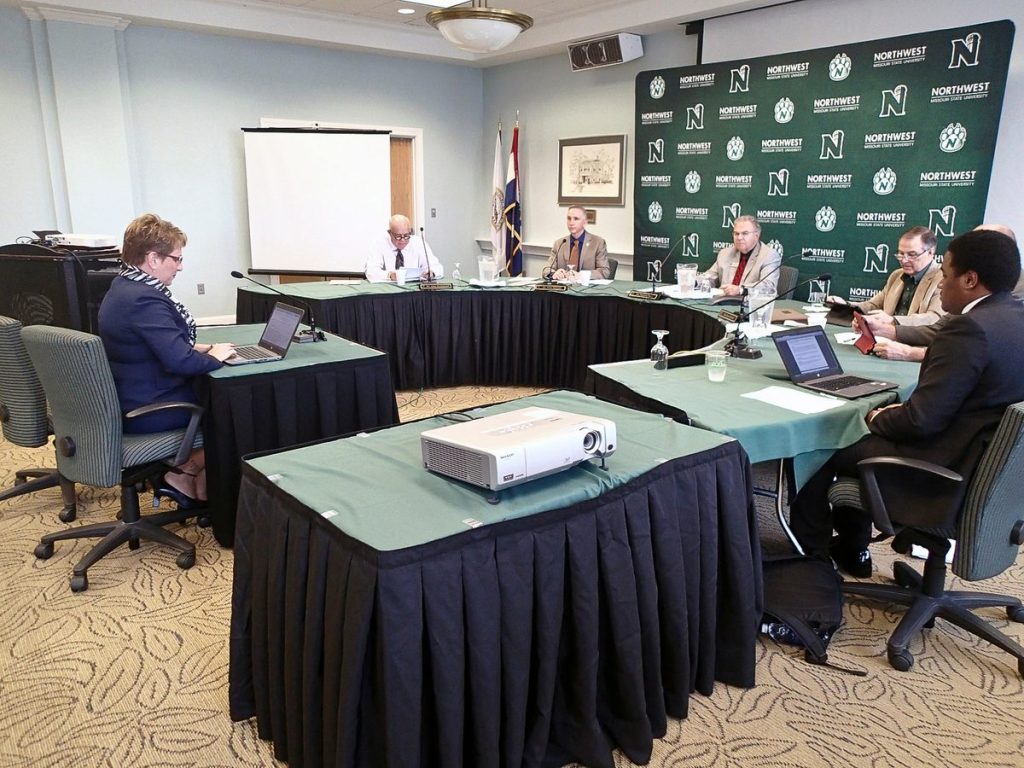
Stacy Carrick, seated left, Northwest Missouri State University’s vice president of finance, addresses the Board of Regents and President John Jasinski on Monday prior to the governing panel’s vote to approve tuition and fees for the 2016-2017 academic year. Tuition will remain unchanged for Northwest students next fall, but three new or increased designated fees will raise their total per-credit-hour cost by $24.
Tuition for students at Northwest Missouri State University won’t increase next fall, but fees will.
Following earlier approval by the Student Senate, the Northwest Board of Regents on Monday approved a new $20-per-credit-hour fee that will be used for facility and infrastructure improvements on the Maryville campus.
Specific projects have yet to be announced but will be included in a new 10-year master plan currently being prepared by Ayers Saint Gross, a Baltimore, Maryland-based architectural and design firm.
Other new designated charges include $2 per credit hour for “campus climate,” a fee that will provide funding for initiatives designed to foster “equity, diversity, and inclusion” among students, faculty, and staff.
In addition, an existing technology fee will increase by $2 from $16.70 to $18.70 in a bid to improve bandwidth and other Internet and computer resources.
Besides higher fees, students will also spend an average of $74 more per year (fall and spring semesters combined) for on-campus dining. Northwest Vice President of Finance Stacy Carrick said food cost on campus is tied to the Consumer Price Index, and that the increase averages about 2.2 percent.
The hike means students living and eating on campus will pay around $8,558 dollars for room and board in 2016-2017 compared to the current average of $8,484. Meal and room costs vary for Northwest students depending on where they live and which of several dining plans they select.
Tuition at the state-assisted university will remain flat next year at $180.61 per credit hour for Missouri-resident undergraduates and $252.86 per credit hour for resident graduate students.
Undergraduate fees will increase from $101.35 to $125.35, bringing the total resident cost per credit hour to $305.96 compared to the current total of $281.96.
Missouri graduate students, who have a slightly different fee structure, will pay $130.10 in designated fees and $252.86 in tuition for a total of $382.96. That compares to the existing per-credit-hour total of $358.96.
Undergraduate students charged out-of-state tuition will pay a combined tuition/fee per-credit-hour total in 2016-2017 of $516.64, up from $492.64. The combined out-of-state graduate total is $635.82 compared to this year’s $611.82.
Under Missouri’s legislatively imposed tuition cap, which is also tied to the Consumer Price Index, the regents could have raised undergraduate resident tuition by 0.7 percent. However, Gov. Jay Nixon has proposed adding 6 percent, or nearly $56 million, in performance-based funding to next year’s higher education budget if the state’s colleges and universities agree to leave tuition unchanged.
However, Nixon’s higher education spending plan, which totals a record $985 million, has run into trouble in the Legislature following racial unrest on the University of Missouri’s Columbia campus.
Lawmakers say the episode, which led to the resignations of UM System President Tim Wolfe and Columbia campus Chancellor R. Bowen Loftin, was handled poorly by administrators and have called for retaliatory spending cuts.
The higher education budget is still making its way through the General Assembly, but one proposal calls for cutting Nixon’s proposed 6 percent increase to 2 percent with no increase at all for the University of Missouri.
Nixon has proposed tuition freezes four times since taking office in 2009, and according to the most recent data available from the College Board, tuition and required fees at Missouri’s public universities rose by just 7 percent between 2008-’09 and 2014-’15, the smallest increase in the nation.
Carrick told the regents that Northwest has posted the lowest combined tuition increase in the United States over the past six years. She added that more than 90 percent of Northwest’s first-time freshmen receive some type of financial assistance, and that the school’s student loan default and indebtedness rates are below the national average.
Northwest President John Jasinski praised the Student Senate, and by extension the student body, for signing on to the $20-per-credit-hour master plan implementation fee, saying that the new revenue will allow the university “to take control of our own destiny” with regard to maintaining existing facilities and building new ones.
Jasinski said that the State of Missouri has provided Northwest with only $40 million in deferred maintenance funding since 1990.
On other fronts, the regents on Monday approved hiring two additional tenure-track assistant or associate professors who will teach courses in computer science and information systems.
Provost Timothy Mottet said the computer science program, which serves mostly international students from India and other South Asian countries, has generated significant revenue for Northwest in recent years, and that enrollment is expected to grow by about 30 percent next year to around 500 students.
Even with the two new hires, Mottet said he expects the computer science student-faculty ratio to be somewhere around 30 to one, or about double the national average.
Total cost of the new hires is expected to range between $177,000 and $199,000.