
March election puts Missouri into national conversation
David Goldman
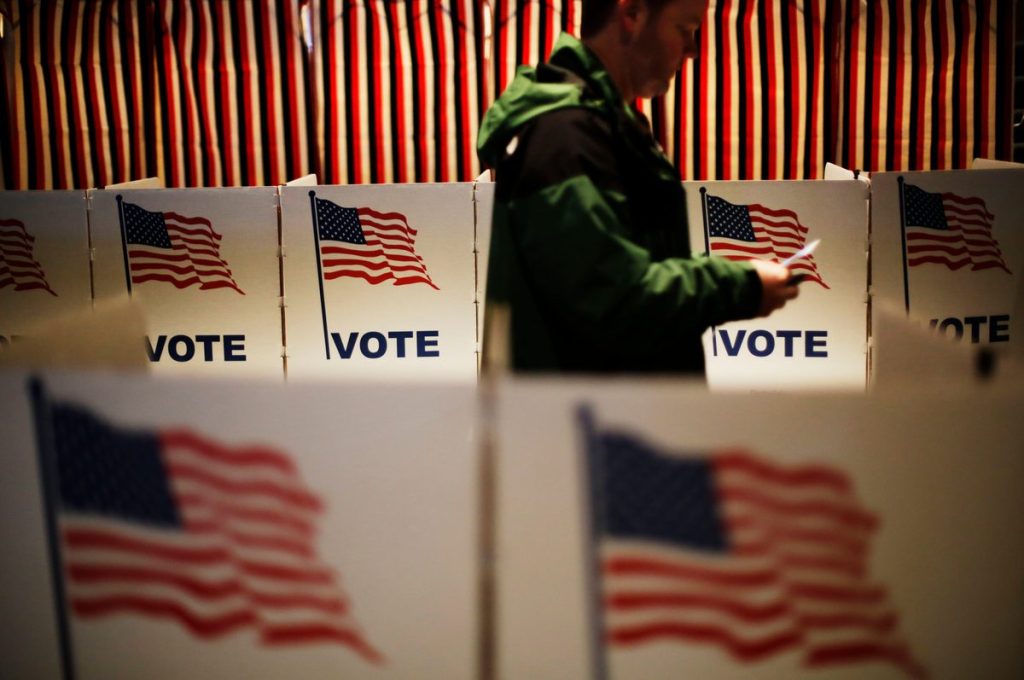
A voter walks over to machine to cast a ballot at a polling site in the New Hampshire primary Tuesday, Feb. 9, 2016, in Nashua, N.H. (AP Photo/David Goldman)
Missouri will join Florida, Illinois, North Carolina, and Ohio March 15 when it holds its presidential preference primary.
Citizens might be wondering about the purpose of having a strictly presidential primary that began in 2000 when there’s a primary election August 2.
According to Northwest Missouri State University Professor of Political Science Bob Dewhirst, it’s complicated.
Part of the answer, Dewhirst said, has to do with state legislatures wanting to get Missouri into the spotlight earlier than August.
Iowa has been leading the nation’s presidential nomination process with its caucuses since 1972. There’s no legal reason why Missouri’s northern neighbor gets to host the country’s first caucuses. It’s only a tradition, and other states want some of the attention.
“To me, it’s just the idea of making a public statement,” Dewhirst said. “We want to weigh in on the conversation.”
In 2014, Gov. Jay Nixon signed a measure that designated the second Tuesday after the first Monday in March as the presidential preference primary. This is the first day allowed by the two national political parties without incurring penalties.
In 2012, the Missouri GOP avoided delegate penalties by treating the February 2012 primary as a non-binding election, which means that votes are advisory. That’s how the primary gets the proverbial “beauty pageant” label.
“Some would argue, that should then instruct their party’s delegates to the national convention that if someone carries a state, we should be loyal to that person. Now that might happen, but there is no rule that says it has to,” Dewhirst said.
Although the March 15 election doesn’t secure delegates for any of the candidates, Dewhirst said, it lets the rest of the country know which candidates Missourians favor.
To some it may not mean much, but it’s good information for the candidates to strategize how and where to campaign, and it could affect how candidates fare a few months later.
In the last presidential preference primary in 2012, statewide, the election cost Missouri an estimated $7 million. Only 8 percent of the state’s registered voters showed up to the polls.
Nodaway County’s turnout was significantly lower, with only 6.7 percent of registered voters casting ballots. With the election costing taxpayers $25,000, if there is a similar participation in 2016, that means each vote will cost about $27.
“It wasn’t a huge turnout,” said County Clerk Karen Leader.
Leader said she finds the low numbers disappointing.
“It should be better,” Leader said. “A lot of people might think that it’s not important because the general election is not until November, but they don’t realize they’re picking the candidates for each side.”
During the last presidential election season, local involvement increased as November drew closer. In the August 2012 primary, 21 percent of registered voters in Nodaway County voted. Voter turnout in the general election for Nodaway County was 65 percent that year.
Presidential candidates filing in Missouri include Democrats Hillary Clinton, Henry Hewes, Roque “Rocky” De La Fuente, Bernie Sanders, Keith Judd, Willie L. Wilson, Martin J. O’Malley, John Wolfe, and Jon Adams. Republicans in the race include Chris Christie, Jeb Bush, Ben Carson, Donald J. Trump, Marco Rubio, Ted Cruz, Rick Santorum, Carly Fiorina, John R. Kasich, Rand Paul, Jim Lynch, and Mike Huckabee.
Libertarian candidates include Austin Petersen, Steven Elliott Kerbel, Rhett Rosenquest Smith, Cecil Ince, and Marc Allan Feldman.
Even though Christie and Bush have dropped out of the presidential race, their names will remain on the March 2015 ballots.
Write-in votes will not be permitted in the March 15 primary, and votes will be cast according to party designation.




