Voters hold key to South Main Street overhaul
PHIL COBB/DAILY FORUM
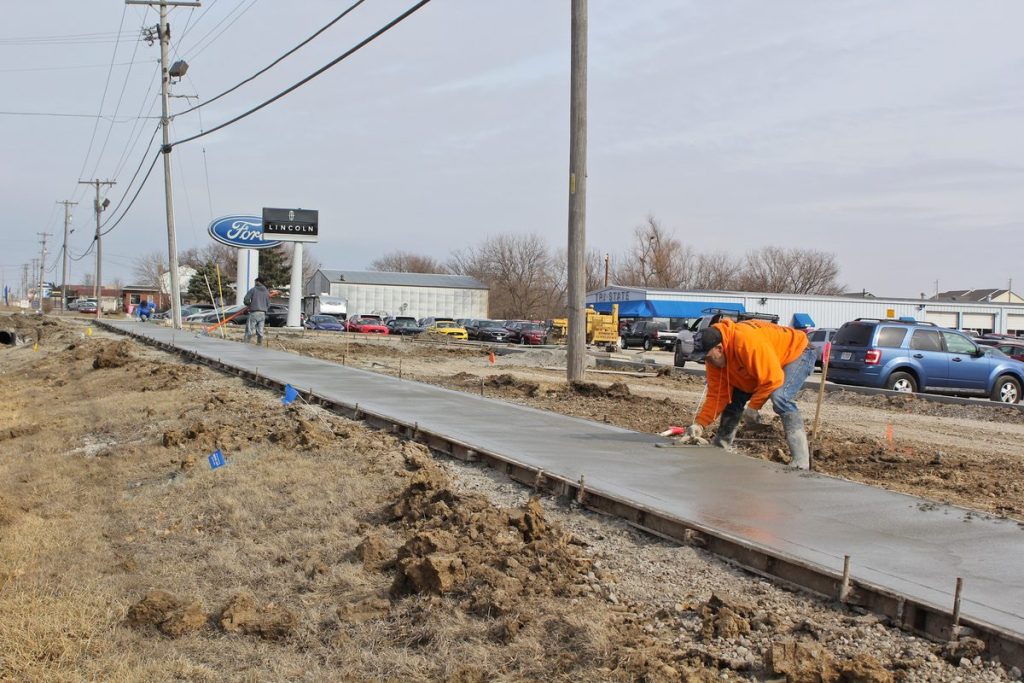
Workers from J.D. Bishop Construction Co. of Chillicothe work to install more than 400 feet of sidewalk in front of the Tri State Auto Family of dealerships Tuesday morning on South Main Street. The work is part of an extensive expansion by owner Todd Hill, which includes a new Ford Lincoln facility and the addition of a Chrysler Dodge Jeep Ram franchise. Hill planned the expansion in accordance with goals set forth in the City of Maryville’s comprehensive plan, which calls for landscaping and improved pedestrian access along the South Main corridor.
It’s not going to happen immediately, but following a green light from the Maryville City Council this week, a planned transformation of the South Main Street retail corridor into an easy-access thoroughfare — complete with improved traffic flow, aligned parking lot entrances, sidewalks, and landscaping — could be at least a partial reality within the next few years.
As expected on Monday, the council hired SK Design Group of Overland Park, Kansas, to perform engineering services along the corridor as a first step toward implementing an ambitious three-phase upgrade to be carried out over the next decade.
If all goes according to plan, City Manager Greg McDanel said, construction of Phase One could begin as early as during the summer of 2017.
Keeping to that timetable, however, requires that local citizens vote next year to renew an existing half-cent capital improvements sales tax that would provide most of the revenue for the proposed improvements.
The tax, which expires in September 2018, brings in about $1 million each year. Current revenues, and those projected over the near term, are mostly earmarked for paying off existing debt incurred for earlier projects, such as the reconstruction of South Depot Street and South Munn Avenue.
But if voters opt to renew the levy for another 10 years, McDanel said, the transformation of the South Main “strip” into a tree-lined boulevard could begin shortly after the April 2017 municipal election.
As for the SK Design agreement, a total of $108,000 has already been allocated in the current municipal budget to pay for planning and engineering. Eighty percent of that, about $86,000, will come from a Surface Transportation Program grant from the Missouri Department of Transportation.
The agreement with SK carries a not-to-exceed cost of $227,500 and calls for the firm to deliver preliminary plans, final plans, construction administration, and other services. The difference is to be made up with an allocation of around $119,000 during the 2017 budget cycle.
Until more funds are appropriated, McDanel said, SK has agreed to halt work once budgeted revenues are exhausted.
The three phases for the planned construction break down as follows: the intersection of South Main and South Avenue to just north of the northernmost entrance into Wal-Mart; from Wal-Mart to Route V; and from Route V to the Highway 71 bypass.
Plans call for the South Avenue-to-Wal-Mart leg to be done first, since the Main Street/South Avenue intersection, though recently improved with radar-controlled traffic signals, is the corridor’s main bottleneck.
In addition to aligning entryways into commercial parking lots and improving or adding turn lanes, the work is to embrace landscaping, sidewalks, and possible relocation, but not burial, of overhead power lines. Each of the three phases carries an estimated cost of about $4 million.
Maryville Public Works Director C.E. Goodall said the effort, taken as a whole, will be “a huge project” requiring close cooperation with south-end stores, shops, restaurants, and other enterprises, especially with regard to changes affecting parking lot access.
“But it’s a good project,” Goodall said. “It needs to be done.”
McDanel added that city officials have already been talking to South Main business owners and managers about the proposal, and that construction would be carried out in such a way that access to businesses along the corridor would remain open, though not unaffected.
“Businesses are going to be inconvenienced, but not closed at any point,” he said.
As for power lines, McDanel said burying overhead utility cables is cost prohibitive.
However, he said it may be possible to work with Kansas City Power & Light to move the lines so that they run behind existing commercial structures rather than along the side of the street.