Maryville council reviews Mozingo impact
TONY BROWN/DAILY FORUM
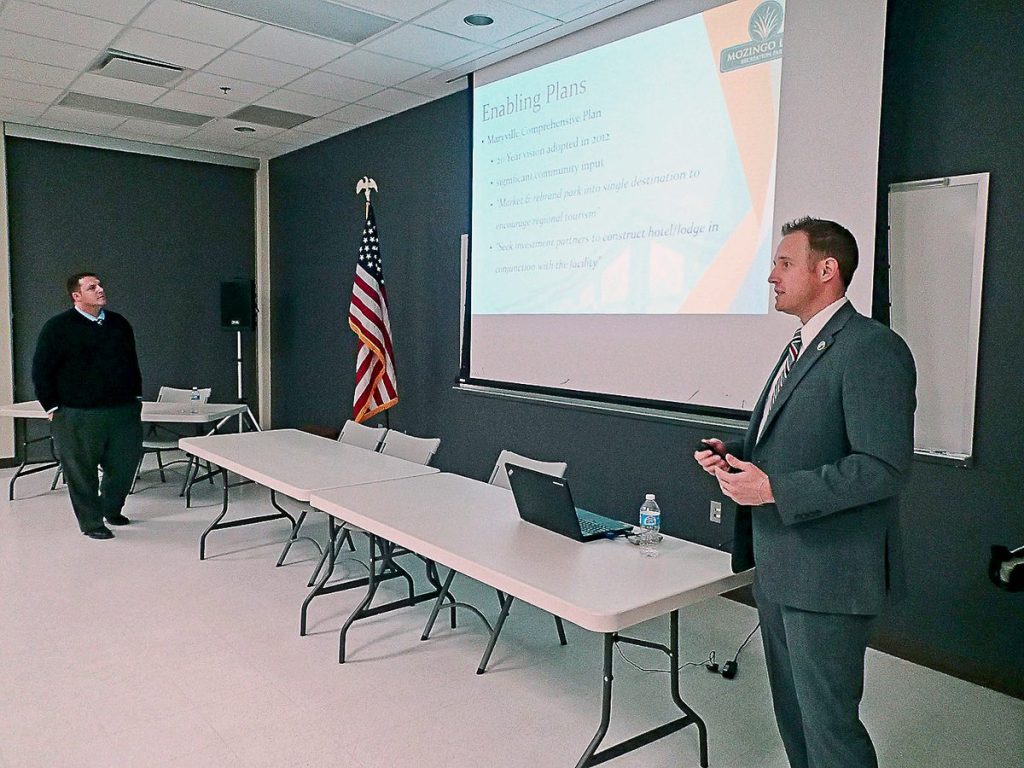
Assistant City Manager Ryan Heiland, left, and City Manager Greg McDanel recently spoke in front of an open forum to inform potential voters about two sales-tax issues being brought before them on the upcoming April election ballot. A recent economic impact study has shed light on the extent at which the local recreation park affects spending in and around Maryville.
The Maryville City Council on Monday reviewed the findings of an economic impact study for Mozingo Lake Recreation Park.
Commissioned early last year from Idaho-based consulting firm EMSI at a cost of $26,000, summarized results from the study were reported several weeks ago, including the finding that the 3,000-acre park, which surrounds a 1,000-acre reservoir, has a $2.3 million impact on the local economy in terms of income.
That’s about 0.5 percent of the area’s gross regional product and the equivalent of 134 jobs.
The total includes more than a million dollars each in local economic impacts related to operational expenditures and spending by park visitors.
At the time the survey was requested, City Manager Greg McDanel said the findings would form an important part of the effort to educate voters about proposed renewal of a half-cent Mozingo sales tax in the April 5 municipal election.
The tax provides about half of the park’s annual $1.9 million operating budget.
In addition to estimating the park’s existing economic impact, the study also gauges the short-term effect of construction of a conference center at the lake that would be financed by a proposed new eighth-of-a-cent sales tax also set to go before voters on April 5.
By applying a “multiplier effect” representing construction dollars recirculating through the local economy, EMSI estimates building the $3.5 million facility would generate $4.6 million in “sales” and just under $446,000 in labor and non-labor income.
The “short-run” income impact, the report states, is equivalent to 18 new jobs.
Other report highlights show that Mozingo’s staff of 59 full-time and part-time employees were paid $860,000 during the 2014-’15 fiscal year. Park spending also embraced an additional $1.6 million for goods and services.
In addition, EMSI research indicates that the park attracts 266,000 visitors a year from outside the local area. Spending by those visitors between October 2014 and September 2015 was said to add $1.1 million in income to the Maryville economy.
Daily out-of-park spending per non-local visitor, according to the report, averages $8.82 for lodging, $12.35 for food, $6 for transportation, and $5.60 for other goods for a total of $32.57.
EMSI estimated that out-of-park sales during the study year totaled $8.6 million, which, again taking into account the multiplier effect, should produce a total impact of $9.5 million. When added to $3 million in operations spending, that impact grows to $12.5 million.
Dividing that number by total park expenditures yields $5.15, meaning that for every $1 spent by Mozingo, an additional $4.14 in added spending is generated in Maryville.
Estimates show that the park serves around 470,000 patrons a year altogether, a number that combines local residents and out-of-towners. However that total actually reflects the number of visits and not the number of visitors, since many people use park facilities multiple times during a 12-month period.
Local residents provide nearly 43 percent of the park’s patron volume and make an average of 22.7 trips to Mozingo each year. Out-of-region visitors, by way of contrast, average 9.8 trips.
However, visitors from elsewhere spend an average of 1.4 days at the park per trip, while local residents are there an average of 1.2 days.
The most popular pastime for Mozingo visitors not from the local area is fishing, with nearly half listing that sport as the reason they came to the park.
Only about a quarter of local visitors are anglers, the survey indicates, with 40 percent marking golf as their preferred activity.
Activity totals combining both locals and people from outside the immediate area and out of state are: fishing, 36 percent; cabins/camping 34 percent; golf, 32 percent; other/boating, 7.6 percent; horseback riding, 1.9 percent; and hunting, 1.2 percent.
The figures add up to more than 100 percent because survey respondents frequently checked more than one activity.