Grant sought for household waste disposal site
TONY BROWN/DAILY FORUM
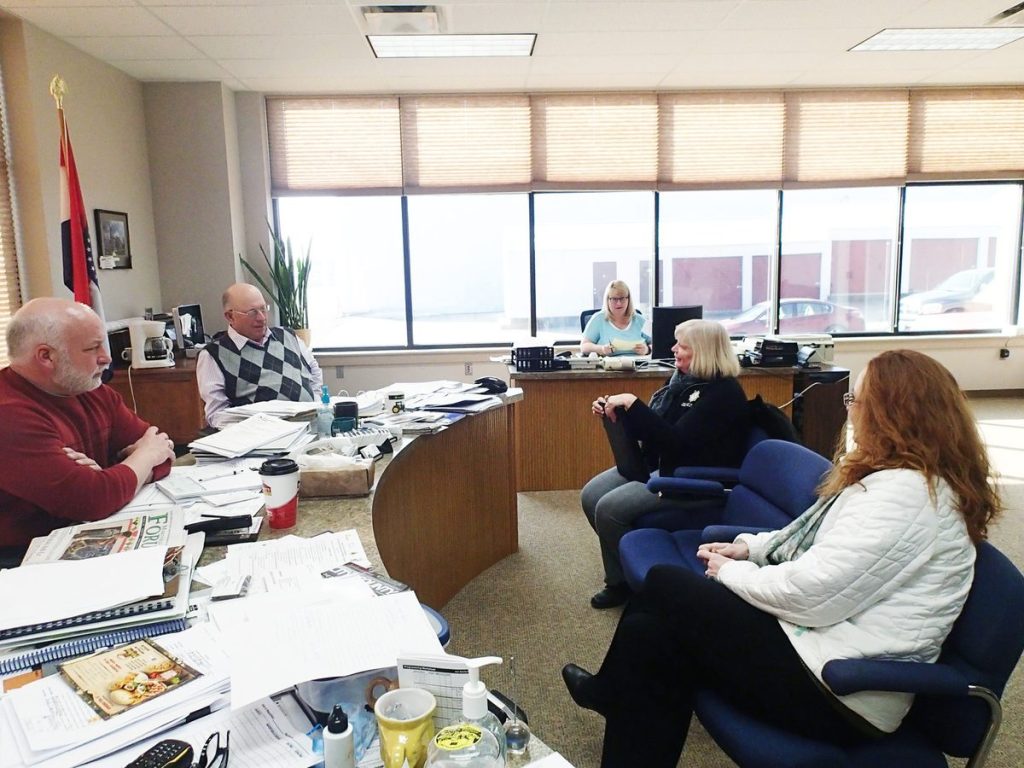
Environmental Planner Linda Laderoute, second from right, talks to members of the Nodaway County Commission Wednesday about the possibility of creating a local household hazardous waste disposal site that would be largely funded through a grant administered by the Missouri Department of Natural Resources. Also pictured, from left, are Presiding Commissioner Bill Walker, South District Commissioner Robert Stiens, County Clerk Karen Leader, and Jackie Spainhower, executive director for the Northwest Missouri Regional Council of Governments.
For the past 20 years or so the Northwest Missouri Regional Solid Waste Management District has organized annual household hazardous waste disposal events in Maryville and various other locations across its five-county service area.
That era may be coming to an end if Linda Laderoute, an environmental planner with the Northwest Missouri Regional Council of Governments, is able to secure a grant that would establish a permanent HHW receiving facility in Nodaway County.
Laderoute and Regional Council Executive Director Jackie Spainhower told the County Commission Wednesday that if the grant application is accepted by the Missouri Department of Natural Resources, the facility could be installed, possibly near the existing county road and bridge maintenance garage, sometime this summer.
All three commissioners voiced support for the project and directed Laderoute to proceed with the grant application process.
Plans are still being worked out, but the facility would probably take the form of a large metal storage container. Such containers have been adapted for use at existing HHW sites in a number of Missouri cities, Lauderoute said, including Higginsville and Rolla.
“This is something that will gain momentum statewide,” she said.
Preparation of such a container typically includes painting and adding ventilation ports and signage. The structure would not be hooked up to electricity or other utilities.
Once the facility is ready to accept waste, Laderoute said, its operation would be pretty much up to the commission. However, only certain types of hazardous waste would be permitted, and waste could be deposited only when a trained county employee is on hand to accept it.
One approach, she said, would be to open the waste facility once a week or a couple of times a month. Depending on volume, waste would be removed from the container once or twice a year by a licensed hauler for transport to an approved site for permanent disposal.
Cost estimates are preliminary pending approval of the grant, but Lauderoute said the waste site could probably be installed and operated during the first year for around $12,500. It is likely the county would be responsible for an in-kind local match that would include site preparation and wages for the operator.
Typically with such grants, Laderoute said, the local match comes to 20 percent of the total project cost.
Spainhower said she and Laderoute plan to talk with officials in the four remaining counties making up the region — Atchison, Gentry, Holt, and Worth — and hope to gauge the level of interest for such facilities in other communities.
But initially, Spainhower said, Nodaway is to serve as the “pilot” location and would likely be open to other residents living within the Solid Waste Management District service area.
Laderoute informally defined household hazardous waste as any potentially toxic or corrosive substance typically found “under the kitchen sink, under the bathroom sink, or in the garage.”
As for an official definition, the County Commission would have final say-so over what and what not to accept. Exclusions will almost certainly include gasoline and motor oil, because of their flammability, along with latex paint and alkaline batteries, which are now classified as regular domestic waste.
Typical household hazardous waste materials comprise oil-based paint, stains, antifreeze and other automotive fluids, polishes, ammonia, bleach, toilet cleaner, adhesives, pesticides, herbicides, pet sprays, florescent tubes and bulbs, thermometers, and lead-acid and lithium batteries.