City officials spread the word on Mozingo sales taxes
TONY BROWN/DAILY FORUM
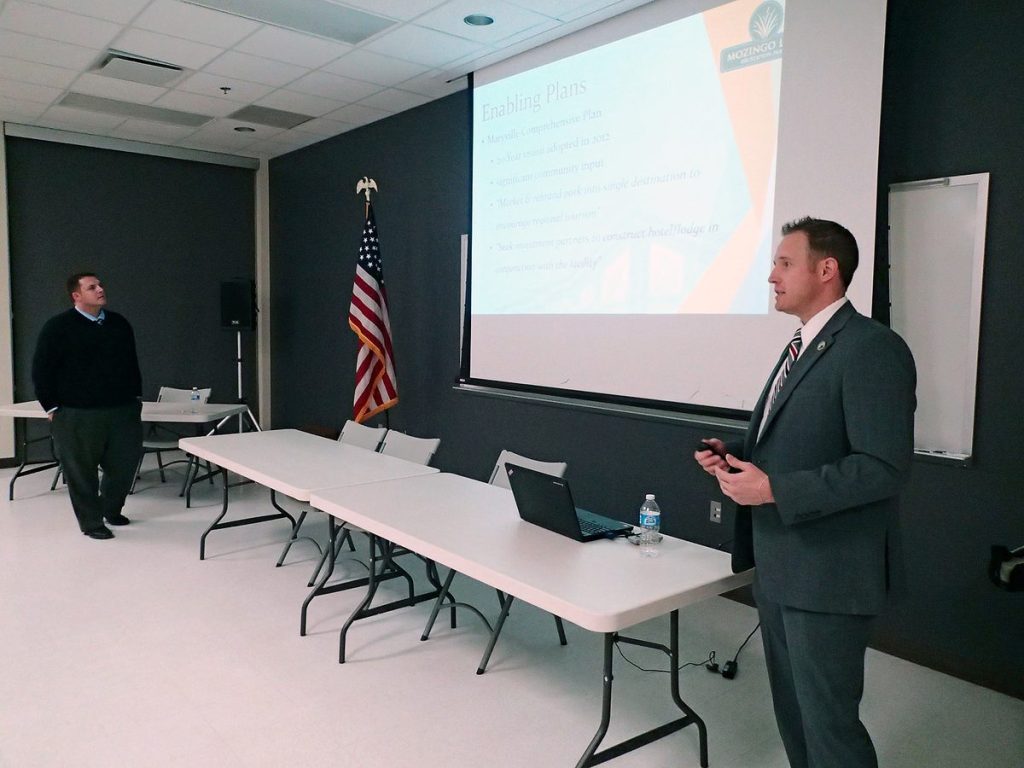
Maryville City Manager Greg McDanel, right, and Assistant City Manager Ryan Heiland speak before a small group of Maryville residents last week during an informational meeting regarding two Mozingo Lake sales tax proposals set to go before voters in the April 5 municipal election. McDanel said he has taken part in about 30 such presentations to local clubs and civic groups over the past 30 days.
If Maryville voters aren’t well educated about a couple of proposed sales tax proposals set for the April 5 municipal election ballot, it won’t be because of a lack of trying on the part of City Hall.
During a sparsely attended public meeting on the two issues last week at the Maryville Community Center, City Manager Greg McDanel said he had made the same presentation to civic groups, service clubs, and other gatherings approximately 30 times during the past month, sometimes appearing at two or three events in a single day.
That may sound like overkill, but when one considers what’s involved — millions of dollars in public spending at 3,000-acre Mozingo Lake Recreation Park over the next 20 years — the topic begins to appear like something voters really ought to spend some time thinking about.
So, here’s a summary:
The April ballot will ask voters to decide the fate of two separate sales tax measures. First, is whether or not to continue for 20 years an existing half-cent per $1 levy earmarked for operations and development at Mozingo that brings in about half the park’s $2 million annual budget.
Renewed twice since the 1,000-acre reservoir was completed in the mid-1990s, the tax is viewed by city officials as essential to maintenance of Mozingo services and facilities at their current level.
Rejection of the levy at the polls would almost certainly mean higher user fees at the park for golfers, boaters, RV enthusiasts, and patrons staying at rental cabins and the Mozingo organized youth camp. It could also mean that planned future developments, such expansion and improvement of existing RV facilities would be curtailed.
McDanel said last week that the half-cent levy has been an integral part of such park improvements as paved golf cart paths, swimming beach and boat dock improvements, and continuing shoreline stabilization efforts, which are seen as important to maintaining water purity.
Though it doesn’t get talked about much, water quality at Mozingo is a key issue, since the lake serves as the primary source of drinking water for both Maryville and the Nodaway County Public Water Supply District.
Renewal of the existing half-cent tax, McDanel said, is also important in terms of providing maintenance funds for the new Watson 9 youth golf course and continuing marketing efforts designed to realize the park’s “full potential as a regional tourist destination.”
In addition, McDanel and Assistant City Manager Ryan Heiland said a renewed half-cent sales tax will provide revenue for such planned park developments as a new welcome center; an enlarged pavilion at The Point, a lake overlook that has seen increasing use as a special events venue; and construction of additional paved walking trails
Keeping the tax on the books, McDanel said, is important enough that should voters opt not to renew it, the city will almost certainly return the issue to the ballot during the Aug. 2 state primary vote and, if necessary, the Nov. 8 general election.
As for the second sales tax question, which city officials are at pains to explain is a separate issue from maintaining existing park operations, voters will mark their ballots yes or no with regard to a proposed one-eighth-cent on the dollar levy that would finance a new $4 million conference center and golf course clubhouse.
McDanel said the measure amounts to a referendum on the center, and that its defeat would mean the structure will likely not be built until some other means of financing is available.
Should the eighth-of-a-cent tax be approved, the city would proceed with construction of the center this year in conjunction with a privately developed 40-room hotel planned by Boulders Inn & Suites of Denison, Iowa, and a local investment group.
Construction of the center has been labeled a top priority by the City Council, and municipal officials, citing a similar city-owned facility in Denison, estimate the complex could attract as many 250 events a year — everything from golf and bass tournaments to weddings and corporate retreats — attended by more than 20,000 people.
McDanel and Heiland said the center would replace the existing 20-year-old golf course clubhouse, which they described as offering limited space and suffering from structural deficiencies.
Built as a “temporary” facility about the time the lake was completed, Heiland said the clubhouse foundation consists of an inadequate 4-inch concrete pad, and that the building can hold 150 people or so at most during tournament gatherings and other events. He added that at least two golf tournaments currently held at the park attract between 300 and 400 people.
“We’re busting at the seams,” Heiland said.
The proposed new conference center, by way of contrast, would include a modular banquet hall embracing 5,500 square feet, enough, McDanel said, to seat up to 500.
Other amenities, should the sales tax win approval, are to include indoor golf cart storage, space convertible into immediate use as a storm shelter, and a full-service restaurant that will be staffed and operated by a private third-party vendor.
McDanel emphasized that both the hotel and restaurant would be private, for-profit concerns operating without any municipal subsidies or investment.
The city manager also said there are a number of reasons why the center should be built now rather than later. First of all, moving forward in conjunction with the hotel is forecast to create economies of scale.
Using the same architect for both buildings, coupled with a rebate from the hotel investment group, McDanel said, will lower design costs for the conference center from an estimated $400,000 to around $130,000.
Also, people attending center events will add an additional $370,000 in sales to the park’s existing economic impact, which city officials claim is already considerable.
According to a recent study commissioned by City Hall and undertaken by EMSI, an Idaho-based consulting firm, Mozingo currently attracts nearly 470,000 visitors a year, including repeat patrons. McDanel said the study indicates that well over half those visitors, 266,000, come from outside the region.
Total local sales generated by the park, according to the EMSI report, total just over $9.5 million.
Passage of the one-eighth-cent sales tax would raise the total local per-dollar levy on local purchases to 8.6 cents, one of the higher rates for comparable cities statewide. However, McDanel said, when current debt on the Maryville Community Center is paid off in 2021, the combined tax would drop to its current level of 8.475 cents.