Missouri Academy students share Spring Festival tradition
JENNIFER DITLEVSON HAGLUND/DAILY FORUM
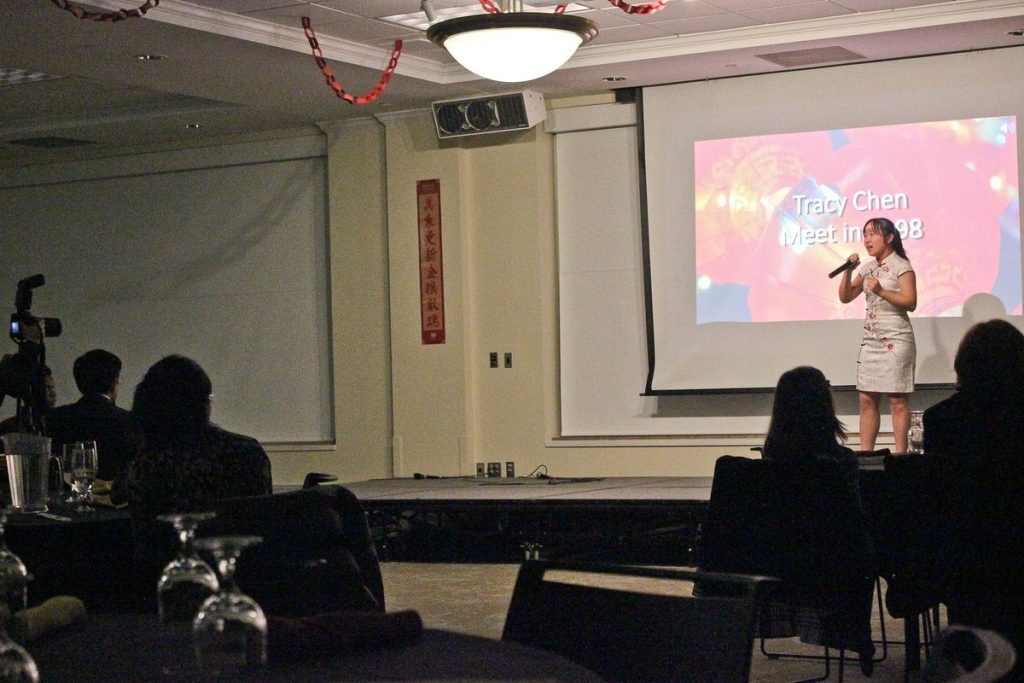
Missouri Academy student Xinyue Chen performs at the Spring Festival Gala at Northwest Missouri State University. The gala recognized the start of the lunar New Year that begins Feb. 8.
Celebrating the Spring Festival Friday evening at Northwest Missouri State University didn’t bring Xinyue Chen back to her home in China, but it helped her to share customs with schoolmates.
Spring Festival, also known as Chinese New Year is Chen’s favorite holiday. If she were in Guangzhou, which is near Hong Kong, Chen would be streaming 24-hour coverage of live performances on China Central Television and spending time with her family.
For Westerners to understand a little bit about the holiday, Chen said it would be like mixing Christmas, New Year’s Eve, and Thanksgiving into one. Then, make it bigger.
As a second-year student in Missouri Academy, Chen has grown to enjoy her friends and professors at Northwest, but she really misses her family. This time of year reminds her of all the memories she shared with her grandfather during the holiday.
“I still remember his face, and it hasn’t felt the same during Chinese New Year since,” Chen said.
At the gala, Chen performed a quiet, emotional song for her fellow students who also took turns singing for each other in the J.W. Jones Student Union ballroom.
According to Chen, stage fright doesn’t matter when it comes to celebrating. Singing karaoke-style is an integral part of the holiday activities. People do it to be funny, offer blessings, and to show off a little bit.
Heather Lange of Jefferson City said she’s learned a lot about her Missouri Academy classmates’ lives through participating in events like the gala. Before attending last year’s New Year’s party, she didn’t even know about the holiday.
“It’s a lot different from our ball drop,” Lange said. “At 12:15, people are already talking about cleaning up.”
Agreeing, MacKenzie True of Platte City said she thought the partying she saw in Times Square paled in comparison to what she discovered about Chinese New Year.
“I learned how big and elaborate everything is,” True said. “We have one night. They have two weeks.”
Festivities typically start the day before the New Year and carry on until the Lantern Festival that takes place on the 15th day of the New Year.
The two-week festival is dictated by the lunisolar Chinese calendar, so the date changes every year. This year, Feb. 8 ushers in the Year of the Monkey. The monkey is the ninth animal in a 12-year zodiac associated with the Chinese calendar.
China, however, isn’t the only country to celebrate the spring festival. People in Macau, Singapore, Thailand, Cambodia, Malaysia, Indonesia, and the Philippines recognize the holiday but often call it something different. Korea and Vietnam also observe the New Year with slight variations in starting dates according to their own calendars.
Juyeong Ihm, who is a Missouri Academy student from Seongnam, South Korea, said it’s an important holiday in his country but doesn’t last nearly as long as it does in China. In Ihm’s experience, it lasts no more than three days — the day before, of, and after New Year’s.
“It’s mostly a time for family,” Ihm said. “We share stories and life advice and drink tea during the process.”
Ihm and Chen both said they traditionally receive money as gifts from their elders. Chen said that the one good thing about not being home right now is that because she is older than 18, it is time she starts giving younger relatives “lucky money.”
Chen said she plans to attend college in the United States when she finishes at the Missouri Academy, which will make it difficult to spend the holiday with family because it takes place after most universities resume classes after winter break. By the time Chen returns, she may have to pay up. In her tradition, the older a person gets, the more money they are expected to give to children.