Maryville Comets streaked to minor league glory


NODAWAY COUNTY HISTORICAL SOCIETY
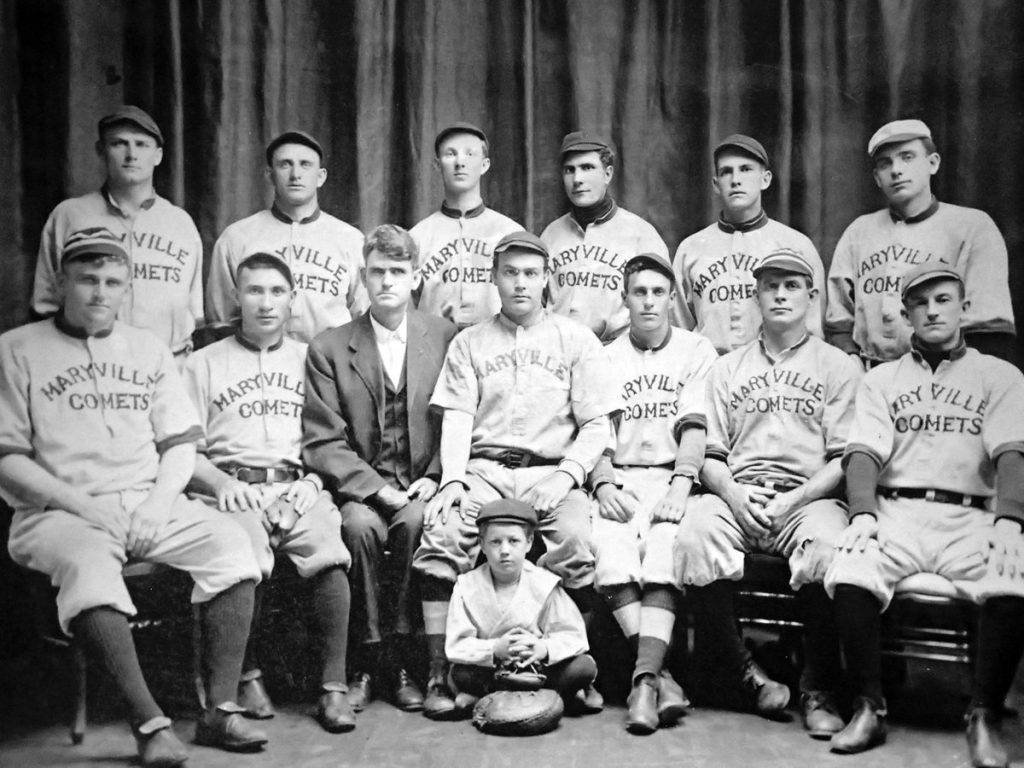
The Maryville Comets, a Class D minor league baseball team, went 45-54 in 1910 and finished fifth in the MINK league (an acronym for Missouri, Iowa, Nebraska, and Kansas). The Comets went 59-41 and won a pennant in 1911, but then moved to Humboldt, Nebraska, where the squad was renamed the Infants and soon ceased to be as the MINK fell on hard times. According to Nodaway County Historical Society records, the photo above was taken during the 1910 season.
In recent decades, the face of minor league baseball has changed dramatically. Today, large urban areas with multi-million dollar ballparks are frequently becoming the home of minor league teams that draw hundreds of thousands of fans each year.
It was much different a hundred years ago when many smaller cities and towns boasted minor league teams, including Maryville.
In 1910 and 1911, the city was a member of the fledgling Missouri-Iowa-Nebraska-Kansas League, a Class D circuit that included teams in many rural communities.
Class D was the lowest level of baseball in the National Association and is a classification that no longer exists. The current designations of Class AAA, AA, A, and rookie level began in 1963. In earlier days, leagues were classified in descending order as AA, A, B, C, and D.
The league was better known by its acronym, MINK, and like most other minor league loops did not last long, folding midway through its fourth season in 1913. There were never more than six teams in the MINK in any season.
Team nicknames in the MINK were colorful, and Maryville was no exception. The squad was called the “Comets,” and their opponents included the Clarinda (Iowa) Antelopes, the Auburn (Nebraska) Athletics, the Falls City (Nebraska) Colts, the Nebraska City Foresters, and the Shenandoah (Iowa) Pin Rollers.
The 1912 season also included a squad from Beatrice, Nebraska, called the Milkskimmers.
Several of these cities have under 6,000 residents today, including Auburn, a community of 3,500.
Small-town baseball was hardly unusual in the early 20th century. A total of 50 minor leagues crisscrossed the nation in 1910, three times the number of today. That number was topped by the minor league boom of the post-war era, when as many as 59 leagues were in operation across America in 1949.
Despite the name, teams from all four states were never represented in the MINK at any one time.
Missouri and Iowa only had teams in the league in 1910 and 1911, while Kansas only had a team in 1912.
Maryville, though, was ready to play ball. In their inaugural season of 1910, the Comets went 45-54 to finish fifth and featured an offense paced by player-manager Joe Wintz, the third baseman, who won the batting title with a .304 average.
None of the league leaders, however, ever made it to the majors, including Wintz, who lasted six seasons in pro ball, never breaking the Class D level.
Falls City went 59-40 to capture the league championship, followed by Clarinda at 57-42. The rest of the MINK was tightly bunched, as Shenandoah (47-52) nosed out Auburn (46-53), Maryville (45-54), and Nebraska City (43-56).
The 1911 season proved more satisfying for Maryville fans, if only for a while. The Comets captured the pennant at 59-41, led by pitcher Jay Erret who went 8-2 to lead the MINK in winning percentage, the highlight of a brief three-season career in pro ball.
Harry Sievers started the season as the Comets’ skipper, giving way to A.F. Bridges in mid-season.
Falls City was two games back at 57-43. Auburn was third at 52-48, followed by Shenandoah (49-51), Clarinda (43-57), and Nebraska City (40-60).
And then the Comets were gone. As was often the case in the early minors, franchises moved to new cities in mid-season. On July 10, Maryville shifted to Humboldt, Nebraska and took on a new name, the Infants.
The franchise remained in Humboldt in 1912, going 44-57 to finish fourth with many of the same players from Maryville the previous season. Nebraska City went from worst-to-first to win the pennant, but the league was beginning to sink financially.
In 1913, Humboldt was only one of four teams to open the season and the MINK was on its last legs. The Infants and Falls City both folded on July 17, driving the league out of business. The Infants were in last place at 12-20 when play ceased.
No Maryville players made it to the majors, though fans were treated to some future big leaguers, including Nebraska City outfielder Les Mann, who led the MINK in runs in 1911. Two years later, Mann broke into the majors and lasted 16 seasons, including eight as a starter. He finished with a .282 average while playing for six teams, appearing in the World Series in both 1914 and 1918.
Beatrice would again host minor league baseball in three different leagues for 13 seasons, the last in 1939. But for Maryville and the rest of the MINK cities, it would be the last kick at the can for minor league baseball. Like the many other towns that dotted the minor league landscape a century ago, memories of professional baseball in Maryville are an echo from a distant era.
EDITOR’S NOTE: Tom Emery is a freelance writer from Carlinville, Illinois, who occasionally submits feature stories to the Daily Forum on historical topics. With spring just around the corner (really!) we thought our readers would enjoy this piece about early 20th century baseball in the four-state area, when a team called the Maryville Comets was among the minor league squads in the region seeking summertime glory on the diamond.