Campus ministries offer ‘a place to land’
JENNIFER DITLEVSON HAGLUND/DAILY FORUM
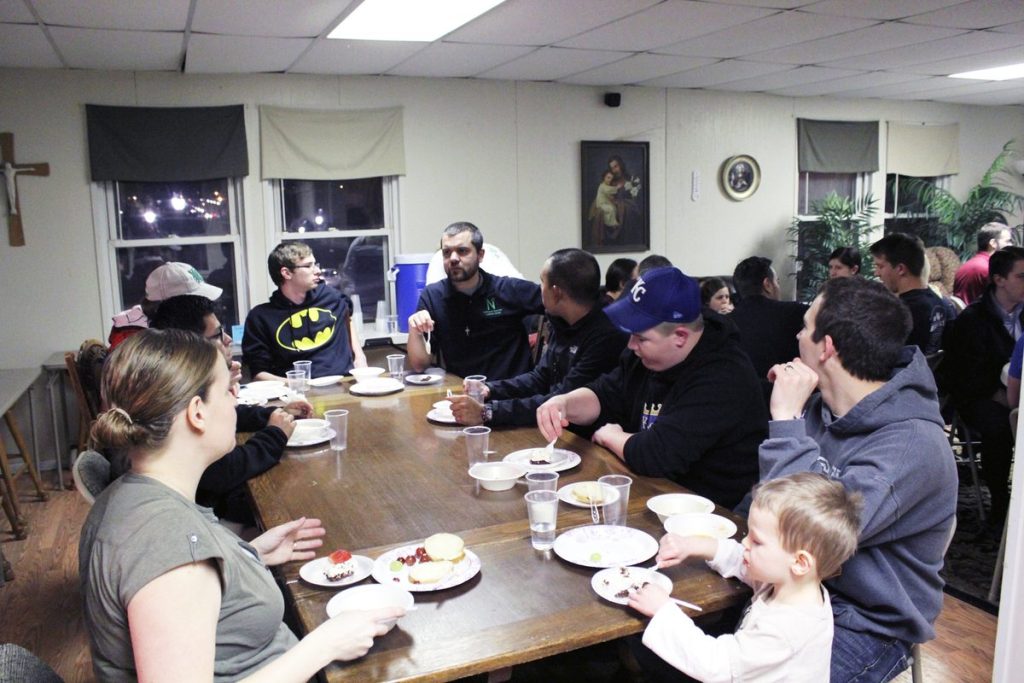
During a Wednesday night dinner at the Newman Catholic Center across the street from the Northwest Missouri State University campus, students, faculty, staff, and community members are shown eating together after celebrating Mass.
About 50 people packed inside a house on Fourth Street are taking turns serving themselves jambalaya from a Crock-Pot. There’s a little boy named Maximilian who has finished his chocolate cake already asking his mother, Andrea Huelsing, for more, even though the answer is “no.” At each table, Northwest Missouri State University students are catching up with each other.
It looks like a big family holiday gathering, but it’s just a Wednesday in late January, and this happens every week at the Newman Center across the street from the main entrance to Northwest Missouri State University following 5 p.m. Mass.
According to Mike Huelsing, team director of the Fellowship of Catholic University Students, not everyone at the Newman Catholic Center tables is Catholic. Some might not even believe in the Judeo-Christian God. But they’re here to get something to eat and visit with friends who do.
The majority of people at this gathering are Millennials, those born between 1981 and the early 2000s.
Researchers and pollsters have studied this generation ad nauseam, and with regard to religious practices their results show a definite trend: Millennials are less likely to be interested in religion compared to their parents and grandparents.
Pew Research found that 51 percent of Millennials feel a sense of “spiritual peace and well-being,” a lower number than for Generation Xers, Baby Boomers, the Silent Generation, and the Greatest Generation.
Generally, Millennials feel less grateful, ponder the meaning of life less, and feel more disconnected with the “wonder” of the universe. All of these things are considered to be aspects of spirituality.
The Pew Research study considers faith on a macro level in the United States, not focusing on any one religion. In regard to the Christian faith, however, the numbers don’t differ much. Nationally, young adults attend church less.
According to Barna Group, a research company specializing in spiritual and cultural studies, 66 percent of Millennials view churchgoers as hypocritical, and just under half of those polled responded that they felt comfortable at church.
Despite national numbers indicating a decline in religious interest by Millennials, campus ministers at Northwest said they’re not seeing the same thing.
According to Max Powlowski, who has been a Catholic campus minister for three years, participation in various activities at the Newman Center has nearly doubled in the last two years.
“I think there’s a difference between statistics and news stories out there that are in the big media and what you find when you meet people here,” Powlowski said. “I think people we meet on campus are open, maybe more than ever. Maybe they’re not going to church as much right now, but they’re more open to understand who God is and what Jesus has done for them.”
Powlowski said he has observed that non-Christian students are more open to finding out about faith when they see peers taking it seriously.
Travis Dimmitt, who took over as director of the Methodist-associated Wesley Student Center in August, said he hasn’t seen much growth, but neither has he observed much of a decline in student involvement since he was attending Northwest in the mid-1990s.
“I don’t know if we can measure fruitfulness in numbers,” Dimmitt said.
Dimmitt has been part of conversations in the Methodist church regarding how to reach young people, and he observed that, after a while, such dialogues can start to sound like a business strategy meeting, which he said misses the point.
“If the church is in decline — and the numbers bear this out — then in many cases I feel it is because we Christ followers set ourselves up for failure by treating Christianity like we’ve entered the membership roles of an exclusive club, when what Jesus commands us to do is be as inclusive as possible,” he said.
Dimmitt said that more than any outreach event or missionary work, relationships attract young people outside the church to consider converting or returning.
“God is found in relationships with people,” Dimmitt said.
For Northwest senior Lauren Foster, knowing people are praying for her throughout the week helps her stay connected to her faith and to her friends. Foster participates in activities at the Wesley Student Center, leading a game day on Fridays.
Foster grew up in a Christian family in Higginsville. When she came to college, she wasn’t searching for a place to attend church, but found herself feeling most at home with the Methodist faith community.
Foster said that when she started looking for a church, she asked herself if the preaching aligned with the Gospel and if the people were welcoming.
“At the Wesley Center, we talk a lot about taking time to listen to people instead of focusing on ourselves,” Foster said.
Dimmitt said he’s hoping young people find “a place to land” at a campus ministry, a goal shared by Lutheran Campus Center Director Shana Ziolko Marting.
This year, there are about 15 regulars at the Lutheran Campus Center, which Ziolko Marting described as providing “a kind of a family atmosphere.”
According to Ziolko Marting, students come to the center in part because they want to find a refuge from partying and other college lifestyle choices that make them uncomfortable.
They’re also looking for answers. After a secular humanist debate on campus last year, Ziolko Marting said she spent more than two hours with students at a Bible study reviewing philosophical and theological points covered in the argument.
In college, she said, students encounter new ideas and can be unsure if those ideas conflict or agree with their upbringing. Other students find that they don’t know if they agree with their upbringing anymore.
Ziolko Marting said she’s often spoken with Powlowski about how it can be difficult to present their particular faith traditions as open and welcoming because the services don’t have the same kind of relaxed appeal that other churches might have. In other words, there’s liturgy. But that doesn’t mean she’s not open to working through student questions and concerns.
Generally positive public opinion about Pope Francis may not be getting people back to church, Powlowski said, but he is seeing more people expressing a favorable view of Catholicism than before.
“I think people are uncomfortable with the world, and students are looking for what is stable and what is lasting,” Powlowski said.