Secretary of state hopeful campaigns in Nodaway
TONY BROWN/DAILY FORUM
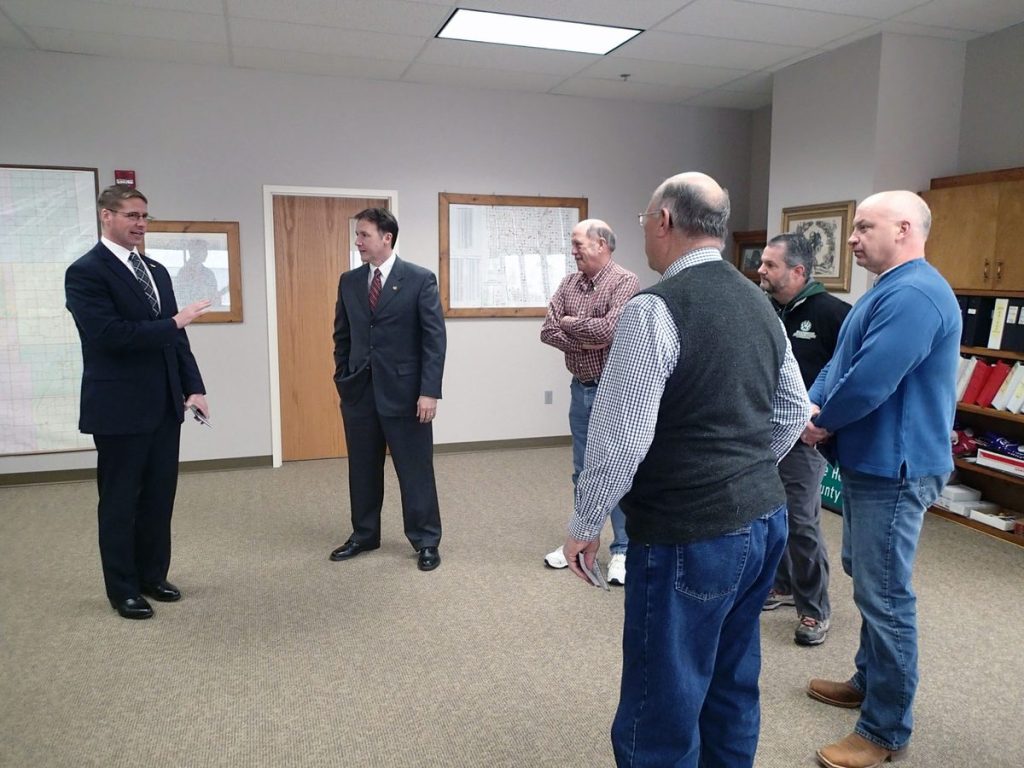
State Sen. Will Kraus, left, talks to, among others, members of the Nodaway County Commission on Friday. Kraus is seeking the Republican nomination for Missouri secretary of state. Also pictured standing clockwise are state Rep. Allen Andrews, North District Commissioner Robert Westfall, Sam Mason of KXCV-KRNW radio, Presiding Commissioner Bill Walker, and South District Commissioner Robert Stiens.
Statewide politics made a rare appearance in Maryville Friday when state Sen. Will Kraus, one of two announced Republican candidates for Missouri secretary of state, visited with members of the Nodaway County Commission along with 1st District state Rep. Allen Andrews.
Kraus was in northwest Missouri as Andrews’ guest, saying that he asked the first-term representative from Grant City for a brief meet-and-greet tour through his district, which includes Holt, Worth, Atchison, and Nodaway counties.
While in Maryville, Kraus, who grew up on a small farm near Sedalia and now lives in Lee’s Summit, also met with Northwest Missouri State University President John Jasinski, who joined commissioners Bill Walker, Robert Westfall, and Robert Stiens at the County Administration Center along with former Northwest counsel Joe Cornelison and Sam Mason of KXCV-KRNW, the university’s public radio station.
During the meeting and photo op, Kraus, 42, emphasized his rural, blue-collar upbringing, military background — he flew missions in Iraq as a U.S. Army helicopter pilot — and advocacy of keynote conservative Republican issues in both the Missouri House and Senate.
Elected to the Senate in 2010 after serving six years in the House, Kraus, a major in the Missouri National Guard, has helped push several measures through the Legislature designed to improve the lot of veterans, including a bill creating veterans’ treatment courts.
Similar to drug courts but tailored to defendants who have served in the military, such courts allow treatment for addiction and mental health issues to take precedence over jail time.
Kraus has also sponsored legislation that makes it easier for serving military personnel to vote absentee and that allows honorably discharged men and women to receive residency waivers, making them immediately eligible for in-state tuition at Missouri public colleges and universities.
Statewide, Kraus is probably best known as the chief architect of a Missouri income tax cut passed over Gov. Jay Nixon’s veto in 2014. The legislation phases in a reduction in the individual tax rate to 5.5 percent from the current 6 percent while gradually introducing a 25-percent deduction on business income reported by individuals.
The cuts are to begin in the 2017 budget year, but only if the state sees annual revenue growth of at least $150 million.
Kraus told the commissioners he has also backed a couple of election reforms that would limit the number of days in a given year when elections can be held and that establish longer deadlines for the approval of ballot language changes.
One such change in 2014 cost Missouri taxpayers $700,000 in reprinting costs, Kraus said.
Kraus said he is emphasizing his experience with election reform because the secretary of state serves as Missouri’s chief elections official. In that regard, Kraus has come out as a strong proponent of a proposal to require Missouri voters to display a photo ID before casting their ballots.
The measure is opposed by many Democrats, who maintain it is an effort to disenfranchise poor, minority voters in urban areas where many citizens lack driver’s licenses. Democratic leaders have also argued that voter fraud is not a significant problem in Missouri.
Those opposing the idea include Nixon, who vetoed a photo ID bill in 2011, saying it would hurt senior citizens and people with disabilities who are less likely to have a driver’s license or other government-issued photo ID.
Kraus claims that voter fraud is a recurring problem in Missouri, and that a photo ID requirement is needed to “keep from disenfranchising people who are voting correctly.”
He said that photo IDs are already required for a wide variety of actions, such as purchasing some over-the-counter medications, and that the process for proving one’s status as a registered voter should be at least as rigorous.
Under Kraus’ plan, photo voter IDs would be provided free of charge to citizens without driver’s licenses or some other valid document. Voters without such identification, he said, would be allowed to cast “provisional” ballots pending verification of their signature.
Charging for IDs, he said, would amount to an illegal “poll tax,” a measure long used in parts of the South to prevent poor blacks from voting.
Kraus dismissed the notion that a photo ID requirement would be similarly discriminatory, stating that of Missouri’s 4.2 million registered voters only 200,000 lack driver’s licenses.
Both Democrats and Republicans have told him they support photo voter IDs, Kraus said, adding that “a very few on the (political) left really believe this is a problem. I don’t know why.”
Turning to the campaign itself, Kraus admitted that he faces an “uphill battle” in the August Republican primary against Jay Ashcroft, an attorney and engineer from St. Louis and the son of former Missouri governor and ex-U.S. attorney general John Ashcroft.
He said he recognizes he will be “running against the money,” but believes his ironclad conservative credentials and identification with rural Missourians and veterans will carry the day.
Just who Kraus would face in November if he wins the GOP contest this summer is still an open question. Right now, Robin Smith, a former St. Louis television news anchor, is the only announced Democrat in the race.
The Democratic incumbent, Jason Kander, has announced that he is not running in order to seek the U.S. Senate seat currently held by Republican Roy Blunt.