Maryville native honored for film industry success
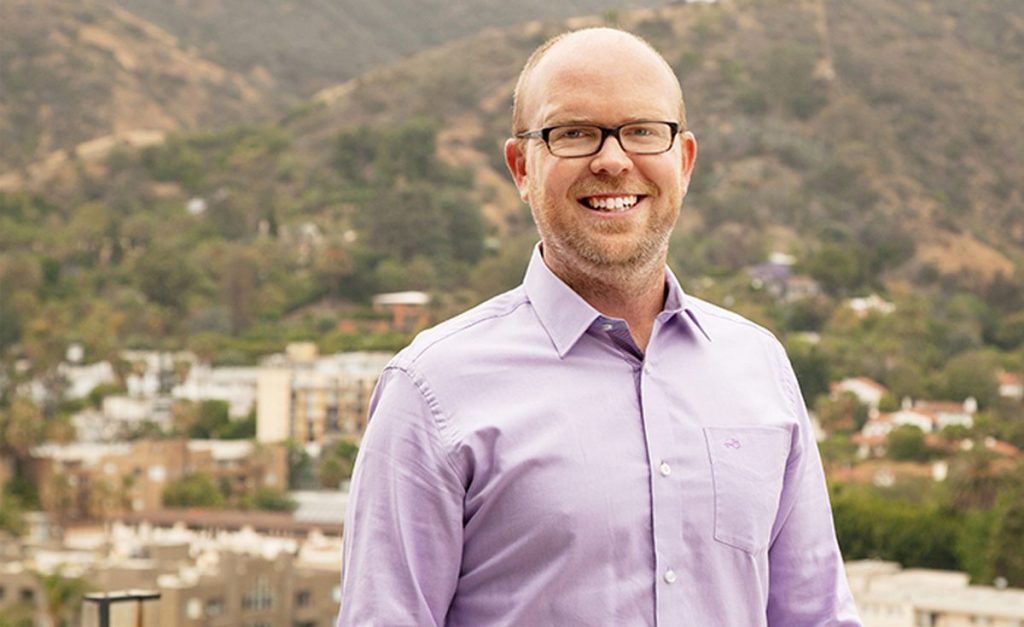
SUBMITTED PHOTO
Maryville native Bobby Gumm, a vice president at the Trailer Park Inc. advertising agency in Hollywood, Calif., recently earned multiple individual and team CLIO Key Art Awards for production work on film trailers.
LOS ANGELES, Calif. — Maryville High School graduate and Northwest Missouri State University alumnus Bobby Gumm, along with the Hollywood, Calif., advertising agency for which he works, recently claimed several honors during the 2015 CLIO Key Art Awards ceremony in Los Angeles.
Gumm, the son of Ed and Katy Gumm of Maryville, earned a broadcasting degree from Northwest in 2003 and serves as vice president of music at Trailer Park Inc., an agency whose specialties include the production of movie trailers.
Individual CLIOs awarded to Gumm recognized his work on trailers for the films “Suicide Squad” and “Mad Max: Fury Road.”
Gumm and his team earned several other CLIOs for trailers used to market such productions as “Inside Out,” “Big Hero 6,” “Jurassic World,” “Breaking Bad,” “The Hunger Games: Mockingjay Part 2,” “American Sniper,” and “Fifty Shades of Grey.”
CLIO Awards recognize innovation and creative excellence in advertising, design, and communication, as judged by an international panel of advertising professionals. Time Magazine has described the CLIO as the world’s most recognizable international advertising honor.
First presented in 1960, the awards are named for the Greek goddess Clio, the mythological Muse known as “the proclaimer, glorifier, and celebrator of history, great deeds, and accomplishments.”
“I’m very proud to have been a part of what we’ve accomplished at Trailer Park,” Gumm said. “In terms of the awards, what means the most to me is that they’re voted on by our peers in the industry. To know that all of these other, incredibly talented, people like the work you did feels really nice.”
Gumm said he developed a love for movies in his youth and is gratified to have been able to turn that passion into a career.
“As long as I can remember, I have loved movies,” Gumm said. “I watched them repeatedly and studied them. I have probably watched ‘Jaws’ more times than any healthy child should. I think I always wanted to do something related to movies, but never really knew what or if that was even an option.”
Gumm said he used connections and experience acquired as a Northwest student to land a job in the film industry after moving to California.
“I loved editing, and I moved to Los Angeles with the intention of becoming a film editor,” Gumm said. “Through a good friend and fellow Northwest graduate, Eric Mickelson, I was able to get an interview at a small ad agency he was working for, and after landing the job I kind of fell into the music supervision role.”
Gumm began his career at Intralink Film, then spent several years with Flyer Entertainment before moving to Trailer Park. During his career he has supervised more than 100 film trailers.
When he entered the field, Gumm said, music supervision was considered a stepping stone to other, higher-profile film-industry professions. But over the years, the field has grown in both importance and prestige.
One result of that change, he said, is Trailer Park has expanded from roughly 60 to almost 500 employees during his six years there.
“It’s definitely more competitive now than it’s ever been,” Gumm said. “With technological advancements in editing, compression, and turnaround times on projects getting shorter and shorter, music supervision is much more essential to the process. Now it’s crucial for any sizable company to have a music supervisor.”
But though the field is increasingly competitive, demand for qualified professionals is still growing, he said.
“At the time I started there were probably only a handful of music supervisors in town, and now there are hundreds, “Gumm said. “There’s definitely more opportunity now, but there’s also more awareness these jobs exist, and the competition is more steep.”
Gumm said there is no doubt that his success in the film industry hearkens back to his days at Northwest.
“The hands-on experiences I had with the equipment at Northwest were important,” he said. “(Faculty) got us on the equipment and software early, and we were given a chance to actually develop our skills during our time there. Spending the countless hours in the edit bay paid off, and the professors were always happy to help.”