Merged photos reveal decades of change
ELIZABETH SCHNEIDER/NORTHWEST MISSOURI STATE UNIVERSITY
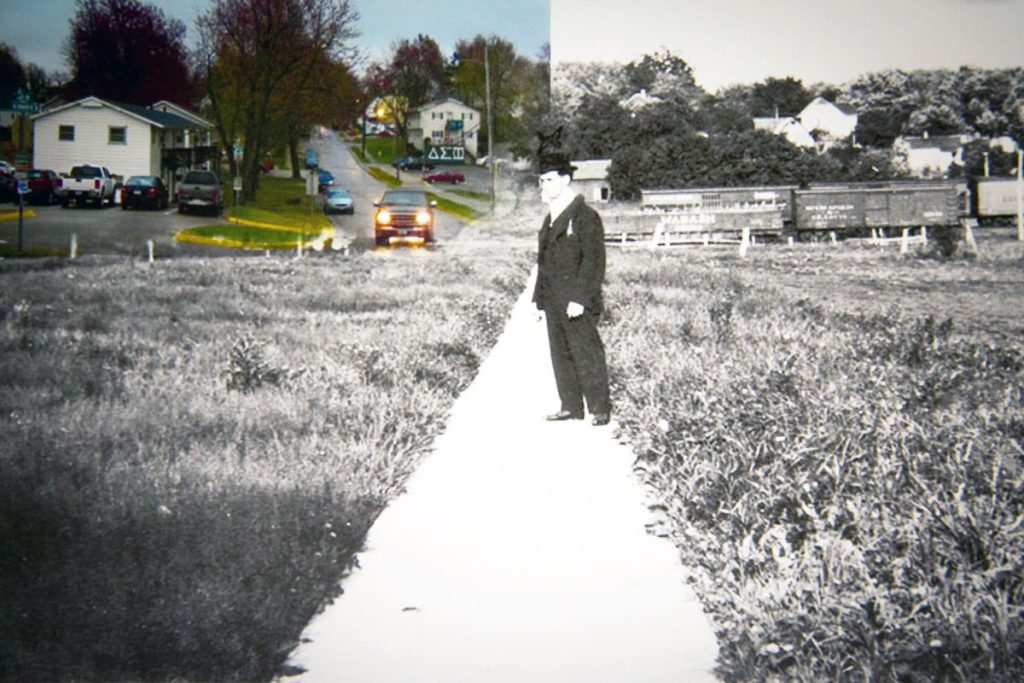
This “repeat photography” image shows the intersection at Seventh and Mulberry streets during two different eras. Northwest Missouri State University students who took Elyssa Ford’s public history course last semester have created several such merged photos, which are currently on display in the B.D. Owens Library, Valk Center, and the J.W. Jones Student Union.
MARYVILLE, Mo. — Using a combination of photographic and research skills, students at Northwest Missouri State University have developed a series of displays that combine scenes from Maryville’s past with images of its present.
The students, who took Assistant Professor Elyssa Ford’s public history course last semester, began the assignment with historic photos of various locations on campus or around town. Each student was then tasked with identifying a location and taking a new photograph of the same scene.
The process, known as repeat photography or re-photography, culminated with students combining the new and old photos to create a photo illustration depicting decades of change — or the lack of it — in a single image.
The photos are currently on display in the B.D. Owens Library, Valk Center, and the J.W. Jones Student Union.
“It was a lot of fun for them to see what Maryville and Northwest used to look like,” Ford said. “They really had to get out there and explore in order to find where their original photograph was taken and learn about what was there, what changed and why.
“A lot of times we think we know about a place just because we live there and have seen the buildings, but we don’t always think about what was there before and why it might have changed.”
The repeat photos include an image of the A&G Restaurant on a Main Street block once lined with busy shops, as well as what is now the The Palms bar during its previous incarnation as Banner Bottling Works.
In another photograph, Fourth Street in downtown Maryville is almost unrecognizable as it appeared during the early 1900s.
Campus photos show a parking lot where there were once grassy fields and railroad east of Roberta Hall along Seventh Street. A picture of the second floor of Wells Hall includes card catalogs from the building’s stint as a library.
Determining the location of the original photos was the toughest challenge many of the students faced, and the task led them to search for clues in the local public library and the Nodaway County Historical Society Museum.
Hannah Mahnken, a senior history major from Schleswig, Iowa, researched an old photo taken at East Fourth and Market streets.
“I knew it was on the square, but many of the buildings on the square have burned down over time,” Mahnken said. “The photos of then and now look almost nothing alike.”
Taking new photos from the same angle as the old images presented difficulties as well, and Mahnken had to set up her shot during the early morning to avoid traffic.
Michelle Estes, a junior math and social science education major from Parkville, worked on the photo showing the second floor of Wells Hall, which served as Northwest’s library from 1939 until the B.D. Owens Library opened in 1983.
Today, Wells is the home of the School of Communication and Mass Media.
“The photos are supposed to be identical in location and angle, but the place the original photo was taken from is now a water fountain,” Estes said. “I had to stand up on a chair and stretch over the water fountain to get a better angle. Also, the camera I was using didn’t have the same lens as the camera they used back then, so it looked a little different.”
“This was a different kind of class because we had a mix of students,” Ford said, “ social science education majors, middle school education history majors, history minors, and public history students. But this project allowed all of them to get some public history experience and learn more about the place where they have been living for the past couple of years.”