Christmas truce 1914: Peace in no man’s land
PUBLIC DOMAIN
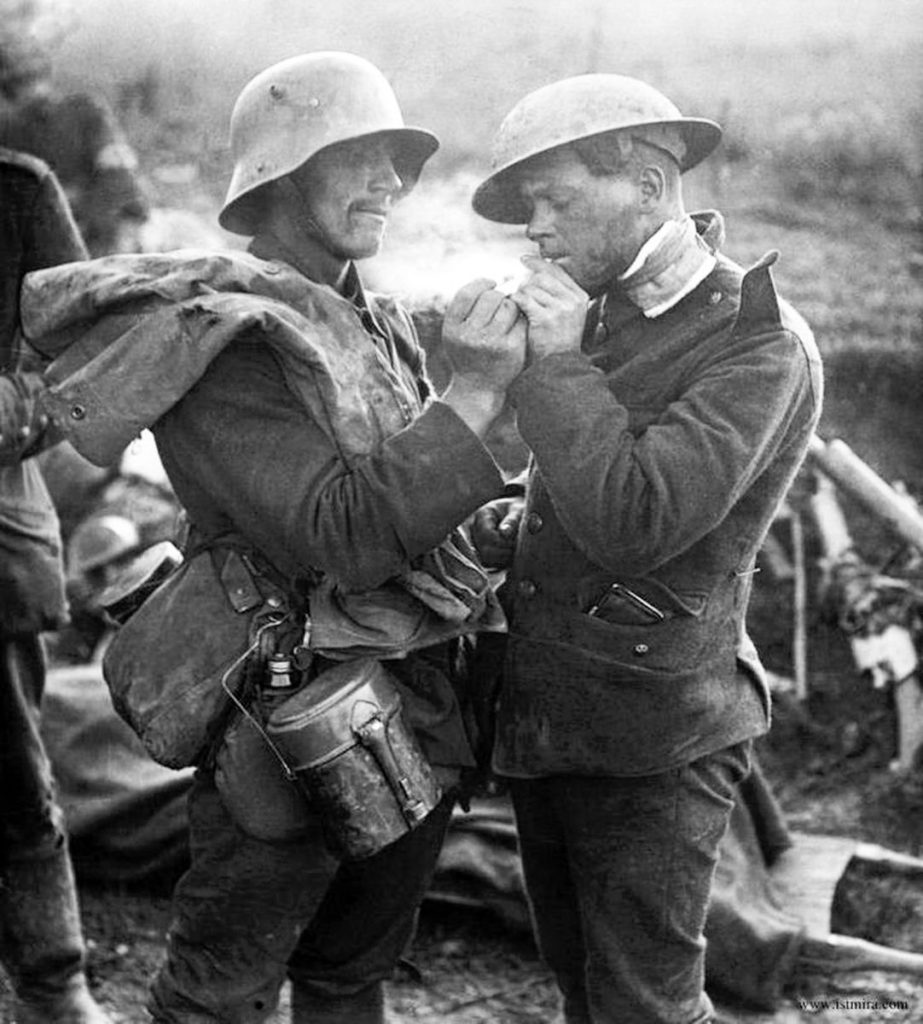
A World War I German infantryman lights a cigarette for a British soldier during the Christmas truce on the Western Front in Europe in 1914.
The First World War shocked the world with its brutality and casualties. But for a brief time at Christmas 1914, fierce enemies became warm friends.
During that first Christmas of the war, men of opposing armies in Flanders called a truce that has become the stuff of legend. While many of the stories of the cease-fire have been embellished with time, the truce stands in contrast to the nightmarish warfare that ravaged Europe.
“In some cases, the men posed for photographs wearing each other’s hats,” said Doran Cart, senior curator of the National World War I Museum in Kansas City. “They exchanged cigars and cigarettes, and drank German schnapps and British rum to celebrate the occasion.”
Accounts of the truce vary widely, and it is apparent that the truce was celebrated with different intensity, and with different length, at various spots along the lines. Much of the truce occurred between Ypres, Belgium, and Neuve-Chappelle, France, and originated when a cease-fire was called to bury the dead between the lines in “no-man’s land.”
“That’s how it started,” said Cart. “It’s certainly not unusual for both sides to request a cease-fire to take care of the dead. It kind of grew from there.”
Some report that German soldiers cheerily called “come over here” to their British counterparts, while others recall Germans placing small Christmas trees on top of their entrenchments on a frosty Christmas Eve. One British soldier compared the lit trees to “the footlights of a theater.”
Multiple accounts note that German troops began singing carols, including “Stille Nacht,” or “Silent Night.” While some Allied troops suspected a trap, many others applauded the music and responded with songs of their own.
As more trees and candles appeared on the parapets, British soldiers cheered mightily, including one who recalled that “I stayed awake the entire night. And it was a wonderful night.”
A young Bavarian officer was one of many who shouted that a Christmas truce should be made, and that both sides should leave their trenches to approach the other. He recalled that the British eventually agreed, and that “a man came out of their trenches, and I on my side did the same. … We shook hands a bit cautiously.”
They were joined by others, and the next day was filled with intermittent visits in no-man’s land, where men found their enemies waiting peacefully.
“Many of the Germans who participated in this were Saxons and Bavarians, and a lot of them had lived or worked in England before the war,” Cart said.
Amid good-natured ribbing about the other side’s war efforts, men stood in small groups chatting and joking while exchanging cigarettes and other small goods.
In some areas, the truce did not end on Christmas Day. Pockets of opposing soldiers extended it into Dec. 26, and in isolated cases for a week or more. Commanding officers on both sides threatened reprisals for the men involved, though there is no evidence of actual punishment. Half-hearted attempts were made to repeat the truce at Christmas in subsequent years of the war, but they came to nothing.
The 1914 truce became a sensation in the English press, and countless British soldiers recounted the events of the truce in letters to home and the papers.
“The people back home were hungry for some good news,” Cart said. “It had been such a bad year with the start of this horrific war, and the story of the Christmas truce was welcomed by the press.”
In the 2st century, the holiday cease-fire has grown into a legend, its story captured in books and television.
“A mythology has arisen from the truce,” Cart said. “There’s no doubt that a truce actually happened, because many, many men on both sides wrote and spoke of it later. But it’s become much larger than it probably was.”
An estimated 8.5 to 10 million soldiers lost their lives in World War I, which ended in late 1918.
EDITOR’S NOTE: Tom Emery is a historian and freelance writer who occasionally submits articles to the Daily Forum. During a season of peace during which the United States and the world at large seem perennially engulfed by warfare and hatred, we thought this article was especially appropriate.