Council calls for additional review of solid waste offers
TONY BROWN/DAILY FORUM
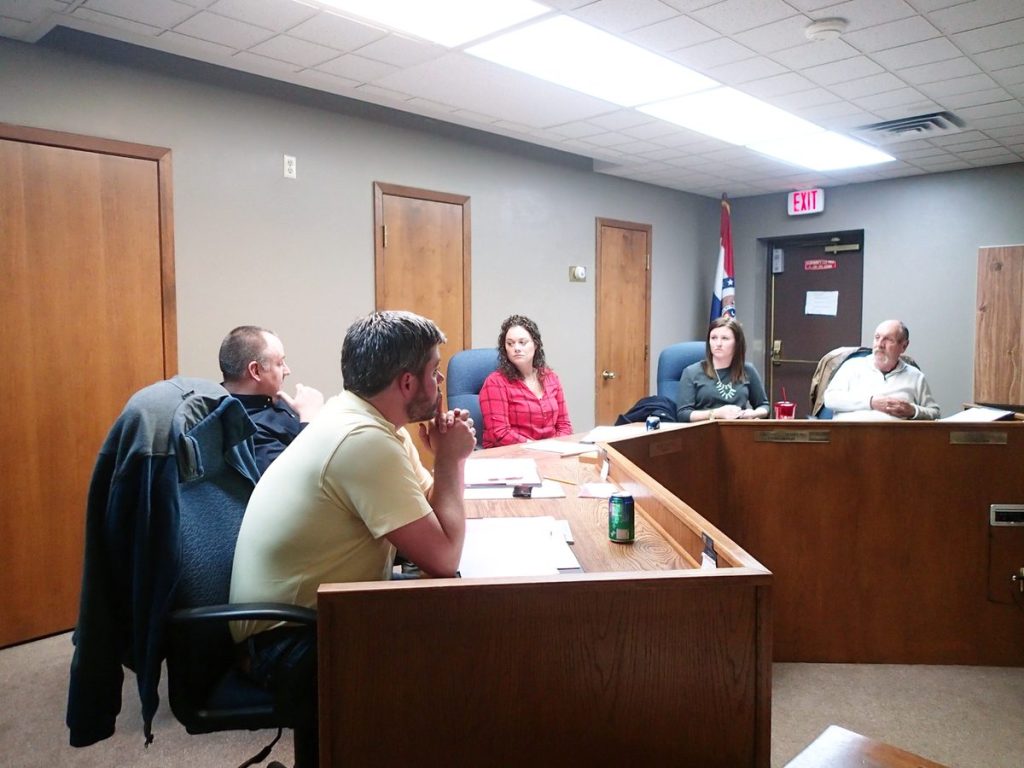
The Maryville City Council this week continued debate on a proposal to privatize operation of the municipal solid waste transfer station north of town. No decision was reached, and the council hopes to receive additional public input before revisiting the issue next month. Those wishing to weigh in on the issue can call City Hall or email individual council members by going to www.maryville.org and clicking the “Government” and “Mayor and Council” buttons. Pictured clockwise at dais are council members Tim Shipley (foreground), Jason McDowell, Renee Riedel, Rachael Martin, and Jerry Riggs.
Discussion continued this week among members of the Maryville City Council with regard to leasing the city’s fiscally troubled solid waste transfer station to a private vendor, but the governing board delayed a final decision pending further evaluation of two pending offers and additional public input.
The council did reach a consensus on a timeline for disposing of the issue, declaring it would further evaluate the two existing vendor offers on Jan. 11, before making a final decision on Jan. 25.
The station, established after Maryville’s landfill was closed in 2001 under orders from the Missouri Department of Natural Resources, is supposed to be self-supporting through the collection “tipping fees” paid by private haulers who deposit solid waste there for transport to approved dumps.
However, since Porter Trash Service opened its privately operated Highway 136 Transfer Station in late 2012, the city facility has operated at a yearly deficit of around $100,000.
City Manager Greg McDanel said during the council’s regular session Monday that the projected deficit for fiscal 2016 is $75,000, an amount that includes an annual $30,000 the city is required to pay Missouri DNR for environmental monitoring at the old landfill.
The DNR fee will remain in place as a municipal liability regardless of whether the city leases the transfer station or closes it altogether, meaning that leasing or shutting down the station would save taxpayers around $45,000.
On Sept. 2, City Hall issued a request-for-proposals that resulted in two offers from entities seeking to lease the transfer station and run it like a private business: one from the newly formed Maryville Trash Cooperative consisting of Klosek’s Trash Service, Mozingo Sanitation, and Gaskill & Son Trash Service, and one from American Recycling & Sanitation Inc. of Rock Port.
Maryville Trash Cooperative has offered to pay the city $100 a month in rent for the station in addition to providing free disposal of up to 360 tons a year of city-generated clean fill, street sweepings, and other refuse.
Proposed tipping fees charged to haulers and residents under the co-op would be $45 a ton, $12 for each load under 500 pounds, and $33 per ton for wood and brush. The Porter station a few miles east of Maryville charges $48 a ton.
American Recycling & Sanitation’s bid proposes $500 a month in rent or free dumping of up to 12.5 tons of municipally generated solid waste. In addition the city would receive $4 for each ton of waste deposited. Proposed tipping fees are $60 per ton, $18.75 for loads under 500 pounds, and $33 per ton for wood and brush.
When, and if, the council accepts one of the two proposals, the winning vendor would be offered a three-year contract to operate the transfer station, along with options for three consecutive one-year extensions.
After listening to summaries of the two offers, Mayor Renee Riedel asked if municipal staff could put together an estimate determining which bid would save the city the most money in terms of dumping street sweepings and other city waste.
McDanel and Public Works Director C.E. Goodall responded that such an estimate was possible but would be based on existing waste volume, which fluctuates from year to year. Goodall said the biggest waste year on record for the city was 2014, when it deposited 281 tons of material at the transfer station.
In addition to attempting to determine which offer comprises the best deal for the city, council members Jerry Riggs and Tim Shipley suggested giving Maryville citizens one more chance to weigh in on the long-debated issue.
“There are a lot of options here,” Riggs said. “This might be a good time to reach out to the people and say, ‘What do you think?’”
Riggs said he wasn’t calling for a special meeting or public forum on the issue, but merely a period during which citizens would be free to email or telephone council members and express an opinion.
For his part, Shipley floated the possibility of some type of forum, possibly a special local radio broadcast featuring city officials and hauler representatives, during which listeners could call in with questions or comments.
Leasing the transfer station to one of the two potential vendors appears to be the course favored by the council because it’s the option most apt to keep existing trash-hauling companies — mostly small, family-owned operations — in business.
Goodall touched on this issue by pointing out that the citizens he talked to don’t much care what the city does about the transfer station as long as residential garbage service remains unaffected.
“What people are saying is, ‘I don’t want to lose my hauler,’” Goodall said.
However, the city does have other options.
These include a proposal by Dennis Porter of Porter Trash, who has said that if the city closes its station altogether he will work with both City Hall and other haulers to keep tipping fees reasonable at his own transfer operation a few miles east of Maryville.
Earlier this year, Porter pledged to offer contracts freezing tipping fees at their current level through 2020. After that, he said, prices would likely increase about 3 percent due to anticipated higher costs for hauling compacted refuse to distant landfills.
Porter’s offer, however, was met with suspicion by competing haulers who believe he would eventually raise fees to unaffordable levels.
Also on the table is a proposal to municipalize trash collection using either city crews and equipment or a third-party vendor, a move that would almost certainly drive a number of local haulers out of business.
A third alternative entails passage of a “flow control” ordinance requiring all local haulers to use the city transfer station. McDanel has stated that such ordinances have proved problematic elsewhere and could lead to lawsuits against the city.
In other business this week, the council:
• Passed an ordinance that will increase sewer rates by 20 percent effective Jan. 1. City officials say the increase is needed to cover debt service on $13.7 million in voter-approved bonds used to build a new wastewater treatment plant.
City Finance Director Denise Town said declining water-sewer income, linked to closure of the Energizer battery plant and greater efficiency on the part of high-volume customers, means the increase is needed to maintain “rate covenant” requirements calling for revenues equaling 110 percent of the annual bond payment.
The rate hike means that a family whose current water bill totals $45 a month will pay about $50 after the first of the year.
• Passed an ordinance for sanitary sewer improvements to be made in conjunction with Northwest Missouri State University that would decrease sewage volume at the city’s Southwest Lift Station, which has a history of problems during times of peak rainfall.
The proposal calls for installation of a new gravity line that would carry sewage from the high-rise residence halls and other campus facilities to the city’s Northwest Lift Station.
Estimated cost of the project is $65,000.
Under a proposed agreement with the university, Northwest will cover labor and installation, while the city is to provide $14,470 in budgeted funds for materials.